
(NCERT : National Council of Educational Research and Training)
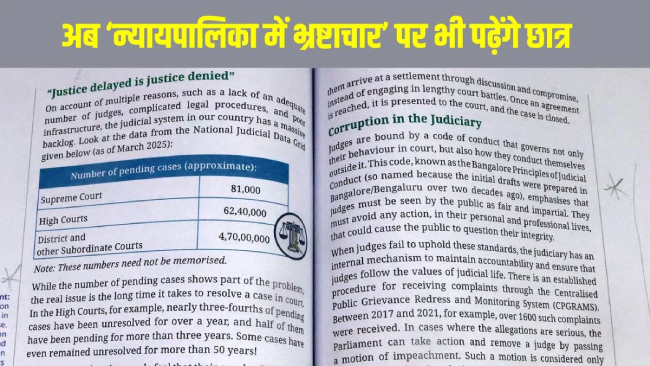
New Delhi – The new Social Science textbook for Class 8, released by the National Council of Educational Research and Training (NCERT) on Monday, includes a section on “corruption in the judiciary” as part of a chapter on “The role of the judiciary in our society”.
The chapter lists “corruption at various levels of the judiciary” and “massive backlog…on account of multiple reasons, such as a lack of an adequate number of judges, complicated legal procedures, and poor infrastructure” as among the “challenges” faced by the judicial system.
The chapter mentions the number of pending cases
- 81 thousand in the Supreme Court,
- 62 lakh 40 thousand in the High Courts, and
- 4 crore 70 lakh in District and Subordinate Courts
What new information has been included in the chapter ?
The section on “corruption in the judiciary”, in the new book, states that judges are bound by a code of conduct that governs not only their behaviour in court, but also how they conduct themselves outside it. It refers to the judiciary’s internal mechanism to maintain accountability, and an “established procedure for receiving complaints through the Centralised Public Grievance Redress and Monitoring System (CPGRAMS)”, adding that over 1,600 such complaints were received between 2017 and 2021.
“In cases where the allegations are serious, the Parliament can take action and remove a judge by passing a motion of impeachment. Such a motion is considered only after a proper inquiry, during which the judge is given a fair opportunity to present their side of the case,” it states.
“Nevertheless, people do experience corruption at various levels of the judiciary. For the poor and the disadvantaged, this can worsen the issue of access to justice. Hence, efforts are constantly being made at the State and Union levels to build faith and increase transparency in the judicial system, including through the use of technology, and to take swift and decisive action against instances of corruption wherever they may arise,” it states.
 A Jharkhand gram panchayat fines Rs 1 lakh and releases accused who sexually assaulted a 3-year-old
 One arrested in the Badrinath Dham theft case
 Separate plans for internet data and voice calls to become mandatory
 Bus conductor asks Karnataka minister to get off the bus for not paying exact change
 Muslim couple arrested for holding Hindu woman hostage and converting her at gunpoint
 Christian father of a Police Sub-Inspector who was converting Hindus arrested !