
Today marks the 647th birth anniversary of Sant Ravidas in Ludhiana (Punjab). On this occasion…
Special programme in the presence of Prime Minister Modi
At a time when Sanatan Dharma in North India was under severe threat due to Islamic invasions, several saints played a crucial role in strengthening devotion within society and safeguarding Dharma. Among these leading figures, Sant Ravidas occupies a prominent place. One of his compositions illustrates this spirit clearly:
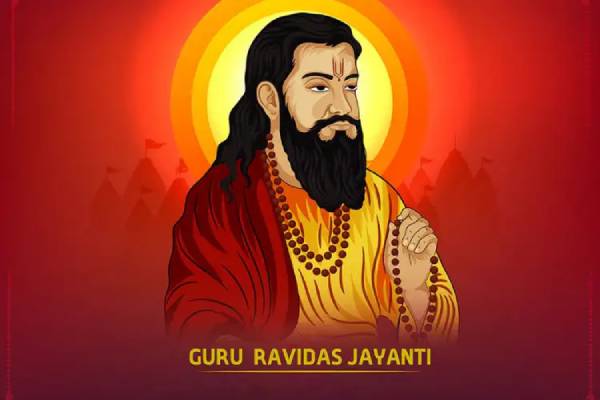
Look at one of their creations –
Ravidas soi sura bhala, jo lar dharam ke het.
Ang ang kati bhui gire, tau na chhade khet.
Dharam het sangram mein, jau kataaye kaate sees.
So jeevan safala bhaya, ‘Ravidas’ milahin Jagadees.
Meaning:
One who fights for Dharma and truth is the true warrior. Even if his body is cut into pieces and falls upon the ground, he does not abandon the battlefield. The life of one who sacrifices even his head for Dharma becomes meaningful, and he attains the Divine.
1. About Sant Ravidas
Sant Ravidas was born on Magha Purnima of Vikram Samvat 1433 (1377 CE) in Govardhanpur, a village near Varanasi, in a family belonging to the Chamar community. His greatness is impossible to describe in mere words. Numerous miraculous events are associated with his life, but beyond these, there are aspects of his work that leave one deeply awestruck when properly understood.
He composed hymns using the 34-letter structure of the Gurmukhi script. Several Rajput kings and queens were his disciples, and Sant Mirabai was also his disciple. Even rulers such as Sikandar Lodi and Babur bowed before him after witnessing his spiritual power. Sant Kabir described him by saying, “Among saints, Ravidas is a Sant-Rishi.” Both Hindus and Muslims revered him. Sant Kabir, Sant Ravidas, Sant Namdev, Sant Gorakhnath, and Guru Nanak were contemporaries and are known to have met one another. Naturally, the hymns of Sant Ravidas are included in the Guru Granth Sahib.
2. Sant Ravidas and his mastery of music
Sant Ravidas composed hundreds of bhajans. One distinctive feature of his compositions is his deep knowledge of music. He composed bhajans in accordance with sixteen different ragas and also classified them. At the beginning of his bhajans, one can often find a mention of the raga in which they are composed.
For example:
“Prabhuji tum chandan hum paani, tum moti hum dhaaga;
Prabhuji tum deepak hum baati, to jalai din raati.
Tohi mohi, mohi tohi antar kaisa,
Kanak katil jal tarang jaisa.”
Meaning:
There is no real difference between Bhagwan and me. The difference is only external, like that between gold and ornaments made from it, or between water and a wave.
Through such verses, one can gain an insight into his intense and exclusive devotion.
3. The teaching of Nirgun Bhakti
Sant Ravidas taught the path of Nirgun Bhakti to all. He explained:
“Satjug sat, Treta jagi, Duapar pooja-achaar;
Teenon jug teenon dide, Kali keval naam aadhaar.”
Meaning:
In Satyuga, truthfulness was paramount; in Tretayuga, yajnas were central; in Dwaparayuga, rituals and formal worship dominated. In Kaliyuga, however, only the Name of Bhagwan is the true support for humanity.
He emphasised that remembrance of Bhagwan’s Name is more important than rituals and pilgrimages. One of his teachings states that unnecessary worldly burdens should not be placed upon the bullock of the mind.
4. Sant Ravidas as a guide to spiritually rooted social order
|
Sant Ravidas undertook extensive journeys for public awakening, known as ‘Udaasis’. During these journeys, he travelled widely across India, including Ranipur, Malpi, Bhagalpur, Kalpi, Narayangarh, Nagpur, Gorakhpur, Bhopal, Hyderabad, Jhansi, Jodhpur, Bundi, Ajmer, Udaipur, Sindh, Kashmir, Kashipur, Gorakhpur, and the Himalayan regions. He also travelled to Arab countries and Afghanistan for the purpose of spiritual awakening.
One of his ‘shabdas’ (bhajans) begins with the lines:
“Begampura shehar ko nao,
Dukh andoh nahin tih thao.”
Meaning:
The city in which I live, called Begampura, is free from all sorrow and suffering, and there is no place for anxiety there.
In this bhajan, he presents a vision of an ideal society from a spiritual perspective, including principles such as freedom from oppressive taxation. Sant Ravidas attained Mahasamadhi at Varanasi on Ashadha of Vikram Samvat 1584 (1528 CE).
Remembering the extraordinary spiritual work of Sant Ravidas, this is a humble prayer at his feet that the importance of the Divine Name, as taught by him, may be firmly established in the hearts of all.
Shri Gurucharanarpanamastu
– (Dr) Durgesh Samant, MD (Medicine),Sanatan Ashram, Ramnathi, Goa (30 January 2026)
 We pay our obeisance a million times on the Birthday (as per Tithi) of
 Mumbai-based advocate Siddhavidya, who is trying to stop trafficking through surrogacy (artificial pregnancy) and animals, and animal killing
 Mandirs : The Building Blocks of the Rashtra
 Vataja Shula – Beneficial diet
 O’ Seekers ! Intensify your sadhana by recognising the ploy of powerful negative energies, which are active in spreading doubts through the medium of Shabdashakti !
 O’ Donors ! Offer wealth for the Dharma-related mission on Guru Purnima !