
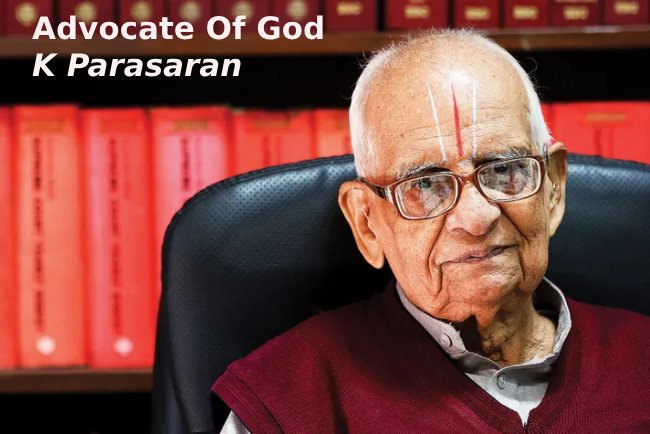

On 9th November 2019 the Supreme Court gave a historic verdict in the Ram Janmabhoomi case, fulfilling the hopes of countless Shriram devotees. The role of senior Adv. K Parasaran from Tamil Nadu (then aged 92) was extremely crucial. He represented ‘Ram Lalla Virajman’ with deep study and seriousness for over 40 years. He was known not only for his legal acumen but also for his knowledge of Hindu Scriptures and Puranas, earning him the title ‘Father of the Indian Bar Council’.
Two Court cases marked his legacy – the Ram Janmabhoomi case and the Sabarimala case, where he opposed the entry of women aged 10 to 50 into the Sabarimala Temple.
Editorial Perspective
|
1. Spiritual affection towards Deity Shriram
K Parasaran was born on 9th October 1927 in Srirangam, Tamil Nadu. His father, Keshava Iyengar was also a lawyer and a Vedic scholar. Since childhood, Parasaran had deep spiritual devotion to Deity Shriram and has been reciting the Ramayan daily since age 7. His devotion led him to argue the Ram Janmabhoomi-Babri Masjid case in the Supreme Court in 2019 at the age of 92.
2. Introduction to his Legal career
A renowned Hindu scholar and accomplished Government lawyer, he served as Tamil Nadu’s Advocate General in 1976 and as the Attorney General of India during the terms of Indira Gandhi and Rajiv Gandhi. Recognized for his service, he received the Padma Bhushan (2003) and Padma Vibhushan (2011) Award. In 2012, he was appointed to the Rajya Sabha by the President. After 2016, he rarely appeared in Court.
He was appointed to the ‘National Commission to review the working of the Constitution’ (NCRWC) by the Vajpayee Government and later chosen as the first trustee of the Shriram Janmabhoomi Teerth Kshetra Trust, established by Prime Minister Modi.
3. Determination, Perseverance, and Mastery on the case
His knowledge of the Ayodhya case was so thorough that he could recall key dates instantly. He had done extensive research and reading on Ayodhya, enough to author a book. Young lawyers assisting him were inspired by his determination, dedication, and study, even at the age of 92. He never gave up working on the case in 40 years. As a result, many members of the Supreme Court Bar Association regard him as their Guru.
4. Calm and composed Lawyer
During the case, Parasaran and his team received countless E-mails, WhatsApp messages, and suggestions. When colleagues expressed frustration, Parasaran calmly said, “People consider the Ayodhya case their own. Accept their suggestions positively”. This made his team realize the sincerity behind the messages.
During a critical moment, when Adv. Rajeev Dhavan (representing the Muslim side) tore a copy of the Shriram Mandir blueprint in Court, Parasaran remained composed and restrained.
5. Dedication to the case
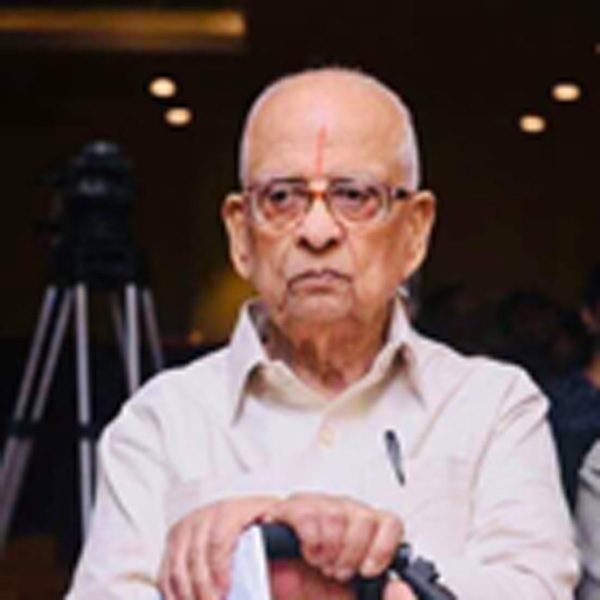
Before arguing the case, Parasaran studied it deeply. He worked daily from 10:30 a.m. till late at night. During the hearings, he felt Deity Shriram’s presence. On occasion, out of his deep devotion to Deity Shriram, he refused to sit or wear footwear and argued for over 4 hours daily for 5 consecutive days. When Dhavan suggested the daily hearings might be too strenuous for him, Parasaran responded, “It is my only wish to complete these arguments before I die”.
His colleague Sridhar Potaraju said, “His commitment in the 40-day Supreme Court hearing was like a great Sage performing a Yajna”. He constantly thought about legal strategies and plans of action. In the Sabarimala case too, he cited Scriptures while defending Deity Ayyappa’s traditions. In a lighter moment, he said, “In 1949, I married my first wife Saroja, but after enrolling as a lawyer, I married a second wife named Law”.
Divine experiences during the Ram Janmabhoomi hearing
During a hearing, the opposition asked, “Was there a maternity ward in King Dasharath’s palace ?” The judge asked Adv. K Parasaran to present evidence. Among the numerous case files, a horizontal file stood out among other files lying vertical. Adv. K Parasaran instructed his assistant to bring the horizontal file and miraculously opened the exact page containing the required answer.
(While narrating this, Adv. K Parasaran got emotional and said that such things can’t be described, only experienced. – Editor).
The next day, the Court delivered the verdict in favour of the Hindu side, declaring that Shriram Janmabhoomi indeed belongs to Deity Shriram
Some Noteworthy Arguments
(Ref.: SanatanPrabhat.org)
|
 Supreme Court refuses to interfere with Bombay High Court’s decision acquitting all the accused !
 Litigant throws documents before Supreme Court Bench !
 Grand mosque project near Ayodhya collapses due to lack of interest from Muslim community
 No one will be spared in the Shriram Temple theft case: Param Pujya Swami Govinddev Giri
 CCTV footage captures 70 incidents of donation theft at Shri Ram Temple !
 AI must be used in legal matters only under human supervision !