
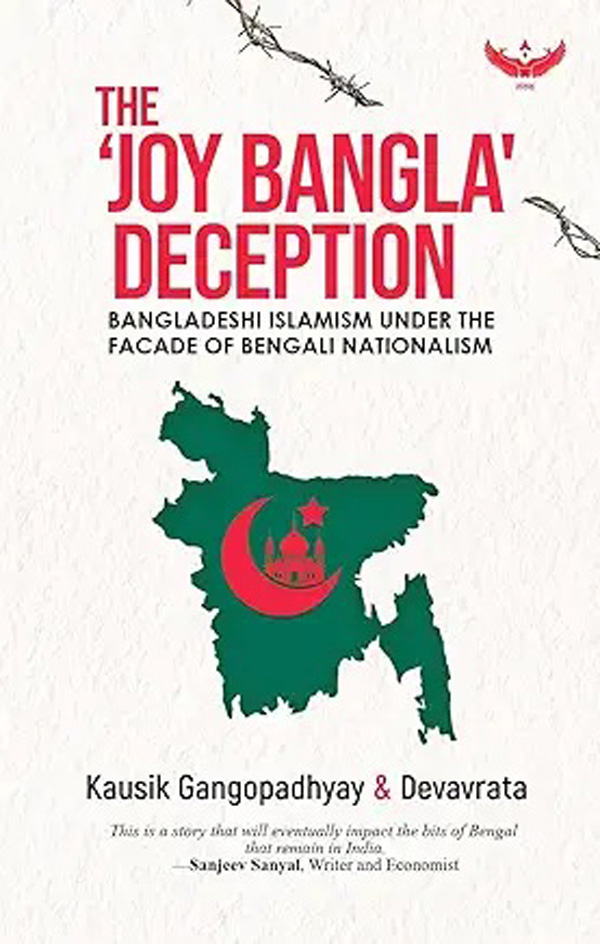
‘Joy Bangla’ is a self-pride slogan of people calling themselves Bengali by culture and language. However, this book by Dr Kausik Gangopadhyay and Devavrata shows that ‘Joy Bangla’ is a mask for a pure and simple Islamic imperialist design set to conquer Bangladesh completely and later include Assam, Tripura, and Bengal. Disturbing, shocking, and illuminating, this book explains the formation of Bangladesh and how it has become a textbook example of religious intolerance where the ‘other’ (mainly Hindus and Buddhists) have been driven out, killed, or subjugated to a position of insignificance.
The genocide of Hindus follows a similar pattern in Kashmir and Pakistan, and sadly, few know about the persecution of the Hindus in Bangladesh. The problem of Bangladesh is at many levels of the individual, society, and state. Future hostilities will undoubtedly persist, primarily affecting West Bengal. At the core of the issue is the intolerance of one religion, and the sooner the problem is addressed by intellectuals besotted with secularism, the better India will be in its ability to deal with such religion-inspired intolerance. Numbers ultimately determine democracy, and weaponized demography can severely impact Hindus’ future fortunes.
The Majoritarian Myth
Kausik Gangopadhyay is a professor of economics at IIM-Kozhikode. He is the author of an important book, The Majoritarian Myth. The present book is a strong validation of the thesis proposed in the first book where he argues that it is a myth that only the majority instigates and perpetuates intolerance in society. Thus, the common narrative of alleged intolerance against Muslims (or even Christians, as per popular reports) pins the blame on the majority, the Hindus. An analogy for such thinking is the tendency to automatically blame the driver of the larger vehicle in any accident, regardless of the actual circumstances and facts.
Gangopadhyay offers a research-based response to the ‘Linear Theory of Social Evolution’ (LTSE). Intolerance has nothing to do with dominant numbers in society, he points out. LTSE, a linear plan manufactured by the ‘liberal West’ for social evolution in a community, has two components :
1. The first component is a general linear plan that applies to all of humanity. Thus, all non-Christians or non-Muslims will become Christians or Muslims, respectively; only the proletariat will become rulers; only liberalism, with its troika principles of diversity, equity, and inclusivity, can give equality. This component makes a group consider one’s own culture, philosophy, ideology, or religion as the best.
2. ‘Otherisation’ of those not believing in the LTSE propositions with sometimes dire consequences. Thus, there will be eternal hell for non-Christians or non-Muslims; non-Communists will be labeled as ‘reactionaries’ fit for elimination; people will be canceled; freedom of speech will be denied to people who do not believe in liberalism; and so on.
It is the belief in LTSE, by even a minority, that sparks intolerance and violence in society. Crucially, there is no scope for evidence-based change in this plan. A majority without an LTSE belief does not show intolerance. Gangopadhyay then shows how political Christianity, political Islam, communism or Marxism, Nazism, racism, present-day cultural Marxism, and liberalism are the most ardent promoters of LTSE. Nazism was a peculiar mixture of socialism, nationalism, and racism. Despite all the atrocities committed by the regime, Hitler did not perceive himself as a leader of the entire world.
Importantly, the author points out that nationalism (as a middle ground between the extremes of anarchy and liberalism), Hinduism, and Hindutva do not have LTSEs embedded in them since they do not subscribe to frozen theories or ideologies, and they change with the times to accommodate diversity organically and without violence.
What could explain the absence of LTSE among the Hindu majority ? It may be important to understand SN Balagangadhara’s thesis that India has no religions. The phenomena we describe as Indic religions (Hinduism, Buddhism, Jainism, and Sikhism) are practices and beliefs of a different kind. The various sampradayas and paramparas where Gurus and lineages, rather than strict monopolist doctrines, are best-termed traditions, for want of a better word. Traditional cultures have a different configuration of dealing with the world, especially the ‘other.’
The Genocide of Hindus
In the preface of The ‘Joy Bangla’ Deception, Richard Benkin argues that the Holocaust against the Jewish people was also the result of inaction by ‘good people’ who chose to ignore the atrocities. A clear parallel exists in the Hindu hatred exhibited by the state, society, and individuals of Bangladesh. The reduction in the population of a particular group is one of the clearest indicators of societal intolerance against that group, as The Majoritarian Myth demonstrates. The reduction happens through killing, conversion, or migration. Kashmir and Bangladesh are stark examples of this phenomenon.
Hindus now make up about 7% of the Bangladesh population, down from a third in 1951. Thus, Hindus who were one in three at the time of independence from Britain are now one in fifteen.
On Direct Action Day (August 16, 1946), in Calcutta (now Kolkata), under the active participation of Chief Minister Suhrawardy, five thousand to ten thousand people, mostly Hindus, were killed. Incidentally, Suhrawardy is a hero in Bangladesh, and a park bearing his name stands in Dhaka, built on the remains of a destroyed Kali temple.
Between August 1949 and January 1950, massive anti-Hindu pogroms resulted in the deaths of thousands and caused two million Bengali Hindus to migrate to India as refugees.
The communal riots in East Pakistan, which later became Bangladesh in 1971 (1950, 1964, 1965, 1989, 1990, 1992, 2013, 2014), are a common occurrence where Hindus bear the brunt of the violence.
Similarly, the Enemy Property Act (later the Vested Property Act) was a ploy by the Government to capture the lands of Hindus forced to migrate to India.
Finally, in 1971, political problems, the details of which the authors explain in detail, led to the invasion by the West Pakistan Army into East Pakistan, or present-day Bangladesh. The Indian Army joined the Bangladeshi forces and defeated the Pakistani army. The latter had inflicted untold brutalities, and it was the Hindus who were most affected.
A plaque at Dhaka University lists 63 Hindus among the 66 people killed at the Jagannath Hall on 25 March 1971. Out of the three million victims of the Bangladesh genocide, it is estimated that about two and a half million were Hindus, despite constituting only 17% of the population at that time. This involved acts of killing, looting, and rape, as well as the destruction of temples.
Bengali-speaking Muslims (Razakars) collaborated with the Pakistan Army and caused more damage to the Hindus than the army itself. 4000 Indian army soldiers died in the operation to liberate Bangladesh. The Pakistan Army surrendered on December 16, 1971. However, on the part of Bangladesh, as time unfolded, there has neither been gratitude for India nor Hindus.
Hindus started losing land between 1972 and 1980 even as the cry of ‘Joy Bangla’ was peaking in intensity. Today, the persecution of Hindus has been normalized, where at election time they get special dispensation : 18,000 cases of rape alone were documented after the 2001 election. One scholar, Shariar Kabir, states that elections in Bangladesh are episodes of terror for religious minorities. It is not only the Hindu minorities but also the Buddhist Chakma tribes who are facing constant persecution and extinction. Nearly 20,000 Chakmas have lost their lives or have gone missing. About 100,000 of them have come to India as refugees.
This book demonstrates that secularism in an Islamic world is a near-impossible dream for people of other faiths bearing the brunt of the state, society, and individuals. The Majoritarian Myth explains the problem of intolerance in societies. At the root level, the solutions, always existing in Indian culture but waiting to be rediscovered, are in the Ghent School’s works, especially The Heathen in His Blindness.
Intellectuals from all sides need to work urgently to have a reboot of our understanding of the phenomena of traditions and religions. The current understanding threatens future generations, putting the beauty of Indian culture at risk. The threat of its disfigurement beyond recognition or repair is real.
(Courtesy : Excerpts from an Article by Dr Pingali Gopal posted on indiafacts.org.in; 23.5.2025)
(Dr Pingali Gopal is a Paediatric and Neonatal Surgeon practising in Warangal, Telangana. He has a keen interest in Indian culture and does his little bit to correct the many wrong narratives which hurt India at many levels. Opening his eyes rather late to the wonder called India, it is now a continuous journey for him)
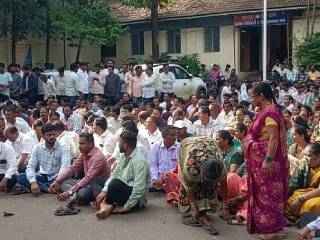 Villagers march to Kagal (Kolhapur district) Police Station in the ‘Love Jihad’ case and demand that the Hindu young woman be handed over to her parents !
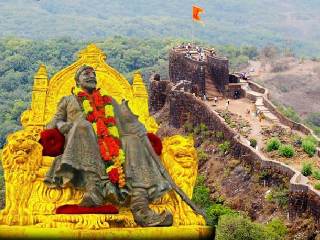 “Statues of Chhatrapati Shivaji Maharaj are being installed to target Muslims !” : France 24
 Actor Aamir Khan is the ‘brand ambassador’ of ‘Love Jihad’; Boycott his films ! : Minister Nitesh Rane
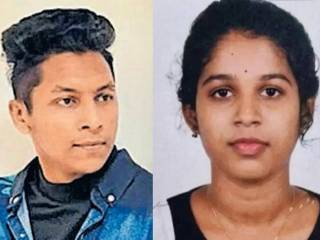 Keralite girl murdered by a fanatic Muslim man in Uzbekistan for refusing to convert to Islam
 Supreme Court refuses to interfere with Bombay High Court’s decision acquitting all the accused !
 School prayer circular upheld : High Court dismisses petition challenging recitation of Gayatri Mantra in schools !