
Canada admits after 41 years
329 passengers of Indian origin had died
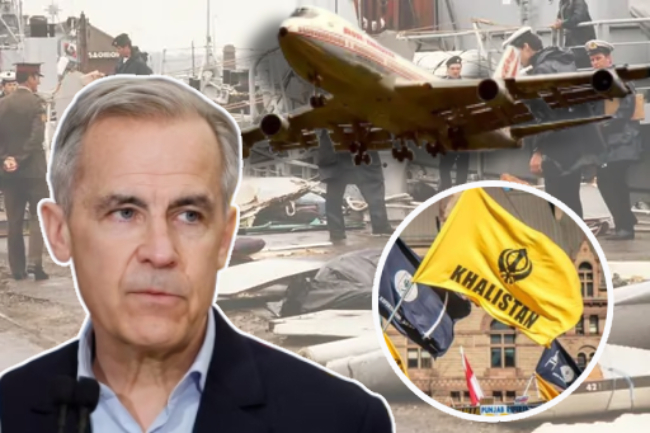
Ottawa (Canada) – The Canadian Government has now officially accepted that Khalistani terrorists were behind the bomb explosion that took place in Air India’s ‘Flight 182 Kanishka’ aircraft on 23rd June 1985. Canada admitted this 41 years after the incident. This aircraft was coming from Montreal in Canada to New Delhi via London. Forty-five minutes before reaching Heathrow Airport in London, there was a powerful explosion in the aircraft over the Atlantic Ocean near the coast of Ireland, and the aircraft crashed into the sea. All 329 passengers on board the aircraft died in this. Of these, 268 were Canadian citizens, the majority of whom were of Indian origin, 24 were Indian citizens, while the remaining were from other countries.
Canada finally admits that Khalistani terrorists bombed Air India's Kanishka flight in 1985, killing 329 people; 41 years later.
An admission alone is not enough. Canada must act against Khalistani extremists operating on its soil, arrest Gurpatwant Singh Pannun, and extradite… pic.twitter.com/bUjeJr86ac
— Sanatan Prabhat (@SanatanPrabhat) June 26, 2026
Canada’s intelligence agency ‘Canadian Security Intelligence Service’ has called this incident a ‘heinous terrorist act’. On the occasion of completion of 41 years of this incident on 23rd June, this agency posted on social media and said, “Today, we remember those 329 people on ‘Air India Flight 182’ who lost their lives in a heinous terrorist attack.”
Biggest terrorist attack in Canada’s history: PM Mark Carney
Canadian Prime Minister Mark Carney said, “This remains the biggest terrorist attack in Canada’s history. Canada stands against every form of violent terrorism.”
Aircraft targeted to avenge ‘Operation Blue Star’
Canadian investigation agencies had concluded that this attack was carried out in response to ‘Operation Blue Star’, which was conducted against Khalistani terrorists hiding in Amritsar in 1984. Khalistanis targeted the Air India aircraft to avenge this operation.
Canada shielded Khalistanis for 41 years
India had already said that the conspiracy behind this attack was hatched by Khalistani terrorists active in Canada; however, the Canadian Government was avoiding using the word ‘Khalistani’. In 2010, a public enquiry chaired by John Major, a retired judge of the Supreme Court of Canada, had said that several serious mistakes by Canada’s security agencies weakened the investigation in this case. The biggest mistake was that the CSIS kept surveillance on Talwinder Singh Parmar, the leader of the organisation ‘Babbar Khalsa’; however, later destroyed hundreds of hours of his telephone audio recordings. Due to this, important evidence was destroyed and the case became weak. There were differences between this agency and the Police department over the exchange of information.
This affected the investigation. Basically, this attack was not taken seriously enough as a matter of Canada’s national security. Also, key witnesses received threats, and some were even killed. Since the evidence was weak, in 2005, the court acquitted the main accused due to lack of sufficient evidence. In 2010, the then Prime Minister Stephen Harper apologised to the victims’ families and accepted that the government had failed in handling this case. Despite this, for many years, Canada’s government agencies did not refer ‘Khalistani terrorists’.
 Ukraine launches drone attacks on 20 Russian vessels !
 Christian stabs Indian-origin Muslim over his religion in the US
 Pakistani Army opens fire on protesters in Pakistan-occupied Kashmir: 12 killed, 38 injured
 US to impose 100% tariffs on five countries, including India, for purchasing Russian oil !
 Trump withdraws 20% levy on vessels passing through the Strait of Hormuz
 Porous Borders, Shadow Operatives: Unpacking the Geopolitical Rift in the US-India Intelligence Relations