
On ‘World Agnihotra Day’ – 12th March 2026
Due to material comforts in today’s fast-paced age, life has become busy and constantly on the move. The primary objective in this struggle is for happiness; however, what exactly is lasting happiness, and how is it to be attained ? Since people do not know the solution to this, all efforts appear to be failing. Accumulating more and more facilities and resources, and endlessly moving within the same cycle, is considered happiness and contentment. But is this all that human life is about ? The answer is clearly no.
If we look around, pollution has intensified at every level, from air and water to even human thoughts. As a result, the balance of Nature is deteriorating, climate patterns are changing rapidly, new diseases and epidemics are emerging, and unrest is increasing.
Everywhere, one finds aimlessness, lethargy, indifference, despair, and helplessness. Today’s conflicting sectarian practices, as well as advanced technology and science, do not offer any concrete solution to these problems. Therefore, philosophers and scientists are now strongly advocating the adoption of a lifestyle that is in harmony with Nature, as this is the need of the times.

1. About Agnihotra
Performing a Yajna for purification of the atmosphere is called Agnihotra. Yajna is a practice meant for daily observance. Various methods of Agnihotra have been described, classified as ‘Shrout’ and ‘Smart’, which in common language are understood as individual and collective (samashti) practices. In general, the daily offering of oblations to fire is its principal action.
This includes the daily Vaishvadev (One of the Panchamaha-Yajnas) ritual performed in every household, as well as the ancient Agnihotra spiritual practice re-established by Sadguru Gajanan Maharaj from Shivpuri, Akkalkot, Maharashtra for the welfare of the Universe. Since the Vedas place great emphasis on worship of Fire, performing Agnihotra in every household, as in ancient times, is the need of the hour as well as the message of this age. Through the Agnihotra ritual, energy cycles within Nature become activated. The Agnihotra ritual is simple to perform and requires very little expenditure.
According to Agnihotra, there are five main components :
1. Accurate observance of local sunrise and sunset timings
2. A pyramid-shaped Yajna vessel made of copper or clay, measuring ten finger-widths
3. Cow-dung cakes prepared from indigenous cow-dung
4. Ghee from an indigenous cow
5. Two spoonfuls of unbroken rice
This is all that is required for performing Agnihotra.
2. Method of performing Agnihotra
Agnihotra oblations may be made individually or collectively in a clean and Holy place. Ignite the fire in the Yajna vessel by applying a little ghee to the cow-dung cakes. At the precise time of sunrise or sunset, offer two oblations of ghee-coated rice into the fire.
At sunrise, chant :
• ॐ सूर्याय स्वाहा, सूर्याय इदं न मम् । (Om Suryaya Swaha, Suryaya Idam Na Mama.)
•‘ॐ प्रजापतये स्वाहा, प्रजापतये इदं न मम्। (Om Prajapataye Swaha, Prajapataye Idam Na Mama.)
At sunset, chant :
• ॐ अग्नये स्वाहा, अग्नये इदं न मम् । (Om Agnaye Swaha, Agnaye Idam Na Mama)
• ॐ प्रजापतये स्वाहा, प्रजापतये इदं न मम् ।(Om Prajapataye Swaha, Prajapataye Idam Na Mama)
Remain seated calmly, gazing at the flames until the oblations are completely burnt. Thereafter, apply the ash or vibhuti produced to the forehead.
3. How does Agnihotra produce its effects ?
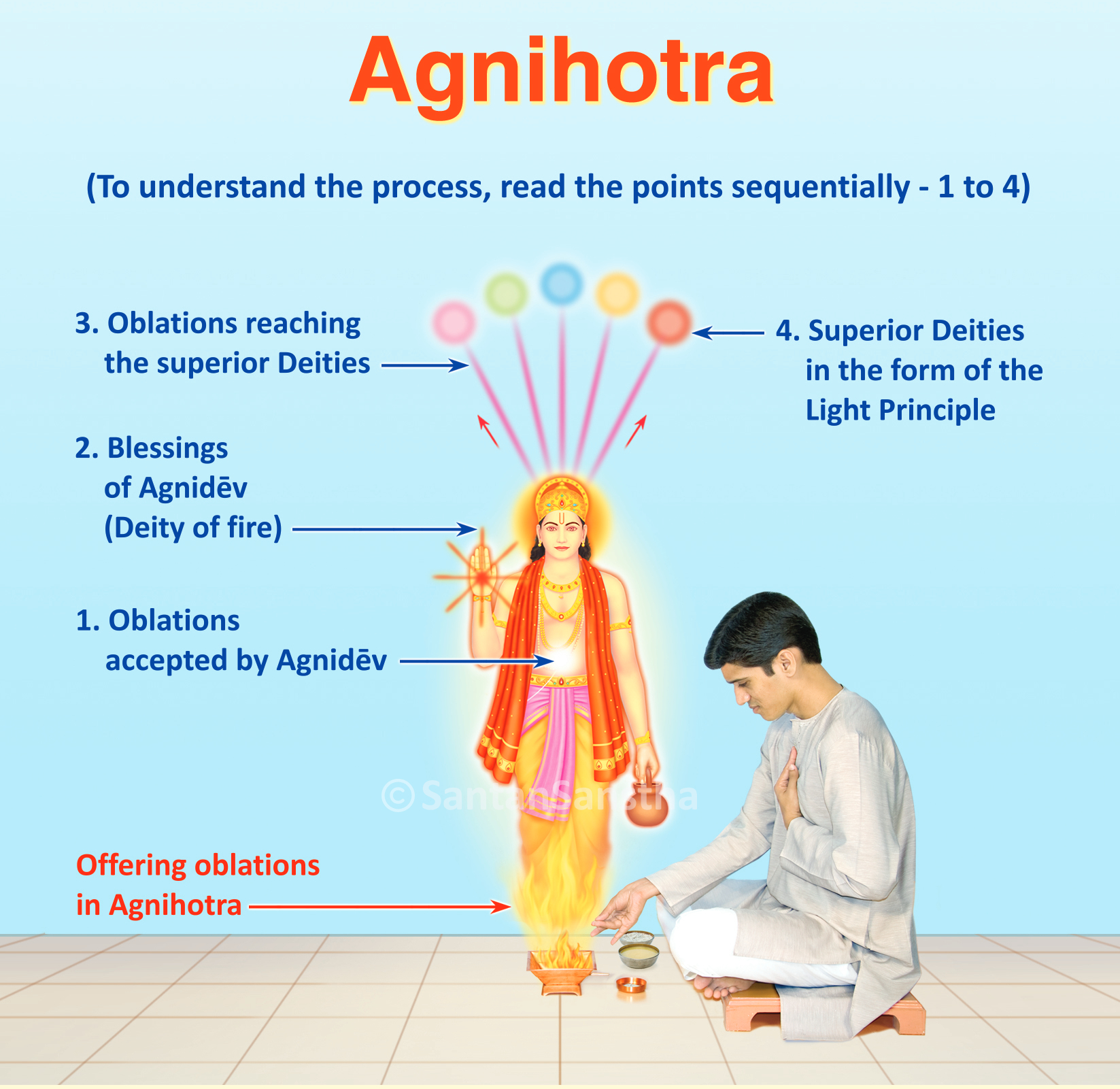
Today, Agnihotra therapy is gaining recognition worldwide. During Agnihotra performed according to ancient Vedic tradition, a large amount of energy accumulates around the copper vessel. At that time, a magnetic-field-like zone is created, which neutralises harmful energy and strengthens beneficial energy. As a result, a positive energy field gets formed around the individual who is performing Agnihotra.
When Agnihotra is performed, its smoke collects harmful radiation particles present in the environment and neutralises their radioactive effects at the subtle level. Nothing is destroyed; rather, only the structure is transformed. At the time of Agnihotra, it is not merely Agnihotra energy that is present; very subtle energy is generated from the fire and rapidly emitted into the atmosphere. Additionally, the medicinal properties of the substances used in Agnihotra ensure the full effect of this Chaitanya-imparting Hom (Fire-sacrifice performed to please the Deities).
Agnihotra has the capacity to neutralise harmful micro-organisms. When one sits before the Agnihotra fire and inhales the smoke produced by the burning oblation materials, it quickly spreads through the lungs and bloodstream. This has an excellent effect on blood circulation. Consuming Agnihotra ash has an even more beneficial effect.
Plants receive nourishment from the environment, thrive, and exhibit improved growth and development. The Sun brings and absorbs energy, thus automatically creating favourable conditions necessary for eliminating pollution.
4. Effect of Agnihotra environment in Agriculture
Due to excessive use of chemical fertilisers, pesticides, and herbicides in Agriculture today, soil nutrition is being depleted. As a result, diseases such as cancer and heart ailments are increasing. Reduced immunity is leading to mental and physical lethargy. Experiences show that Agnihotra is highly beneficial for increasing soil fertility and producing toxin-free food grains.
It has been observed that the Agnihotra environment is useful for controlling all types of pests and diseases in crops with short as well as long-term production cycles. Crops such as jowar, wheat, bajra, maize, onion, tomato, cabbage, cucumber, as well as fruits such as banana, mango, orange, and lemon, benefit through enhanced disease resistance and increased yield.
Agnihotra is also beneficial for improving the health of domesticated animals and increasing both the health and milk-producing capacity of dairy animals.
5. Agnihotra – the greatest support for Agriculture, soil and water
A. Earthworms generate manure in the soil, making it fertile. Spraying a mixture of 100 grams of Agnihotra bhasma (Sacred ash) and 100 grams of alum in 200 litres of water in the morning makes the soil loose and fertile.
B. In moist soil, performing this treatment once a month helps increase the earthworm growth.
C. Adding Agnihotra bhasma to Jeevamrut (A natural, fermented bio-fertiliser used in traditional and organic Indian farming) also produces immediate positive results.
D. Spraying crops with a solution of 5 grams of Agnihotra bhasma in 13 litres of water helps control pests.
E. Use of Agnihotra bhasma is beneficial for the growth of underground crops such as turmeric, ginger, onion and garlic.
F. It helps increase oxygen levels in the soil, thus nourishing it. If the salt content in well water or borewell water is high, Agnihotra bhasma can be used to reduce it.
G. On every Ekadashi, mixing 2 litres of indigenous cow’s milk with 5 litres of bio-chemical solution and 10 litres of water, and adding it to wells or borewells, helps convert saline water into potable water. This experiment should be continued uninterrupted for at least six months. To strengthen water sources, mixing 100 grams of Agnihotra bhasma and 10 litres of cow urine with 10 litres of water and adding it to wells or borewells on every Amavasya and Purnima, for a minimum of six months, is beneficial.
For disease-free and toxin-free Agriculture, Agnihotra is proving to be the greatest support. Its effectiveness needs to be scientifically examined, researched, and applied therapeutically. It is hoped that scientists and philosophers will come forward in this regard.
(Courtesy : Article written by Ravindra Digambar Deshmukh published in Quarterly ‘Pragyalok’, Jan.-Mar. 2024; Agnisom Seva Pratishthan)
For more information – SanatanPrabhat.org/english/128707.html
Read Sanatan’s Text On Agnihotra
When Agnihotra is performed, its smoke collects harmful radiation particles and neutralises their radioactive effects !
 Radiant Thoughts of Sachchidananda Parabrahman (Dr) Jayant Athavale
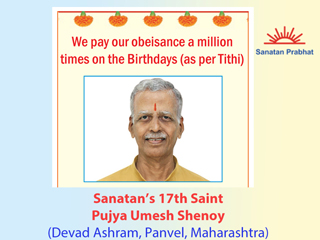 We pay our obeisance a million times on the Birthday (as per Tithi) of
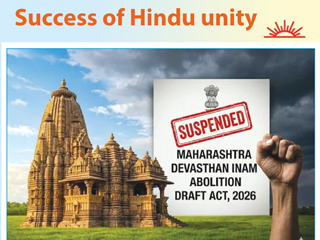 Major win for Hindu unity : Maharashtra Government suspends the controversial ‘Devasthan Inam Abolition Draft Act’
 Mumbai-based advocate Siddhavidya, who is trying to stop trafficking through surrogacy (artificial pregnancy) and animals, and animal killing
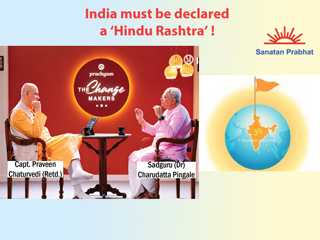 Secularism and the ‘Hindu Rashtra’
 Construction of Sanatan Dharma Complex halted due to threats in Bangladesh