
Courts and Police keep mum on forced conversions
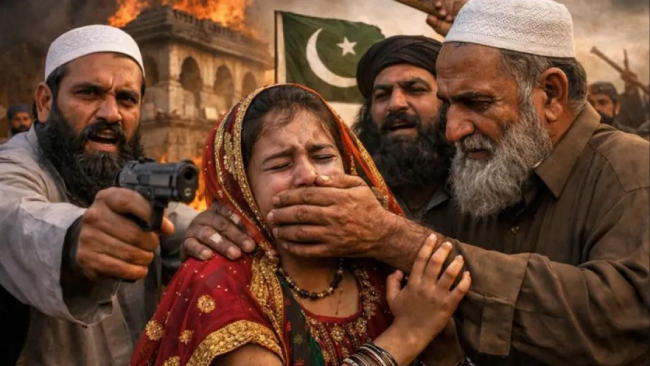
Karachi (Pakistan) – In Pakistan’s Sindh province, an organised and systematic campaign is being carried out against minority Hindus. Incidents such as the abduction of minor girls, their forced conversion, and subsequent pressure to marry occur repeatedly. Girls from extremely poor and socially marginalised Hindu communities—such as the Bhil, Meghwar, and Kolhi—are specifically targeted. The primary reason is that such families are unable to sustain long legal battles and have little access to the media or centres of power. Hindus are being targeted through networks associated with dargahs and madarasas. Individuals linked to the Pir Sarhindi dargah have claimed that around 1,000 Hindu girls have been converted there so far.
This entire process often begins with outright abduction or through fear and coercion. Minor girls are shown false dreams of marriage, employment, or financial security. Threats are frequently issued, and the girls are forced to leave their homes in helpless circumstances. Soon afterward, they are taken outside their districts. The purpose of this rapid relocation is to sever the girl’s contact with her family, prevent access to lawyers or social activists, and avoid drawing the attention of local media.
Conversions in mosques, dargahs, and madarasas
Conversions are primarily carried out at locations linked to specific mosques, dargahs, or madarasas. In this entire process, networks associated with extremist organisations play an active role, and everything is executed in a planned manner. Another grave aspect of this method is the manipulation of documents. Fake identity papers are prepared, in which the ages of minor girls are altered to show them as adults.
| Pakistan’s Stolen Daughters: The Hidden Horror of Forced Conversion | Statecraft | Episode 129
(Courtesy: India Today Global) |
Bypassing child marriage laws
These altered documents are used to bypass Sindh’s child marriage laws. Within just three to four days of conversion, the girl is married off. Often, the nikah is conducted with an older man or someone who is already married. In this way, an appearance of complete legality is created around the entire case.
Pakistan’s judiciary siding with the accused
Judicial procedures further aggravate the problem. In many cases, statements of the victim girls are recorded under pressure. Even so, the Police and courts accept claims of “voluntary conversion” without thorough investigation. Once a court recognises a conversion, overturning that decision becomes nearly impossible. As a result, legal avenues for the victim and her family are almost completely closed.
A system has emerged in Pakistan where legal loopholes exist, social vulnerability prevails, and the administration appears either indifferent or openly aligned with extremist accused. Consequently, minority girls get trapped in a cycle that is extremely difficult to escape. Challenging such cases legally is even more difficult. There are large numbers of documented cases of this nature in Pakistan.
After conversion, a minor Hindu girl married to a father of seven
In October 2025, a 15-year-old minor Hindu girl in Sindh province was married to a man who was the father of seven children. The girl was hearing-impaired and had been converted to Islam. Her father alleged that his hearing-impaired daughter could never have consented to marry a drug trafficker who already had seven children, and that force was used against her. Shiv Kachhi, who works for the rights of Hindus and minorities in Pakistan, stated that despite filing a complaint regarding the abduction, the Police took no action on it.
Threats of “Convert to Islam if you want to study”
The level of extremism in Pakistan is such that Hindu girls are being pressured in schools to accept Islam even to continue their education. In December 2025, such an incident came to light at a government higher secondary school in Mirpur Sakro in Sindh province. Parents of some Hindu students stated that the school principal told their daughters that they must accept Islam if they wished to continue their studies. Parents alleged that students were forced to recite the kalma (Islamic declarations praising Allah) and that Hinduism was mocked. When they refused, some students were sent home from school.
14,000 Hindu girls abducted and converted in 12 Years
The situation of Hindus in Sindh is so terrifying that many express a desire to leave Pakistan under any circumstances. There have also been cases of suicide among members of the Hindu community due to the inability to obtain Indian visas. In 2023, Manji Luhar, also known as Kaka, president of the Gadiya Luhar Assistance Committee in Sindh, stated that four Hindus known to him had committed suicide in the previous six months.
Social activist Roshan Bhil says that every Hindu family wants to forget its past, but that is not possible. Over the last 12 years in Pakistan, incidents involving the abduction, forced conversion, and gang rape of 14,000 Hindu girls have come to light.
Editorial PerspectiveProtection of Hindus in Pakistan has not occurred so far, and given the present situation, it is unlikely to happen in the future either. As a result, one day it may have to be said merely that “Hindus once lived in Pakistan.” |
 Pakistani Army opens fire on protesters in Pakistan-occupied Kashmir: 12 killed, 38 injured
 US to impose 100% tariffs on five countries, including India, for purchasing Russian oil !
 Shrikrushna was a Muslim who offered namaz five times a day: Maulana Jerjis Ansari
 If sexual intercourse is based on cheating or blackmail, it will be considered ‘rape’ ! : Madras High Court
 Boards stating ‘This fort belongs to Hindus; Muslims are not allowed entry here’ put up at Sinhagad Fort
 Touching a woman’s chest does not amount to an attempt to rape: High Court