
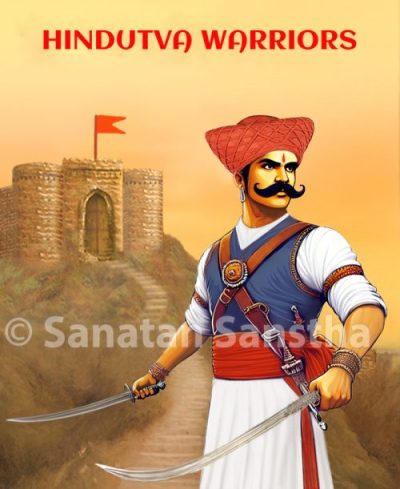
The sacrifice of the soldiers and generals for the Hindavi Swarajya as envisaged by Chhatrapati Shivaji Maharaj is supreme. Similarly, in the present times, many devout Hindus and patriotic citizens of this country have been striving to protect the Nation & Dharma.
The ‘Warriors of Hindutva’ is a series of articles that sheds light on their life and their struggle to protect Hindu Dharma. We hope that it serves as a catalyst for the mission of establishing the ‘Hindu Rashtra’ and inspires many others. – Editor

Ms Wirth has published over 100 articles in German and English in various magaz-ines and web-sites. Some of her articles have also been translated into Hindi, Marathi, Malayalam, Tamil, and French. She has spoken at numerous international conferences, including the World Hindu Congress in Bangkok in 2023.
1. Brief introduction to Ms Maria Wirth and her curiosity about God
Maria Wirth grew up in a Catholic family in southern Germany and attended a convent boarding school. From the age of 16, she began questioning the Christian conception of God. Dissatisfied with the answers provided by priests, she gradually distanced herself from Christianity. She stopped attending church services on Sundays – a practice considered sinful in Christianity – and by then had overcome her fear of the concept of ‘eternal hell’. This was during the 1960s, an era marked by an anti-Christian sentiment and the emerging hippie movement.
Despite this, her questions about God remained. She wanted to know definitively whether God truly existed but didn’t know how to seek the answer.
Once, during a physics class, she heard the idea that ‘all energy is one’, leading her to think, ‘If God exists, maybe that’s it’, though the thought seemed too abstract at the time.
After completing her schooling, Maria Wirth interned with Lufthansa Airlines, fulfilling her childhood dream of traveling extensively. At age 20, she completed a course on Transcendental Meditation and began meditating daily. However, when she later heard that such practices could drive a person insane, she stopped. Four years later, she left Lufthansa and enrolled at the University of Hamburg to study psychology.
2. Finding answers about God in India
Maria Wirth arrived in India in December 1979. She had low expectations of finding spiritual answers in India because she was taught that India was polytheistic. However, by Divine providence, she discovered the profound ancient wisdom of India, which astounded her and answered all her unanswered questions ! The knowledge shared by the ancient Sages resonated deeply within her, even though she lacked the words to express it initially.
The first book she read was Jnana Yoga by Swami Vivekananda. Later, she attended the Kumbha Mela in Haridwar and, under the presence of Devaraha Baba and Anandamayi Ma, gained true understanding of the Sages’ wisdom.
She realised – ‘The fundamental essence of everything in this universe – including our personality – is one, eternal, formless, and everlasting. All forms are like temporary waves on the ocean, clinging to their form out of fear of losing themselves, yet ultimately, all waves are the ocean itself. When the form disappears, nothing is truly lost. Similarly, we falsely see ourselves as separate from the universe and cling to our transient personalities, but our true identity is pure, blissful awareness, and even if the personality is lost, the true self remains’. This insight clarified her life’s true purpose : The search for ‘Who am I really ?’
3. Maria’s meetings with spiritual Gurus
During her first 20 years in India, Maria led a simple life, primarily staying in Ashrams and meeting various spiritual Gurus, including Osho, Sathya Sai Baba, Swami Chinmayananda, Haidakhan Babaji, and many lesser-known Saints. Later, she met Amma, Sri Sri Ravi Shankar, and Yoga Guru Swami Ramdev.
4. Motivation to study Indian history
After realising the existence of God and that He is the creator and all-pervasive, Maria experienced immense joy. Aware that the Western world had little to no knowledge of this wisdom, she began writing articles for German magazines. In 2002, Maria moved to Dehradun, where she encountered highly educated friends who surprisingly criticised Hinduism. This prompted her to delve into Indian history. She discovered that the British had educated Indians in a way that made them admire Britain and disdain their own heritage.
5. The ‘Deep State’ and forces trying to harm India
There are powerful forces – known as the ‘Deep State’ (A secret network of Government officials and private entities) – that possess limitless funds to create unrest. If the Indian Government withdraws special privileges given to minorities, such forces might exploit the situation to harm India. Muslims in particular must realise they are often used to create chaos. Disclosures about USAID funding highlighted the involvement of many Muslim organisations, a truly eye-opening revelation.
6. Hindus’ intellectual struggle and necessary efforts
Another important point is that some forces are deliberately trying to intellectually weaken people by addicting them to junk food, video games, pornography, and drugs. This is to sever their connection to their inner strength. Hinduism, on the other hand, provides clear guidance on how to connect with inner strength, which makes it a threat to these forces. A person connected to his inner power cannot be easily controlled.
The economic power of the opposition is almost limitless, making a direct financial battle difficult; however, Hindus have the truth on their side.
Despite the mainstream Western and even social media often maligning Hinduism, platforms like Prachyam and Curious Plus are creating excellent short videos presenting Hinduism positively. Articles, including Maria’s blog posts, are also clarifying Hinduism for many people. These resources need wider dissemination, even to schools if possible, though as of now there is little support for such efforts.
7. We are currently in a spiritual war
Maria believes we are currently fighting a spiritual war similar to the battles between the Deities and egoistic demons described in ancient Indian Scriptures. Today, the demonic tendencies are stronger in the Western world, where even Satan worship is granted religious status, while in India, Deities are still revered. Although some Indians are selfish, they are a minority. Very few would sell their conscience for power or wealth. Among Hindus, religious conduct and Dharma are still deeply rooted, and this is likely why Hinduism and Hindus face such fierce attacks. Dharma strengthens individuals internally, and once a person is strong within, he or she cannot be easily controlled.
(Ref.: SanatanPrabhat.org/english/)
| The greatness of Hinduism and the need for spiritual practice
Hindus must understand the fundamental principles discovered by their Sages and live according to them. Currently, especially among the younger generation, this is rarely seen. They are not even aware that Hindu traditions are superior to other superstition-based religious systems; because Hinduism is founded on the pursuit of knowledge, not on blind faith. It does not oppose science; rather, it inspires science. There is hope that the situation will improve with the inclusion of the ‘Indian Knowledge System’ in the new educational policy. However, for this to succeed, spiritual practice is essential. Teachers as well as students must engage in spiritual practice. If schools were to hold fifteen minutes of silent meditation daily, it would be highly beneficial. India is indeed a ‘Hindu Rashtra’ In my view, India is a ‘Hindu Rashtra’ because the majority of its population is Hindu. I have never understood why some Indians feel uneasy when India is called a ‘Hindu Rashtra’. These very same people have no objections when Germany is called a ‘Christian Nation’ or Pakistan an ‘Islamic Nation’. Today, even though only 49% of Germans are Christian, Germany is still recognised as a ‘Christian Nation’. No one objects to this. Officially, Germany is a ‘secular’ country like India. I do not know what legal advantages a country gains by having an official religious identity; however, in my opinion, the most important thing is that all religious communities be treated equally. This has not happened in India after Independence. Therefore, India is not truly a secular country. Secularism means that the state and the Union Governments must remain completely impartial toward the religion of their citizens. It is my wish that India treats everyone equally. – Maria Wirth |
| Maria discovered that the British had educated Indians in a way that made them admire Britain and disdain their own heritage ! |
 Porous Borders, Shadow Operatives: Unpacking the Geopolitical Rift in the US-India Intelligence Relations
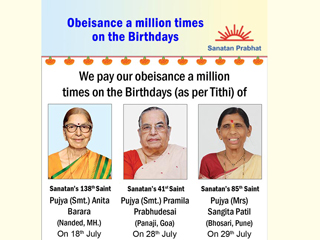 We pay our obeisance a million times on the Birthdays (as per Tithi) of
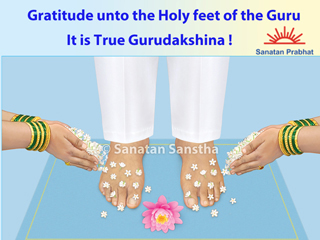 Offering gratitude unto the Holy feet of the Guru is true Gurudakshina !
 Messages of the Gurus on the occasion of Guru Purnima (29th July)
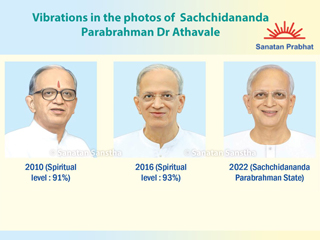 Sadguru (Dr) Mukul Gadgil’s analysis of the vibrations in the photos of Sachchidananda Parabrahman (Dr) Athavale, corresponding to His spiritual level at different times
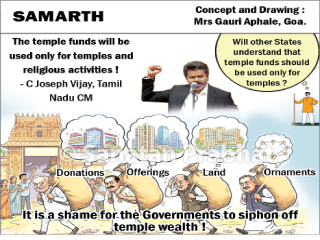 Projects of funding commercial complexes worth Rs 246 crore using temple funds cancelled by Tamil Nadu Government