
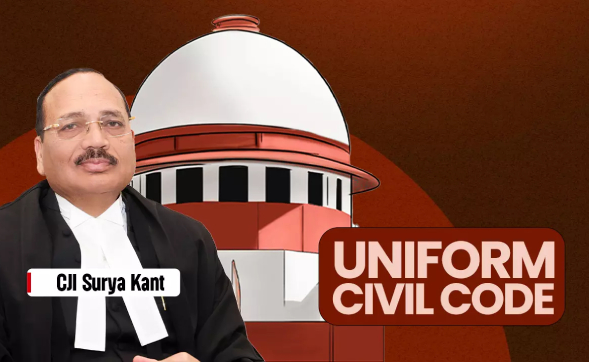
New Delhi – The Supreme Court of India observed that the Uniform Civil Code is a constitutional expectation and has no connection with religion.
The observation came during the hearing of a petition challenging the constitutional validity of certain provisions of the Muslim Personal Law (Shariat) Application Act, 1937, which were alleged to be discriminatory against women. The Court issued notice to the Union Ministry of Minority Affairs seeking its response.
The petition argues that the existing inheritance rules under Shariat show clear discrimination against women and should be struck down.
Senior advocate Prashant Bhushan, appearing for the petitioners, argued that if the Shariat provisions are struck down, the Indian Succession Act could apply. He submitted that personal law is not protected under Article 25 of the Constitution and can be invalidated if it violates constitutional principles. He further stated that Muslim inheritance law is not codified simply and is complex even for legal practitioners. He also remarked that he often tells his Muslim friends not to oppose the Uniform Civil Code.
The Court questioned whether the matter is fit for judicial intervention or should be left to the legislature. In response, Bhushan argued that courts can strike down discriminatory practices, stating that giving women half or lesser share compared to men is discriminatory. He also submitted that this is a civil matter and not an essential religious practice under Article 25. He added that under inheritance rules, a Muslim cannot bequeath more than one-third of his property through a will, limiting personal autonomy even over self-acquired property.
The Court noted that women facing discrimination under Shariat law should approach the judiciary for relief.
 Can English be considered an indigenous language of India ? Supreme Court
 Christian stabs Indian-origin Muslim over his religion in the US
 Theft during cash counting at Gujarat’s famous Ambaji Shakti Peeth Temple also came to light two months ago !
 Pakistani Army opens fire on protesters in Pakistan-occupied Kashmir: 12 killed, 38 injured
 If Prabhu Shriram married only once, the same can be expected of Rahim !
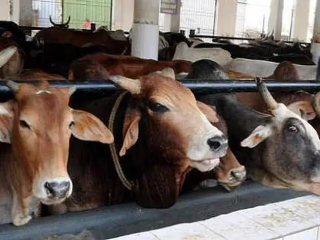 Rajasthan: 38 Goshalas siphon off crores in government grants by inflating cattle numbers