
Discrimination against Hindus exposed through employee handbook
(Hijab refers to a garment worn by Muslim women to cover the head and neck)

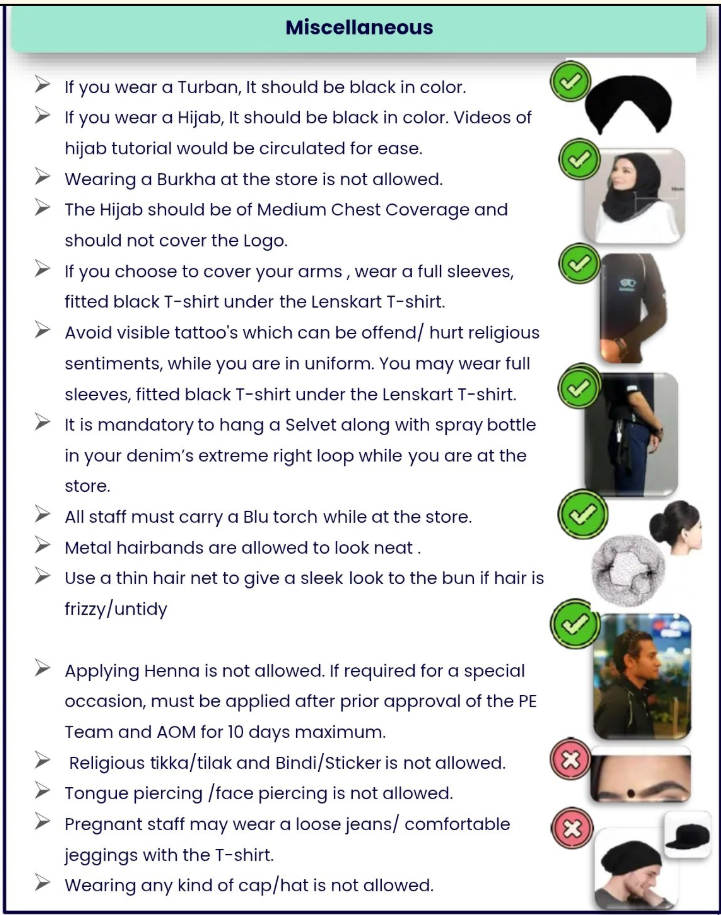
New Delhi – After reports of religious conversions of Hindu employees in Tata Consultancy Services, discussions have intensified about alleged anti-Hindu bias in the corporate world. In this context, eyewear company Lenskart has come under criticism. According to its employee handbook, dress code and uniform rules reportedly prohibit employees from wearing a “kalava” (sacred thread) or applying kumkum/bindi on the forehead while at work; employees may be sent home for doing so. In contrast, the same rules reportedly allow wearing a hijab. This has led to criticism of the company on social media.
Lenskart's employee handbook reveals employees are allowed to wear hijab, but bans kumkum/bindi.
Such discriminatory rules by an Indian company in a Hindu majority Nation is a disgrace.
Hindus should boycott such firms as these have only grown due to Hindus customers.
Because… pic.twitter.com/A1pYjWiWSZ
— Sanatan Prabhat (@SanatanPrabhat) April 16, 2026
1. The renowned devout-Hindu writer Shefali Vaidya criticised Lenskart, stating on X that it is condemnable for a company operating in a Hindu-majority country like India, with most employees and customers being Hindus, to adopt such a policy. She said she would never purchase from Lenskart.
Sorry, does NOT cut it. Who drafted this atrocious document? How did it even pass the first cut in the internal meeting? Who drafts your policy? What is the current policy document? Why are you not making it public? How about a simple, clean, clear apology saying that you are… https://t.co/3ssJ7sSCzf
— Shefali Vaidya. 🇮🇳 (@ShefVaidya) April 16, 2026
2. Many individuals have called for a boycott of Lenskart. One person questioned the company’s owner Peyush Bansal, asking how wearing a bindi, kalava, or kumkum disrupts a professional work environment or creates discrimination, and why such restrictions are being imposed.
3. Another person stated that they would never buy glasses from Lenskart again and sarcastically suggested that only women wearing hijab should now purchase from the company, also remarking that the company might as well teach employees how to offer prayers and observe fasting during Ramadan.
4. The media outlet OpIndia claimed that its representatives visited some Lenskart stores in Delhi, where employees, on condition of anonymity, said the rules discriminate against Hindu employees.
कलावा-बिंदी को ना, हिजाब को हाँ; Lenskart के हिंदू विरोधी नियमों का हुआ पर्दाफाश
कर्मचारियों का दावा; कलावा पहनने या तिलक लगाने पर लिया जाता है एक्शन; कमर्चारियों को स्टोर से भेजा जाता है वापस
पहले TCS में ग्रूमिंग गैंग और अब Lenskart के हिंदू विरोधी नियम
आखिर कॉर्पोरेट में चल… pic.twitter.com/figuCbpTvc
— ऑपइंडिया (@OpIndia_in) April 16, 2026
Owner’s ridiculous clarification
Peyush Bansal, owner of Lenskart, gave the following clarification
‘Hi, all. I’ve been seeing an inaccurate policy document going viral about Lenskart. I want to speak directly that this document does not reflect our present guidelines.
Hi, all. I’ve been seeing an inaccurate policy document going viral about Lenskart.
I want to speak directly that this document does not reflect our present guidelines.
Our policy has no restrictions on any form of religious expression, including bindi and tilak, and we…
— Peyush Bansal (@peyushbansal) April 15, 2026
Our policy has no restrictions on any form of religious expression, including bindi and tilak, and we continue to review our guidelines regularly. Our grooming policy has evolved over the years and outdated versions do not represent who we are today.’ (Even if this explanation is to be believed, it clearly shows that Lenskart used to discriminate against Hindu employees in the past. If a thief says, “I committed many thefts earlier, but now I am not a thief,” would the Police simply let him go ? Therefore, why should the Police not take action and arrest Peyush Bansal for promoting religious discrimination and violating Articles 14 to 16 of the Constitution of India ? – Editor)
Take following action against Lenskart in order to teach them a lesson1. Visit nearby Lenskart stores and register protest against religious discrimination in a lawful manner. 2. Pressure the company to withdraw such discriminatory rules. 3. Demand changes within 8 days. 4. Encourage Hindu employees to wear kumkum, bindi, or tilak at work for a month to assert their identity and warn of an economic boycott if demands are not met. |
 Can English be considered an indigenous language of India ? Supreme Court
 Theft during cash counting at Gujarat’s famous Ambaji Shakti Peeth Temple also came to light two months ago !
 Pakistani Army opens fire on protesters in Pakistan-occupied Kashmir: 12 killed, 38 injured
 If Prabhu Shriram married only once, the same can be expected of Rahim !
 Rajasthan: 38 Goshalas siphon off crores in government grants by inflating cattle numbers
 Shrikrushna was a Muslim who offered namaz five times a day: Maulana Jerjis Ansari