
Holy festivals, Religious festivals and Vowed religious observances are an inseparable aspect of Hindu Dharma. Today, festivals are often celebrated merely by wearing good clothes and eating good food; however, there are specific natural, social, historical, and spiritual reasons underlying celebration of Hindu festivals.
Each festival has a profound and subtle scriptural foundation, adherence to which bestows spiritual benefits. Hence, understanding the underlying scriptural basis is very important. Rangapanchami is the festival of colours, which is celebrated 5 days after Holika Dahan (Ritual bonfire performed on the night before Holi, symbolising the destruction of evil and the victory of devotion and righteousness). Here, let us look at information on the science underlying Rangapanchami, its benefits, and related aspects.
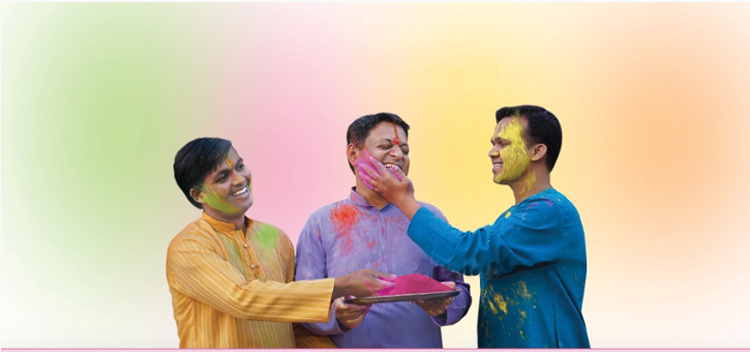
1. What is the purpose of celebrating Rangapanchami ?
Rangapanchami, celebrated on Phalgun (Lunar month) Krushna Panchami (Fifth day of the dark fortnight), symbolises victory. Due to the fire lit during Holi, negative energies in the atmosphere are destroyed. Ranga-panchami symbolises the culmination of activity that begins on the day of Holi. On the day of Holi, Bhagawan Vishnu first descended on the Earth, resulting in the destruction of negative energies. The next day, Dhulivandan is observed by applying the ash of Holi (a form of bhasma) to the body as an expression of gratitude, and on the fifth day, Rangapanchami is celebrated as the conclusion of this process.
Another purpose of Rangapanchami is to obtain the benefit of Deity Principles associated with colours after the destruction of negative energies. On Rangapanchami, dry colours are thrown on one another or coloured water is sprinkled. During the Maratha rule, it was customary to hold a grand court on this day, where sardars and jagirdars would throw gulal (A pink powder which attracts the Deity’s Principle, used in ritualistic worship) on one another.
2. Is there any connection between colour therapy, Deities, and human beings ? How does one obtain its benefit on Rangapanchami ?
The seven higher Deities in the Universe – Ganapati, Shriram, Hanuman, Shiva, Shri Durga, Dattatreya, and Bhagawan Shrikrushna are associated with the seven colours. Similarly, the seven chakras of Kundalini (Centres of dormant spiritual energy in the subtle body) in the human body are associated with the seven colours and the seven Deities. Celebrating Rangapanchami means awakening, attracting, and absorbing the Principle waves of the seven Deities through colours. In a way, we benefit from the Principles of the Deities associated with these colours. When the Principles of all Deities become complete within the human body, one’s sadhana becomes spiritually complete, and the individual remains immersed in Anand (Bliss). This clarifies that experiencing the touch of Deity Principles through colours is the sole objective of Rangapanchami. To fulfil this objective, colours are used in two ways – by throwing them into the air and by sprinkling them on one another using water.
3. Is there any science underlying the act of throwing colours into the air ?
A. Rangapanchami should be celebrated not by physically applying colour, but by joyfully throwing colours into the air. One should pray with bhav (Spiritual emotion) – Through colours, the Deities are being invited to function in the Universe, and a carpet of colour particles is being laid to welcome the Chaitanya (Divine consciousness) source of the descending Deities’.
This will help increase devotion unto the Deities in the individual throwing colours, and also facilitate the imbibing of Deity Principles. By surrendering unto the feet of the Deities in this manner, the purpose of celebrating Rangapanchami is fulfilled.
B. One must also understand the processes taking place in the environment on the day of Rangapanchami. On this day, particles of the Tejtattva (Absolute Fire Principle) based Shakti (Spiritual energy), Chaitanya, and Anand are attracted to the Earth. Along with this, the nirgun (Non-materialised) Principle from the Universe is also attracted to the Earth. A sheath of Chaitanya becomes active in the environment, creating a sheath of Anand. Through the colours thrown into the air, streams of Anand are emitted. Similarly, particles of Tejtattva-based Shakti destroy the negative energies active in the environment.
4. Which natural colours can be used?
A. Saffron made from Palas (Flame of the forest) flowers
B. Yellow made from turmeric powder
C. Green made from Henna powder
D. Purple made from beetroot
E. Bright yellow made from marigold flowers
5. Due to inappropriate behaviour on the days of Dhulivandan and Rangapanchami, some feel these festivals should not be celebrated. What should be the stand of Hindus ?
The festivals of Dhulivandan and Rangapanchami should be celebrated in accordance with scriptural guidelines, understanding their meaning and purpose, and with devotion unto the Deities. When celebrated thus, one obtains exceptional benefit from the prevalent Chaitanya. Unfortunately, this is not happening today; it leads to inappropriate practices such as molestation of women and forceful throwing of water balloons. Women often fear that balloons filled with coloured water may wet their clothes. In Mumbai, there have been several incidents in local trains where water balloons have caused serious injury to eyes and ears. Causing distress to others on festival days is sinful and invites Deities’ displeasure. Such wrongful acts by youth highlight the urgent need for education on Dharma.
– Mr Ramesh Shinde (National Spokesperson, Hindu Janajagruti Samiti)
 Committees to be constituted in Maharashtra to decide cases of passive euthanasia
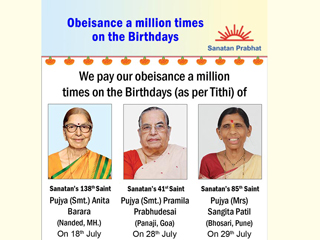 We pay our obeisance a million times on the Birthdays (as per Tithi) of
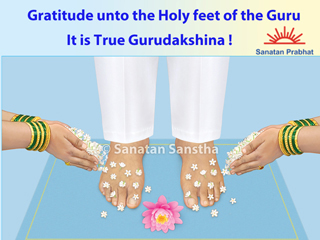 Offering gratitude unto the Holy feet of the Guru is true Gurudakshina !
 Messages of the Gurus on the occasion of Guru Purnima (29th July)
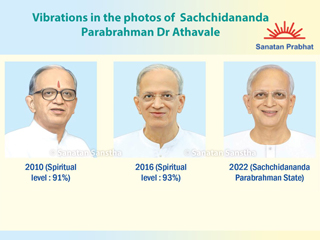 Sadguru (Dr) Mukul Gadgil’s analysis of the vibrations in the photos of Sachchidananda Parabrahman (Dr) Athavale, corresponding to His spiritual level at different times
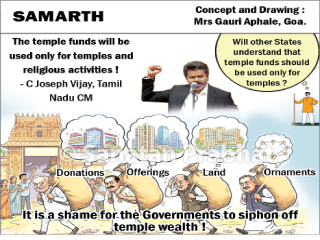 Projects of funding commercial complexes worth Rs 246 crore using temple funds cancelled by Tamil Nadu Government