
The friction tearing through our society today is not out of any circumstances, it was engineered. The fraying trust between men and women is breaking families, and children are growing up amid confusion and contradiction. At the root of this unrest lies the steady infusion of foreign ideologies; radical feminism, cultural self-hatred, civilizational guilt and perpetual victimhood, introduced to weaken social cohesion from within. The Hindu family structure now stands strained between conflicting narratives.
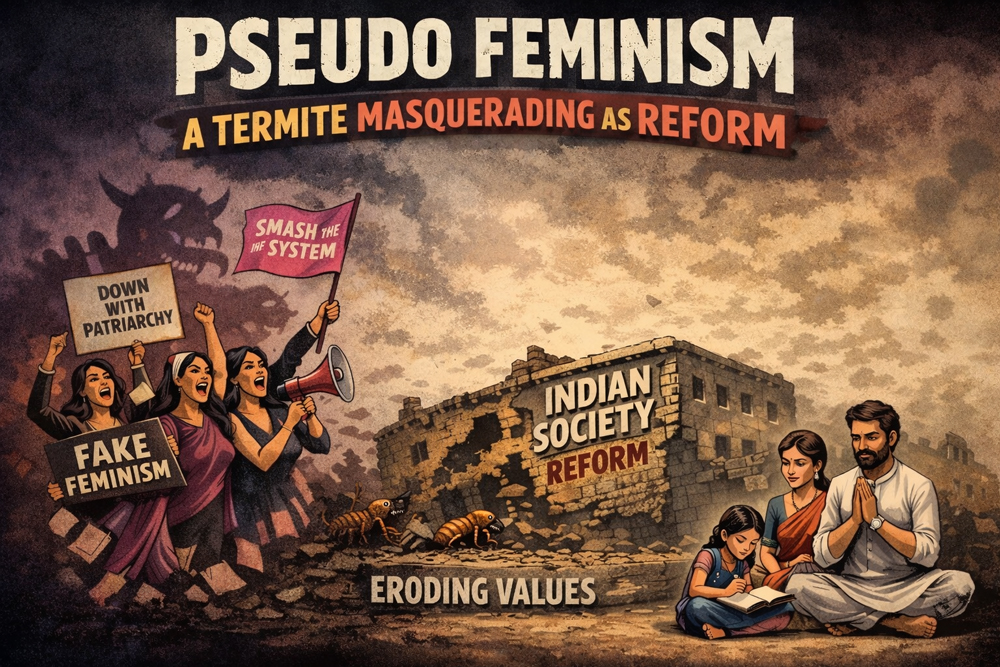
In our previous Issue, Part 1 of this Article, we read that the framework of feminism and women’s empowerment did not emerge from Hindu civilizational thought, it is a product of historical conditions elsewhere. Empowerment need not come at the cost of family, dignity, or harmony. Detached from Bharatiya context, ‘Pseudo-feminism’ has reshaped social narratives. Now, let us read the concluding Part. (Part 2)
Whereas thousands of miles east, in Bharat, the position of women has always been fundamentally rooted in respect, and spiritual authority rather than subordination. Hindu society never regarded woman as inferior; it worshipped her as Shakti, honoured her as mother, protector, teacher and the very soul of the household. From the Vedic period onward, women were active participants in intellectual, spiritual and social life. The Rishikas; Gargi, Ghosha, Lopamudra and Apala composed hymns, engaged in philosophical debates and were recognized as Brahmavadinis, standing on equal intellectual footing with men. Thirty such women are mentioned in the Rig Veda alone, a testament to their spiritual authority and unhindered access to sacred knowledge.
Women studied the Vedas, philosophy, music and statecraft alongside men in gurukuls, decisively challenging any Western notion that women were historically subordinated or denied learning.
Hindu society understood marital and familial relationships as partnerships, not hierarchies of domination. Men and women were seen as complementary halves, each essential for the well-being of the family and the proper functioning of society. The concept of Ardhanarishvara embodies this eternal unity, showing the equal importance of masculine and feminine principles. The wife is the Ardhangini, literally the ‘half-body’ of her husband, signifying mutual completeness. This cosmological vision shaped social life, women were revered not only as mothers, wives and daughters, but also as moral and spiritual guides, whose counsel and active participation were indispensable for living a Dharmic life.
Women in Hindu society were never confined to the home. Alongside their education and intellectual pursuits, they actively took part in religious rituals, managed economic and agricultural activities, engaged in trade and even shaped the affairs of the state.
Queens like Rani Durgavati and Rani Ahilyabai Holkar were far more than ceremonial figures, they ruled with wisdom, courage and exceptional administrative skill, earning admiration and respect from their people.
Law codes like the Dharma Shastras recognized their right to own property, inherit family wealth and give consent in marriage, acknowledging them as independent agents with real social and economic authority. In sharp contrast, European feudal systems bound women legally to fathers or husbands, denying them both public voice and personal autonomy.
Hindu scriptures further affirm this equality. Men and women have equal access to Dharmic knowledge, spiritual practices and the pursuit of Moksha. Goddesses are revered as embodiment of wisdom, prosperity and power. Rituals place women at the centre, highlighting their vital role in sustaining life, society and Dharma.
Marriage, in this worldview, is understood as a sacred partnership, where duty and responsibility complement one another rather than creating hierarchies. In the household and community alike, contribution of women; whether domestic, agricultural, or commercial, was valued and respected, never exploited for political gain or economic convenience. Unlike Western models, which often equate their labour outside the home with liberation.
Even in times of war or societal crisis, Hindu tradition never sidelined women. They were seen as equal partners in the resilience and defence of the land. History remembers women who led armies, guided communities and safeguarded social order during invasions, standing shoulder to shoulder with men in courage and duty.
In every sphere, spiritual, social, economic and political, Hindu women exercised authority and earned respect. Hindu civilizational ethos does not need slogans of ‘empowerment’; since dignity, responsibility and autonomy have been woven into the very fabric of life.
It is this inner cohesion of civilization that Chanakya cautioned must be protected. As he observed, ‘A state collapses from within before it is conquered from without… external enemies merely exploit internal rot.’ In Book IX, Chapter 3 of the Arthashastra, he identifies sedition, espionage, fifth-columnists and internal collaborators as the most dangerous instruments through which external enemies penetrate a Nation.
He asserts that foreign aggression succeeds by first corrupting loyalties, sowing dissent and hollowing out the defenses of a state from within.
In the same way, ideas imported from outside create an undercurrent that erodes the very foundations of society long before any overt attack. This is exactly how notions like ‘pseudo-feminism’ and similar ideologies have operated in Bharat; by fuelling movements and protests that disrupt social harmony, corrode trust between communities and genders, fracture families, and dismantle the value systems that have sustained Hindu civilization for millennia.
Hindu society was never built on hostility between men and women, at its core lay Dharma, balance and mutual respect. Imported feminism, divorced from civilizational grounding, teaches our daughters to view families as cages, our sons to see commitment as a liability and all members to approach each other with suspicion. Independence does not mean separation, equality does not mean conflict and empowerment is not alienation; true freedom is built on trust, responsibility and the harmony that binds families and communities together.
Today, that harmony is under threat from a new class of power brokers who control the narrative, portraying the Hindu family as oppressive and mocking virtues like duty and sacrifice. Political parties, NGOs and global institutions raise women related issues to gain influence, mobilize support, or silence dissent. Safety is invoked during elections, laws are passed but rarely enforced and outrage rises or falls with political convenience.
Corporate feminism reduces empowerment to a slogan for selling products and polishing images, measuring success in output rather than dignity or well-being. Pseudo-feminism is not about women, it is about control.
Why should we imitate the failed social experiments that have fractured the Western world ? If we wish to preserve our own civilizational continuity and harmony, such narratives must be rejected. The values of mutual respect and complementary equality that lay dormant over the last four to five decades must be consciously revived and re-instilled in our sons and daughters. Unless the values that once drew the world to Bharat for learning – science, art, moral guidance and trade, are passed on to the next generation, our civilizational strength cannot endure.
(Meenakshi Sharan is a hospitality entrepreneur, an avid history buff, an independent researcher known for debunking false narratives and a civilisational activist. She is a contributing writer at various print and online publications.)
| Hindu society was never built on hostility between men and women, at its core lay Dharma, balance and mutual respect ! |
| What is Pseudo-feminism ?
Pseudo-feminism, also known as fake feminism or feminism appropriation, refers to the act of co-opting feminist rhetoric and ideologies for purposes that contradict or undermine the goals of feminism. It involves using the language and imagery of feminism to promote ideologies, products, or actions that reinforce traditional gender roles, objectification, or oppression of women. Pseudo-feminism is often criticized as a form of pinkwashing, where corporations or organizations try to market themselves as supportive of women’s rights and feminist values while engaging in practices that harm or exclude women. It can also manifest as individuals or groups claiming to be feminists while promoting misogynistic, anti-feminist, or regressive views. (Courtesy : Wikipedia) |
 Radiant Thoughts of Sachchidananda Parabrahman (Dr) Jayant Athavale
 We pay our obeisance a million times on the Birthday (as per Tithi) of
 Major win for Hindu unity : Maharashtra Government suspends the controversial ‘Devasthan Inam Abolition Draft Act’
 Amazon Insults Aryabhata : Hindu Janajagruti Samiti serves legal notice
 Murtis of Hindu Deities found in the basement of Jama Masjid in Bharuch (Gujarat)
 Mumbai-based advocate Siddhavidya, who is trying to stop trafficking through surrogacy (artificial pregnancy) and animals, and animal killing