
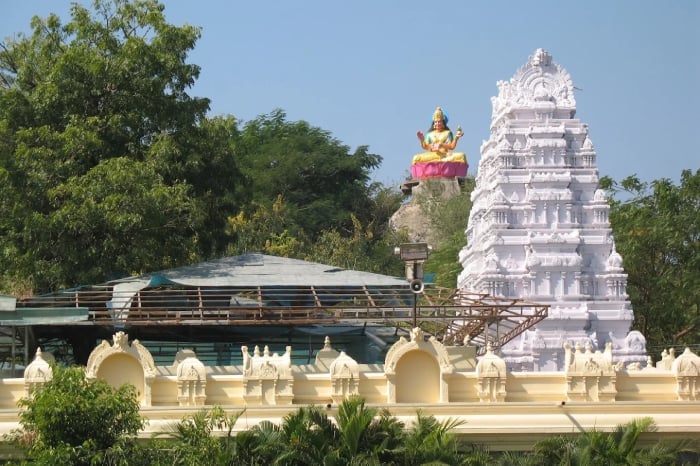
Background : In November 2025, a major controversy had emerged at the Sri Gnana Saraswathi Temple in Basar, Telangana, following the decision of the Government-controlled Temple administration to discontinue the free distribution of laddu Prasad during the Aksharabhyas ceremony and to increase the price of laddus. This decision had triggered widespread resentment among devotees and had once again highlighted the adverse impact of government control over Hindu temples.
The Temple administration had issued a notice stating that the free laddu Prasad could no longer be provided due to alleged financial losses. The price of the laddu, which had earlier been Rs 100, had been increased to Rs 150. Devotees were informed that objections could be submitted within fifteen days. However, the notice had been placed near the Executive Officer’s office, nearly 500 metres away from the main Temple, making it inaccessible to most devotees. This had led to accusations that the decision had been deliberately kept away from public scrutiny.
The Hindu Janajagruti Samiti (HJS) strongly opposed the move and rejected the claim of financial loss. HJS pointed out that the Temple collected Rs 1,000 for Aksharabhyas and earned additional income from kumkuma archana, Chandi hom, accommodation, shop rentals, and hundi donations. In this context, HJS stated that a temple earning crores of Rupees annually could not credibly claim financial loss.
HJS further stated that discontinuing free Prasad during Aksharabhyas had violated long-standing religious tradition. For generations, lakhs of families had initiated their children into learning at Basar, where free Prasad had always been part of the sacred ritual. Converting this spiritual practice into a commercial transaction was described as unrighteous and exploitative of devotion.
After the issue became public, HJS circulated awareness videos and appealed to devotees to lodge formal objections. The organisation demanded immediate withdrawal of the notice and restoration of free Prasad distribution, warning that large-scale protests would follow if corrective action was not taken.
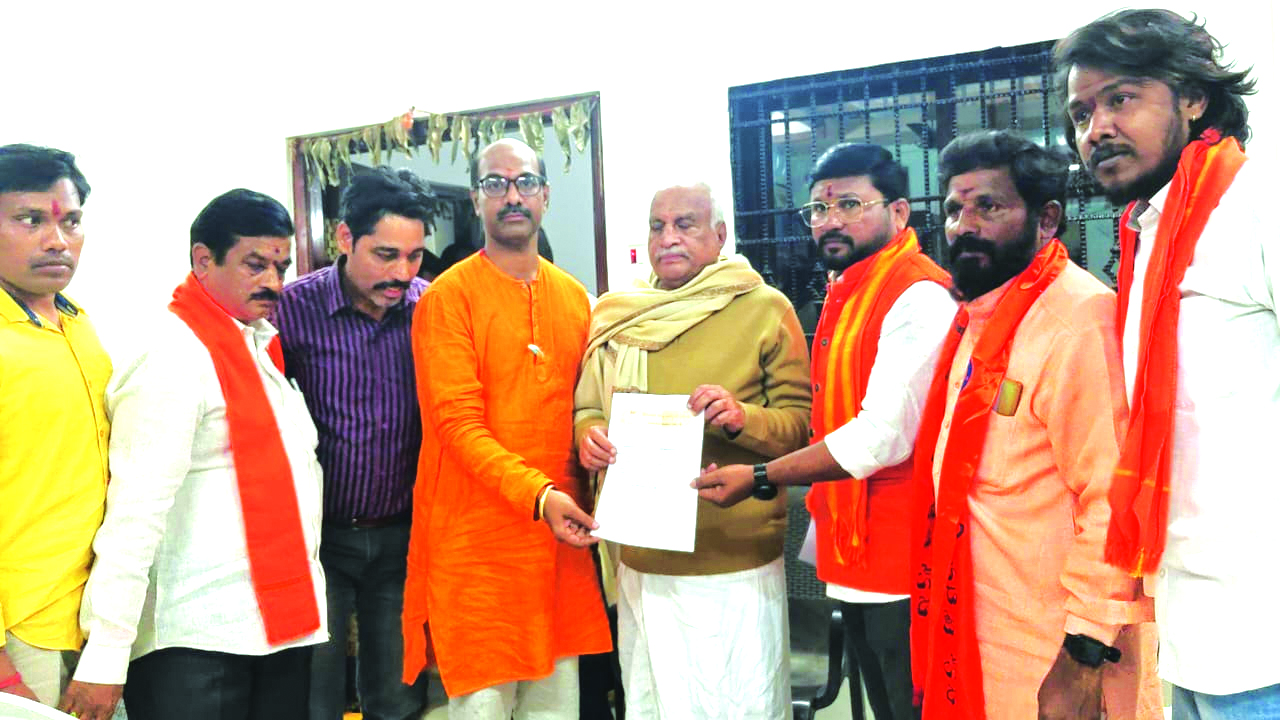
On November 27, 2025, representatives of HJS and other Hindu organisations submitted a detailed memorandum to the Executive Officer of Shri Gnana Saraswathi Devasthanam. The memorandum condemned the commercialisation of Prasadam and Temple services and stated that the decision had deeply hurt the religious sentiments of devotees.
The memorandum cited provisions of the Telangana Endowments Act, which required temple administration to prioritise devotee welfare rather than profit. It also questioned financial transparency, noting that audit reports and expenditure details were not being made publicly accessible despite statutory requirements.
Several administrative irregularities were highlighted, including corruption in Prasadam preparation, incidents of alcohol and meat consumption within temple premises, deteriorating accommodation facilities, and illegal encroachments on temple land.
Key demands placed before the administration
The memorandum had the following main demands :
• The Aksharabhyas service should be completely free of charge.
• The laddu Prasad included with the Aksharabhyas ticket must be provided free of cost.
• The laddu price earlier fixed at Rs 100 should be restored to Rs 25.
• Audit reports and development work details of the past ten years must be made public.
• The temple premises must be maintained in a strictly sattvik and disciplined manner.
• All illegal encroachments on temple land must be removed.
• Corruption in Prasadam preparation and distribution must be investigated.
• Devotee welfare must be prioritised over commercial considerations.
The representatives emphasised that a temple was not a commercial establishment but a sacred institution meant to preserve faith and spiritual dignity.
The memorandum was submitted under the banner of the Hindu Rashtra Samanvay Samiti, with participation from HJS, Hanuman Chalisa Group, Rashtriya Shivaji Sena, and Hindu Dharma Shiksha Sevak. The temple administration stated that it would review the matter.
Following this, sustained agitation was carried out by HJS and allied organisations. Delegations visited Basar, staged protests, met local MLAs, and submitted representations to senior officials of the Endowments Department in Bhagyanagar.
As a result of this consistent pressure, the Charitable Endowments Department finally withdrew the notice. The free laddu Prasad during Aksharabhyas was restored, and the laddu price hike was cancelled, with the price reverting to Rs 100 per half kilogram.
This development was widely regarded as a major success for Hindu unity and organised advocacy. Gratitude was expressed towards Sachchidananda Parabrahman (Dr) Athavale and Mata Gnana Saraswati Devi for the favourable outcome.
The Basar Saraswathi Temple episode demonstrated that Government-controlled Temple administration often led to commercialisation and insensitivity towards religious traditions. At the same time, it proved that disciplined and united Hindu resistance could compel authorities to reverse unjust decisions.
The restoration of free Prasad thus stood as a clear symbol of the power of collective Hindu effort in protecting the sanctity and dignity of Hindu temples.
 Illegal church in Solapur and misconduct by a municipal employee to be investigated
 Radiant Thoughts of Sachchidananda Parabrahman (Dr) Jayant Athavale
 We pay our obeisance a million times on the Birthday (as per Tithi) of
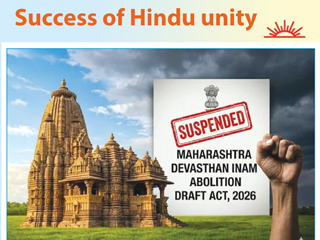 Major win for Hindu unity : Maharashtra Government suspends the controversial ‘Devasthan Inam Abolition Draft Act’
 Mumbai-based advocate Siddhavidya, who is trying to stop trafficking through surrogacy (artificial pregnancy) and animals, and animal killing
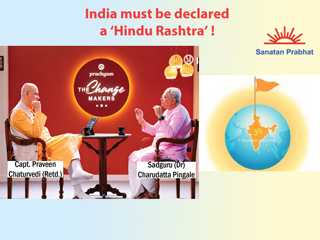 Secularism and the ‘Hindu Rashtra’