
Recently a 13-year-old girl, Ms Divya, from Nagpur, Maharashtra committed suicide by hanging herself. Reason – Her parents refused to give her a mobile.
A few months ago, in Sindhudurg District of Maharashtra, a student committed suicide because his mother did not buy him an expensive mobile. In reality, the child’s mother did not have enough money to buy an expensive mobile, as she barely managed to make a living through daily wage labour.
In another incident, a student struck his mother on the head with a cricket bat since she objected to his playing cricket. This assault resulted in her death. We have also read news reports of some minors committing atrocities on young girls close to them. News of students committing suicide because of failing in exams have now become routine. These are some extreme examples of impulsive behaviour.
In addition, excessive use of mobiles by children, watching inappropriate videos on mobiles, children insisting on trivial things at home and sulking, throwing tantrums, or banging their hands and feet if parents do not fulfil their demands – these problems are faced by almost all parents. On top of this, after reading reports of incidents of extreme steps taken by the children, it would not be surprising if fear arises in parents’ minds that if they do not fulfil their child’s demands, they may harm themselves.
Some parents are troubled by thoughts such as – Our child does not have good, reliable friends. Because of those friends, the child is developing bad habits. Even after explaining, the child does not listen. Hence, questions such as how to explain the difference between right and wrong to children today, how to inculcate good sanskars (Subtle impressions) in them, are surely troubling all parents.
This is an attempt to reduce the stress of parents to some extent, or rather to have a heart-to-heart conversation with them through this Article ! (Part One)
What exactly are Sanskars (Subconscious impressions) ?To remove inappropriate sanskars in children and to inculcate appropriate ones, we must first understand what a sanskar actually means. Inappropriate sanskars arise and function due to the predominance of Raja*-Tama** qualities, whereas appropriate sanskars arise and function under the influence of Sattva***-Raja qualities. Therefore, while inculcating sanskars in children, mental-level remedies as suggested by present-day intellectual social reformers are not useful. For this, the very root of sanskars has to be addressed, which is possible only by increasing the Sattva component. *** Sattva : One of the three basic components in the Universe, signified by purity & knowledge * Raja : One of the three basic components in the Universe, signified by activity & passion ** Tama : One of the three basic components in the Universe, signified by inertia & ignorance Otherwise, all parents already know what is good and what is bad, and they also tell their children so; yet, why do children still go astray ? Intellectuals cannot explain this. Hence, if proper and lasting sanskars are to be inculcated in children, it is essential to reduce Raja-Tama components in oneself and in children, and to increase the Sattva component. This is possible only through daily sadhana (Spiritual practice). For this, even before the birth of the child, parents should read, contemplate, and reflect upon Spiritual Texts. After the child is born, parents should sit beside the child and chant hymns and mantras. As the child grows, it should be told the life stories of National heroes who dedicated their lives to serving the Nation & Dharma, and be taught the noble principles of our exalted Dharma. Through this, not only will good sanskars be inculcated in children, but through the influence of Chaitanya (Divine consciousness) in Scriptures, hymns, and mantras, their inappropriate sanskars will also be erased. This will lead to the formation of a magnanimous, cultured, confident, patriotic and Dharma-abiding society. |

1. Every individual is governed by sanskars from past births embedded in the subconscious mind
All children are not alike. Some are sensible, some obstinate; some are calm, others hot-tempered. Every parent must first understand this principle. For example, if a newborn baby is not fed immediately, it cries incessantly; and even after being fed, it may continue sobbing for some time. Though it may appear that the baby cannot tolerate hunger, its behaviour is actually influenced by sanskars from past births embedded in its subconscious mind.
Some children are gentle, while others are stubborn. If things do not happen according to their wish, such children bang their hands and feet on the ground, raise their hands at elders, or throw objects at hand. In such situations, no one has taught the child to act this way; it is due to improper sanskars from past births that the child behaves so.
Therefore, instead of wondering why their child behaves in a particular manner, parents should think how to remove the improper sanskars, and inculcate good sanskars from the child’s early years itself.
2. Since inculcating good sanskars is possible at an early age, parents should put in more effort
As young children have had little interaction with the world, they have fewer improper sanskars compared with older children. Hence, removing these improper sanskars and inculcating good sanskars at a young age is relatively easier. Once children begin to grow older, their ego increases.
Due to the influence of the surrounding environment and friends, the improper sanskars in their minds become stronger, and some new improper sanskars are also formed. Therefore, it becomes difficult to remove these improper sanskars once children grow up.
Upon reaching adolescence, children often behave as if acting exactly against what their parents say is their birthright. In such situations, parents too are left wondering what to do, because scolding or spanking children at this age is not appropriate.
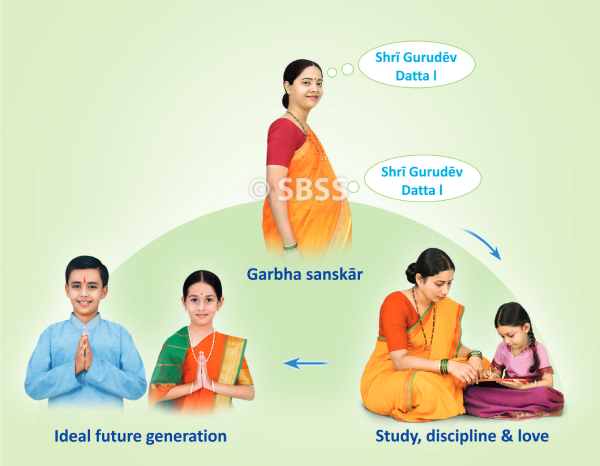
Hence, in truth, if good sanskars are to be inculcated in children, the process should begin the moment the child enters the mother’s womb, so that by the time the child is born, many good sanskars have already been formed, creating a favourable environment for further good sanskars in the future.
We have the excellent example of Abhimanyu in this regard. While Abhimanyu was in the womb of his mother Subhadra, Bhagawan Shrikrushna explained to Subhadra how the Chakravyuha (A military formation used to surround enemies) is formed, and Abhimanyu learnt this while still in the womb. This proves that sanskars can be inculcated in children right from the prenatal stage.
3. Stages of inculcating sanskars according to Dharma Shastras (Scriptures)
According to Hindu Scriptures, until a child turns five years old, parents should shower affection upon the child, encourage it to perform proper actions and lovingly make the child aware of its improper behaviour.
For the next ten years, parents are advised to be firm when necessary to inculcate proper sanskars. Unfortunately, in today’s times, parents are seen excessively pampering children during precisely this period, which later results in suffering for the parents themselves.
Scriptures further state that once the child enters the sixteenth year, parents should adopt a friendly mode of communication with the child. If parents study Scriptures and act accordingly, it will become easier to know how to behave with children at different ages.
(To be continued in our next Issue.)
– Mr Yogesh Jaltare (Group Editor, Sanatan Prabhat Media)
Children should be told the stories of National heroes who dedicated their lives to serving the Nation & Dharma !
 Radiant Thoughts of Sachchidananda Parabrahman (Dr) Jayant Athavale
 We pay our obeisance a million times on the Birthday (as per Tithi) of
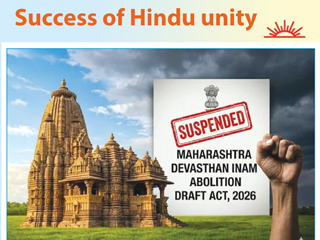 Major win for Hindu unity : Maharashtra Government suspends the controversial ‘Devasthan Inam Abolition Draft Act’
 Mumbai-based advocate Siddhavidya, who is trying to stop trafficking through surrogacy (artificial pregnancy) and animals, and animal killing
 Secularism and the ‘Hindu Rashtra’
 Construction of Sanatan Dharma Complex halted due to threats in Bangladesh