
26th January – Our Republic Day. A thought crossed my mind – to examine how the Constitution that governs the entire country is repeatedly endangered. Even a superficial observation reveals that those who cry hoarse about the Constitution being in danger, are the very ones who, since Independence, have been literally tearing it apart and murdering it every day. In fact, they are the real murderers of the Constitution. Let’s see how. (Part 1)
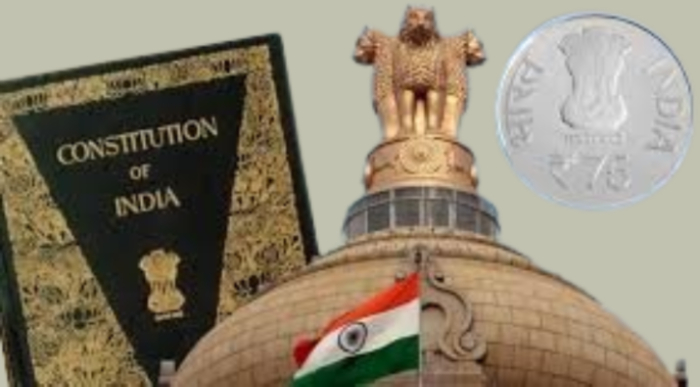
I remember a story I read in childhood … A crane tells the fish in a pond that a calamity is about to befall them. “The water in the pond is going to dry up. Therefore, instead of dying here, I will take you to another pond”, says the crane. The innocent fish are deceived, and every day some fish go with the crane to the other pond. It goes without saying that the crane devours those fish on the way. As a result, a day comes when there were no fish in that pond.
Something similar is noticed in our Democratic and Independent India. Every year, at certain intervals, someone from the Congress Party, or a Communist, or someone from the so-called peace-loving community, or someone who has been using the Constitution to their own advantage since Independence, raises the alarm, ‘The Constitution is in danger !’ In the last election, these people made such a fuss about it that the naive and innocent voters thought they had never encountered such a serious crisis. Therefore, they too fell prey to the deception of these human cranes. Anyway, that is not our topic of discussion today.

1. The Preamble of the Constitution
When you open the first page of the Constitution, you see the Preamble. From 1950, it is as follows. It is given here exactly as it is, including its grammar and structure.
“WE, THE PEOPLE OF INDIA, having solemnly resolved to constitute India into a SOVEREIGN SOCIALIST SECULAR DEMOCRATIC REPUBLIC and to secure to all its citizens : JUSTICE, social, economic and political; LIBERTY of thought, expression, belief, faith and worship; EQUALITY of status and of opportunity; and to promote among them all FRATERNITY assuring the dignity of the individual and the unity and integrity of the Nation; IN OUR CONSTITUENT ASSEMBLY this twenty-sixth day of November, 1949, do HEREBY ADOPT, ENACT AND GIVE TO OURSELVES THIS CONSTITUTION.”
2. The Preamble amended by the then Congress Prime Minister – Indira Gandhi
The original framers of the Constitution intended no future amendments to the original Preamble; however, Congress’ beloved Prime Minister, Indira Gandhi, felt that the country was in unprecedented danger due to internal unrest, and using the provisions of Article 352 of the Constitution, she recommended to the then President Fakhruddin Ali Ahmed to declare a state of Emergency. Experts say that in reality no such situation existed in India at that time; but during this period, Indira Gandhi introduced the 42nd Amendment, directly amending the Preamble of the Constitution and inserting three new words : Socialist, Secular, and Integrity.
The inclusion of these three words led to the following changes to the first and last sentences :
“We, the people of India, having solemnly resolved to constitute India into a ‘Sovereign Socialist Secular Democratic Republic and to secure to all its citizens …’ and to promote among them all Fraternity assuring the dignity of the individual and the unity and integrity of the Nation; …..”
In addition, other changes were also made to the Constitution at that time; but these three words plunged the future of Hindus into unprecedented darkness. Knowing very well that the Congress leaders will not accept that this was an attack on the original Constitution by the then Congress leaders, we will not comment on that on the occasion of Republic Day, but let us also examine if the Congress leaders, who are now shouting from the rooftops about the Constitution being in danger, were actually acting in accordance with the Preamble during their tenure.
3. Did Indians receive social, economic, and political justice during the Congress rule ?
The second important point in the Preamble is the assurance of social, economic, and political justice to the citizens. Articles 36 to 51 of the Constitution outline the guiding principles regarding this. Article 38 states – ‘The State shall strive to promote the welfare of the people by securing and protecting, as effectively as it may, a social order in which justice, social, economic and political, shall inform all the institutions of national life’.
The crucial question is – How many people developed inspiration during the Congress rule ? Article 39 states, ‘The citizens, men and women equally, have the right to an adequate means of livelihood; that the ownership and control of the material resources of the community are so distributed as best to subserve the common good; that there is equal pay for equal work for both men and women,’ etc. Did women receive equal pay as men during the Congress rule ? Did they get equal opportunities for livelihood ? Did the Congress leaders refrain from accumulating wealth ? How many industries did they distribute among their close associates ?
According to the NITI Aayog report, when the Congress rule at the Centre ended, India’s poverty index was 29.17%, which has now come down to 11.28%. Does this indicate that they provided economic justice to the citizens ? If the Congress answers all these questions, then the answer to the question, ‘Did Indian citizens receive social, economic, and political justice during the Congress rule ?’, will be found.
In this country, Court hearings are held from 2:30 a.m. till 4:50 a.m. to stay the execution of Yakub Memon, a terrorist convicted in the 1993 Mumbai serial bomb blasts; but the Malegaon bomb blast case remains pending before the Courts for years, leaving Hindu Nationalist suspects languishing in jail. They do not even get bail. Even in sensitive cases like the Nirbhaya rape case, hearings are held at 2:30 a.m. for the convicts before their execution, while Hindus who come to Court merely to make a legitimate demand for the preservation of their Deity’s Idol are told to go and ask the Deity itself. Sadhvi Pragya Singh, despite being sick, is brutally assaulted in Police custody solely based on suspicion, while the Luthra brothers, accused in a case where 25 people burned to death in a Goa nightclub, are provided with mattresses to sleep in Police custody. What kind of justice is this which is different for different citizens of India ? That’s the question I have. Should this be considered a failure of the Congress Party, or of the Indian Constitution that promises justice to all ?
4. Freedom of thought, expression, belief, faith, and worship

This is the third point in the Preamble. If we look at our history, we will understand how the Congress party completely disregarded people’s freedom of thought and expression during the Emergency. We will discuss this in detail later. As for the freedom of belief, faith, and worship, this freedom was certainly granted to followers of other religions, but not to Hindus. It was as if the Congress expected Hindus to consider only the Constitution as their Deity. Consequently, it took almost 7 decades after India’s Independence and became a Republic, for the construction of the Shriram Mandir to begin. If Hindus expressed themselves, it was considered hate speech; if others threatened to kill or ridiculed Hindu Deities, it was considered their freedom of expression.
Retired Justice Kolse-Patil, who enjoyed his position during the Congress rule, spent his life denigrating Hinduism and Brahmans. Today, misusing the freedom of expression granted by the Constitution, he says, “Those who came to power due to the Constitution are now trampling upon it”. What could be a greater irony than these people, who pretend to even breathe in accordance with the Constitution, criticizing others over the Constitution ? Have they ever followed even a single principle of the Constitution ? This is the tragedy. Hundreds of examples of such people could be given here, which would warrant a separate series of Articles.
5. Freedom of expression in the Constitution; but for whom ?
Article 19 of the Indian Constitution grants every citizen the freedom to express his thoughts; however, this freedom is not unlimited. According to Article 19(1), every Indian citizen has the right to express his thoughts, opinions, and beliefs orally, in writing, in print, or through any other medium.
This includes freedom of speech and writing, freedom of the press, peaceful demonstrations without violence, commercial advertising, the right to information, etc.
Article 19(2) of the Constitution also grants the Government the power to impose reasonable restrictions on this freedom. These restrictions include things you cannot say, write, or do, such as undermining India’s sovereignty and integrity, jeopardizing the security of the State, making declarations or writings that advocate the division of the country; revealing military secrets or making statements that would assist an enemy country, harming friendly relations with foreign countries, making inflammatory speeches against friendly countries that disrupt international relations, giving provocative speeches that incite riots or disturb peace, making objectionable and derogatory remarks about Court judgments or Judges, spreading false information about any person to defame them in society, disseminating obscene material, or engaging in conduct that endangers public morality.
Now, I shall give some examples of how these limitations have been violated in the name of freedom of expression.
A. In Delhi’s Jawaharlal Nehru University, ‘Bharat tere tukade honge’ (India, you will be cut into pieces) slogans were raised in support of the terrorist Mohammad Afzal.
B. The Raza Academy instigated a riot in Mumbai’s Azad Maidan under the guise of a protest.
C. Over its attack on the Gaza Strip, some prominent individuals in the country launched a movement against India’s friendly country Israel.
D. Former Maharashtra Chief Minister Prithviraj Chavan of the Congress party aided the enemy country by making a distorted statement regarding ‘Operation Sindoor’.
E. Naseeruddin Shah, Shah Rukh Khan, and Aamir Khan feel insecure in India, but at the same time, they feel compassion for Pakistan, and this fear or compassion is expressed from time to time in the name of freedom of expression.
F. Congress leader Mani Shankar Aiyar always supports Pakistan, while Navjot Singh Sidhu hugged Pakistan’s Army Chief Bajwa. Digvijay Singh demanded proof of the ‘surgical strike’ conducted by India against Pakistan. Southern actress Ramya praised Pakistan after visiting it. These do not fall within the limitations of Article 19(2) of the Constitution, yet they are considered to be their freedom of expression.
G. Today, many websites and OTT platforms spread obscenity in India. With a few exceptions, no concrete restrictions have been placed on them.
H. Akbaruddin Owaisi openly threatens Hindus in a public meeting, saying, “Remove the Police for 15 minutes… see what we 25% will do.” This is also considered his freedom of expression; however, …
H1. Pramod Muthalik’s (Founder President of Sri Rama Sene) entry in Goa was banned for many years because his speeches would endanger law and order.
H2. Several cases have been registered against T Raja Singh, a staunch Hindu MLA from Telangana, under the pretext of hate speech, and he is subjected to restrictions in various places.
H3. Cases have also been filed against Basanagouda Patil Yatnal of Karnataka for making inflammatory statements.
H4. The Police have tried to suppress many Hindus who protested against MF Husain (the painter of pervert paintings of Hindu Deities) by threatening them with legal action.
H5. The Supreme Court reprimanded Nupur Sharma for using strong words that allegedly offended the ‘peace-loving’ Muslim community.
H6. Despite writing with proper evidence, the former Editor of ‘Sanatan Prabhat’ had to endure unwarranted imprisonment.
There are many such examples. This inevitably raises the question – Who are the beneficiaries of the freedom of expression granted by the Constitution ?
6. Equality of Grade (Quality) and Opportunity
This is another point mentioned in the Preamble of the Constitution. Today, in the name of reservations, opportunities are denied to meritorious students, and they are being given to non-meritorious students. As a result, India’s talented generation is migrating abroad to prove its worth. Regarding equality of grade, no one has treated others with as much contempt as the Congress leaders. Senior leader Sitaram Kesri had once picked up the shoes of the young Rajiv Gandhi. At that time, the Congress members did not bother about the seniority of Mr Kesri. When Karnataka’s Congress Chief Minister Siddaramaiah slapped Dharwad’s Additional Superintendent of Police, Narayan V Barmani, he forgot that Barmani was an Indian Police Service (IPS) officer. Politicians often trample on the dignity of others. Many such incidents happen around us. Politicians look down upon IAS officers, and IAS officers look down upon their subordinates. The common man is not even considered worth paying attention to. Is this the equality of grade and opportunity granted by the Constitution ? Today, there is a Waqf Board for Muslims, and independent institutions run by the churches for Christians. Who is there for the Hindus ? The Government uses Hindu temples’ funds to offer subsidies to Muslims and Christians. Is this the equality of grade and opportunity that the Constitution envisions ?
7. A solemn resolve to promote fraternity assuring the unity and integrity of the Nation
This is the last sentence in the Preamble of the Constitution. Here, unity means different people living together in an organised manner, and integrity means having the feeling that all people are together despite the diversity in their religion, caste, language, and culture. This concept involves a feeling of affection and solidarity for the Nation and for one another. This feeling binds the Nation together and inspires development. This was true when our freedom fighters united under the mantra of ‘Vande Mataram’ and fought together for Independence; however, after Independence, the Congress Party, like the British, pursued the policy of ‘divide and rule,’ creating unprecedented divisions among Indian citizens. As a result, whatever unity and integrity that existed among Indians vanished completely. They created divisions among castes through caste-based reservations, created divisions between regions through language politics, and appeased minorities and suppressed Hindus. Therefore, the Congress Party itself undermined the resolve of the Constitution-makers to promote fraternity. They increased bitterness among Indians, which is the exact opposite of fraternity. As a result, let alone all Indians, even the majority Hindus in India have become so alienated from each other that they no longer understand the need to unite even for the safety of their own lives.
Congress alone cannot be blamed; the Constitution, in Article 51, has also laid down some duties for us (i.e., Indian citizens). Let’s examine some of these prominent duties.
8. Some fundamental duties of Indian citizens as mentioned in the Constitution
A. To abide by the Constitution and respect its ideals and institutions, the National Flag and the National Anthem
The above article may have partially clarified how the rulers, instead of abiding by the Constitution, have turned it into a toy to play with. We citizens are also not quite different from our rulers. We insult India’s National Flag, meaning, the Tricolour, every year to an extent that even enemy Nations do not. By engaging in various activities such as sticking plastic Tricolour flags to vehicles and then throwing them in the dustbin the next day, painting faces like the Tricolour, cutting cakes decorated like the Tricolour, and wearing clothes coloured like the Tricolour, we insult the National Flag in many ways. For several years, crimes related to hoisting the Tricolour halfway, not lowering it even after sunset, and burning the Tricolour during protests were recorded annually. Not singing the National Anthem, mocking it while it is being played, and moving hands and feet during the Anthem are also common occurrences in India. From this, we can ourselves consider how well we fulfil this duty. To ensure that the National Flag is respected and its honour is upheld, the Hindu Janajagruti Samiti had to launch a major campaign, make numerous visits to Government offices, and even seek redress in the Bombay High Court. Only after doing all this, some degree of awareness has been created regarding this matter.
B. To cherish and follow the noble ideals that inspired the national struggle for freedom
A prime example of this is the National song ‘Vande Mataram’, written by the revered Bankim Chandra Chattopadhyay. It was the Congress leaders themselves who belittled Vande Mataram. In 1923, at the Indian National Congress session in Kakinada, Andhra Pradesh, the then president, Maulana Muhammad Ali, opposed singing Vande Mataram. At that time, the staunch patriot and singer Pandit Digambar Paluskar defied Ali’s opposition and sang the complete Vande Mataram. Later, there was also opposition to singing Vande Mataram on All India Radio.
After India gained Independence in 1947, the Chairman of the Constituent Assembly, Dr Rajendra Prasad, officially declared on January 24, 1950, that “Jana Gana Mana will be the National Anthem of India… and since the song Vande Mataram played a historical role in the Indian freedom struggle, it will be given the same and equal respect as Jana Gana Mana”. Since then, Vande Mataram has been given the status of a National song; however, even before Independence, Muslims had a problem with Vande Mataram. This continued even after Independence. Consequently, the Congress itself omitted some important verses from Vande Mataram which allegedly offended Muslims. Even then, Muslims rarely sing Vande Mataram. This explains how much the Congress Party loves the Constitution and respects constitutional duties.
The contribution of Veer Savarkar to the Indian freedom struggle is undeniable. Instead of presenting his contribution to the citizens, Congress’s Mani Shankar Aiyar committed the sin of removing the plaque bearing the inspiring thoughts of Veer Savarkar from the ‘Freedom Flame Pillar’ at the Cellular Jail in Andaman. This means that far from upholding and emulating Veer Savarkar’s ideals, they were trying to erase those very ideals, and now they say that the Constitution is being murdered. Hindus are not even required to be told where they are falling short in this matter.
C. To uphold and protect the sovereignty, unity, and integrity of India
It must be clear from the above article that we are falling far short in fulfilling this duty as well.
D. To defend the country and render national service when called upon to do so
Indians are fundamentally not taught how to fulfil this duty. From their student days, Indian citizens remain trapped in the cycle of earning money, career, prestige, and academic achievements. They are not taught about rendering National service. A good example of this is that even when people were asked not to go out during the COVID-19 pandemic, they still did and had to be punished for doing so. The crowd of onlookers makes it difficult for the fire brigade to reach the location of fire. Ambulance carrying serious patients do not get clear path for passing through the crowded streets. In the event of a road accident, the victim is worried more about his belongings getting stolen rather than receiving first aid. When something is being given away for free, a huge crowd gathers. This is our tragedy. Where is the place for security of the Nation and serving the Nation ?
E. To protect and improve the natural environment including forests, lakes, rivers, and wildlife, and to have compassion for all living creatures
Far from fulfilling this duty, we see its blatant violation. Reports are frequently published about how all these natural resources have been damaged due to the dumping of empty liquor bottles, plastic waste, and non-biodegradable solid waste in forests, forts, rivers, lakes, and the sea. We Indians seem to have become indifferent to this. In the name of development, the rulers and the citizens have caused immense harm to the environment. We first encroached upon the forests, and now we complain when herds of elephants, leopards, and foxes enter human settlements. Except for a dog, we have no compassion for any other living creature, be it a cow or a human being. Under such circumstances, can we say that we are fulfilling this duty ?
F. To safeguard public property and to abjure (Avoid) violence
This is yet another National duty assigned to us by the Constitution. When peace-loving Muslim take out processions, there is no guarantee that public property will remain safe; however, neither the general public nor the Police and the Government have the power to stop them. Whenever anything even remotely anti-Muslim happens anywhere around the world, Indian Muslims protest about these happening here in India. Be it the protest organized by the Raza Academy in Mumbai’s Azad Maidan in 2012 in support of the Rohingya Muslims of Myanmar, or the protest in South Mumbai in 2020 after the controversy over the caricatures of Prophet Muhammad in France, or the demonstrations that followed the false alarm about the desecration of a mosque in Tripura, these protests inevitably turn violent. In fact, during the protest at Azad Maidan, Muslim protesters assaulted the Police. Lady Police officers were molested. A television channel’s OB van was set on fire. A Jihadi kicked the memorial of martyred soldiers. Despite these horrific consequences, only paper orders for compensation were issued; in reality, no compensation was paid. In this unruly crowd of Muslims, it is impossible for an ordinary citizen to protect the public property. Where even the Police get assaulted, what chance does an ordinary citizen have ? How can he fulfil this duty in such a situation ? Instead, why is there no provision in the Constitution to train these so-called peace-loving people ? Or, if they still don’t follow the rules, why aren’t Indian citizens trained to control them, or why aren’t these peace-loving Muslims sent to their beloved countries ?
G. To strive towards excellence in all spheres of individual and collective activity so that the nation constantly rises to higher levels of endeavour and achievement
This is also a duty that the Constitution has asked Indian citizens to perform; however, today, education is pursued and businesses are conducted solely with personal gain in mind. Who will think about the country then ? Everyone undertakes initiatives for themselves, reaches higher levels in them, and strives to achieve the highest level of success in their field by hook or by crook, regardless of what happens to the country. Paying huge donations to get children admitted to prestigious schools, giving and accepting bribes to get one’s work done, exploiting others to fulfil one’s own interests… all such practices stem from this. Thus, this duty is being fulfilled, but in self-interest, not for the Nation !
This is indeed like the tip of the iceberg a superficial overview of the Preamble and some duties mentioned in the Constitution.
9. To save the country, establishing a ‘Hindu Rashtra’ based on Dharma is inevitable
Now, those who say that the ‘Constitution is in danger’ should consider whether they have misused the Constitution, or whether the Constitution itself was written for misuse. Since this is a matter of personal reflection, I leave it to the readers. Lastly, I feel that just as a monkey given a burning torch will set everything on fire, the Congress Party with the current Constitution will set the entire country on fire. To save the country from this fire, there is no other option but to strive for establishing a ‘Hindu Rashtra’ that is based on Dharma.
– Mr Yogesh Jaltare (Group Editor, Sanatan Prabhat Media, 25.12.2025)
(Read complete Article on https://bit.ly/4srag60)
| Indira Gandhi introduced the 42nd Amendment, directly inserting three new words : Socialist, Secular, and Integrity ! |
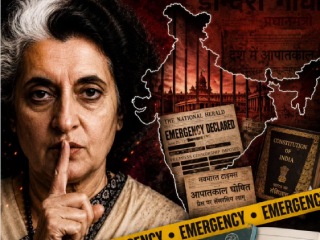 Information on the 1975–77 Emergency included in NCERT’s Class 9 textbook
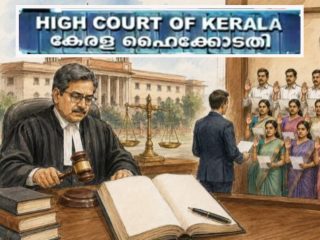 Oath cannot be taken in the name of Deities, Mother India and political martyrs: Kerala High Court
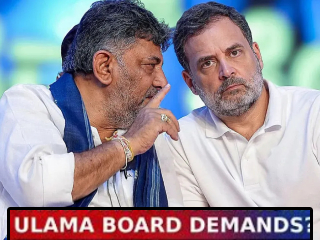 Karnataka: Ulema demand three ministerial berths for Muslims from Congress
 Priyank Kharge’s conspiracy to divide Hindu society ! : Kota Srinivas Poojary, BJP MP
 Woman dies while attempting to remove branches hanging over her house after the municipality failed to act despite repeated complaints
 Non-bailable arrest warrant issued against progressive actor Prakash Raj