
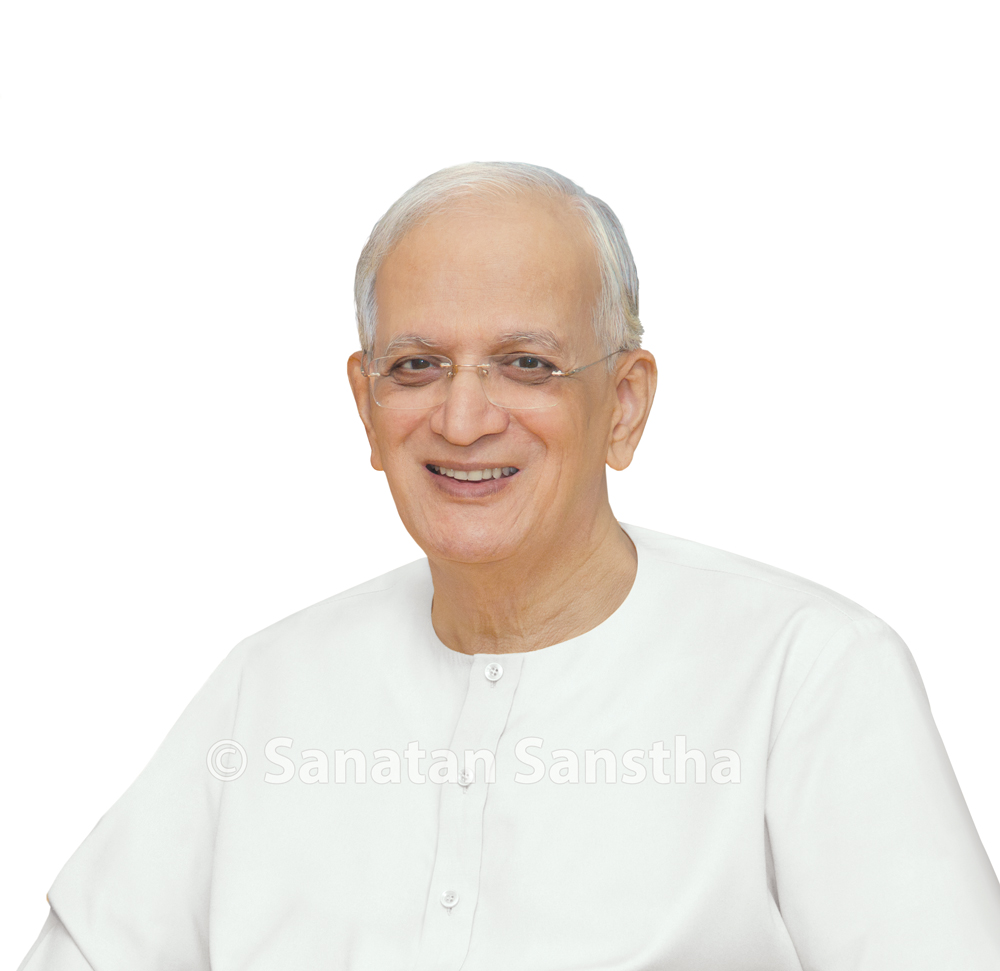
On the occasion of the 83rd Birth Anniversary of the Founder of Sanatan Sanstha, Sachchidananda Parabrahman (Dr) Jayant Athavale (Fondly called ‘Gurudev’) and the Silver Jubilee of Sanatan Sanstha, the Sanatan Rashtra Shankhnad Mahotsav was held from 17th to 19th May 2025 on the grounds of the Goa Engineering College at Farmagudi, Goa. By Gurudev’s grace, the Shankhnad Mahotsav took place at the spiritual level and Gurudev made a resolve for establishment of the ‘Sanatan Rashtra’. Gurudev has been working through the subtle dimension for the creation of a ‘Hindu Rashtra (the Satyayug within Kaliyug)’ comparable to Ram Rajya, to establish Sanatan Dharma.
| ‘Even at the age of 78, the article written by Pujya Shivaji Vatkar is like that of a young man who has a warrior attitude. Congratulations to Him for His approach !’ – Sachchidananda Parabrahman (Dr) Athavale (11.6.2025) |

From 1996 to 1998, Gurudev held public meetings (which had an average attendance of 5,000 seekers and curious individuals). At that time, I had a wish that one such public meeting should be held on the vast 28-acre ground of Shivaji Park in Mumbai; because, at that time, meetings of highly renowned & eminent personalities and senior political leaders used to be held on this ground. The meetings of these people would attract 1-2 lakh people. I used to feel that if seekers from all States and people from Mumbai attended together, a crowd of 25,000 attendees would be a realistic possibility.
I enquired about this with the management of Shivaji Park, which comes under the Municipal Corporation of Greater Mumbai. They told me that we could hold a meeting in one corner of the ground. I told Sachchidananda Parabrahman (Dr) Athavale about this at that time, and He said, ‘We will not have a public meeting there now. In the future, in the Divine Rule, our large meetings will take place’. My latent wish that a glorious meeting of Sachchidananda Parabrahman (Dr) Athavale be held at Shivaji Park, Mumbai remained unfulfilled then. That wish has now been fulfilled on the 23-acre ground of the Goa Engineering College through the Shankhnad Mahotsav.
This Mahotsav was not merely a 2-3 hours affair; rather, it lasted 3 days. Over 30,000 people from 23 countries attended the Mahotsav each day. The attendees included not only seekers and curious individuals but also patriots, followers of Dharma, devout Hindu leaders, journalists, political leaders, Saints, heads of Sects, highly eminent individuals, etc. From this, it becomes clear that the Divine mission of Sachchidananda Parabrahman (Dr) Athavale, akin to that of Shrikrushna in restoring Dharma, is underway.
The difference observed between the meetings of other organisations and the Mahotsav and meetings organised by Sanatan Sanstha and Hindu Janajagruti Samiti : Earlier, instead of conducting one major meeting at Shivaji Park, Mumbai, Sachchidananda Parabrahman (Dr) Athavale asked seekers to conduct Hindu Rashtra-Jagruti Sabhas (Meetings) on behalf of Hindu Janajagruti Samiti. Thousands of such meetings were organised, which had attendance ranging from 1,000 to 25,000 curious individuals and devout followers of Hindu Dharma. As a result, Hindus across India were being united for the protection of the Nation & Dharma. The culmination of this process was the Sanatan Rashtra Shankhnad Mahotsav.
Sachchidananda Parabrahman (Dr) Athavale suggested the above points to me for the benefit of the samashti and got them written through me. I express gratitude at His Holy feet with the bhav (Spiritual emotion) of surrender.
Given ahead is the the difference I observed between the meetings of other organisations and the Mahotsav & meetings organised by Sanatan Sanstha and Hindu Janajagruti Samiti
| Other organisations’ meetings / Mahotsavs | Sanatan Rashtra Shankhnad Mahotsav (Mahotsavs & meetings organised by Sanatan Sanstha and Hindu Janajagruti Samiti) |
|
| 1. Objective | A. To promote some individual, political party or organisation and to exhibit strength | A. To protect the Nation and bring about awakening on Dharma, and to increase sattvikata (Spiritual purity) in society to establish the ‘Hindu Rashtra’ |
| B. To increase the dominance of political parties or their heads and to mould leaders | B. To guide and develop leadership qualities in Divine beings who have a high spiritual level, sent by God to govern the Divine Rule | |
| C. To create activists who are predominant in Raja-Tama components, capable of working at the physical and mental level | C. To mould seekers and Saints who are capable, Sattva predominant and strong-minded for the creation and functioning of the ‘Hindu Rashtra’ | |
| 2. Planning | A. To show off to society and influence people through publicity | A. Planning carried out as per Divine will and under the guidance of Gurudev; planning to give society what it needs, rather than simply giving what it likes |
| B. No consideration is given to austerity, sattvikata, etc. | B. Due consideration is given to time, place, expenditure, etc. during the planning | |
| 3. Attendance | A. Increasing attendance by paying people to attend or by enticing them with food and drinks | A. People attend at their own expense and with self-motivation |
| B. Presence of some curious individuals, Raja-Tama predominant listeners, casual onlookers, irresponsible individuals and political leaders | B. Presence of patriots, Dharma-abiding individuals, curious individuals, seekers, Saints, Divine souls in the subtle dimension, and Deities | |
| 4. Disposition of attendees | Extroverted | Introverted |
| 5. Nature of exhibitions at the meetings / Mahotsavs | Attractive stalls and food counters to draw crowds, giving the Mahotsav the feel of a fair | Exhibitions and displays that teach history and Spirituality and also inspire people to perform sadhana, satseva, protection of the Nation and bring about awakening on Dharma |
| 6. Support / opposition of negative energies | Since the work is demonic in nature, it is supported by negative energies | Since the work is Divine, there is tremendous opposition from negative energies |
| 7. Physical and subtle effects on organisers and attendees | ||
| 7A. Increase in personality defects / ego | Increase in the personality defects and ego of the organisers and attendees, and as a result, increase in competition, jealousy, politics, divisiveness and immorality | Increase in the virtues of team spirit, warrior-spirit, Brahmatej (Radiance of Brahman), Kshatratej (Radiance of warrior), bhav-bhakti (Spiritual emotion and devotion) among the organisers and attendees |
| 7B. Level of benefit (Gross / subtle) | More physical level benefit to the attendees due to purely psychological level guidance of the chief guests, speakers, and spokespersons | Gurudev guiding seekers and curious individuals at the spiritual level, and as a result, the seekers obtaining physical level benefits such as encouragement and having darshan, as well as subtle level benefits such as obtaining Chaitanya (Divine consciousness) |
| 7C. Increase / reduction in distress | Increase in physical, mental and spiritual distress | The resultant spiritual healing leading to the reduction of physical, mental and spiritual distress |
| 7D. Effects of inconveniences and discomfort | Attendees react to inconveniences, physical or mental discomfort, quarrel among themselves, and thus their prarabdha (Destiny that is experienced in this birth) increases; organisers take credit for good actions and blame others for mistakes | Inconveniences, physical or mental discomfort becomes a form of penance of the attendees; organisers learn from mistakes as part of their sadhana and improve upon subsequent plannings; all this results in sadhana of the concerned and they obtain Anand (Bliss) |
| 7E. Spiritual experience | Experience of vibrations of Shakti and pleasure |
Experiences of bhav, Chaitanya, Anand and Shanti (Peace) |
| 8. Effect on the halls, venue, and surroundings | Spread of Raja-Tama components and distressing energies |
– Pujya Shivaji Vatkar (Age 78, Sanatan’s 102nd Samashti Saint), Sanatan Ashram, Devad, Panvel, Maharashtra. (21.5.2025)
Objective of the Mahotsav is to protect the Nation & bring about awakening on Dharma, and to increase sattvikata in society !
| Spiritual distress : This means that the individual has negative vibrations. If the individual has more than 50% negative vibrations, it denotes ‘severe’ distress. If the negative vibrations are between 30 and 49%, it denotes ‘moderate’ distress; if the negative vibrations are less than 30%, it denotes ‘mild’ distress. Spiritual distress is caused by spiritual reasons such as destiny, distress due to departed ancestors, etc. |
 Illegal church in Solapur and misconduct by a municipal employee to be investigated
 Radiant Thoughts of Sachchidananda Parabrahman (Dr) Jayant Athavale
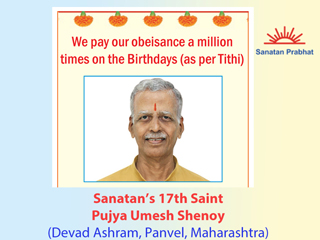 We pay our obeisance a million times on the Birthday (as per Tithi) of
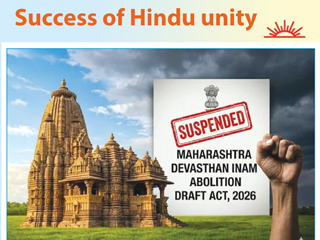 Major win for Hindu unity : Maharashtra Government suspends the controversial ‘Devasthan Inam Abolition Draft Act’
 Mumbai-based advocate Siddhavidya, who is trying to stop trafficking through surrogacy (artificial pregnancy) and animals, and animal killing
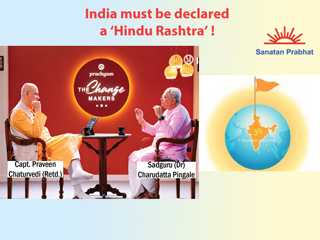 Secularism and the ‘Hindu Rashtra’