
|
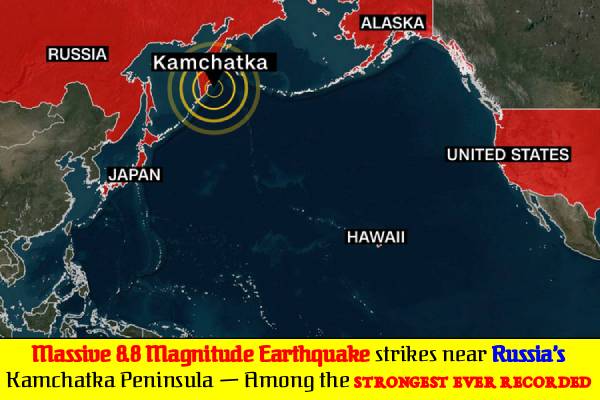
Petropavlovsk-Kamchatsky (Russia) / Tokyo / Honolulu – On 30 July 2025, a powerful 8.8 magnitude earthquake – one of the six strongest ever recorded – struck near Russia’s Kamchatka Peninsula at 4:54 am IST. The quake’s epicentre was located approximately 119 km southeast of Petropavlovsk-Kamchatsky at a depth of 19 km, according to the United States Geological Survey.
Key developments:
- Tsunami in Kamchatka
Waves up to 5 metres hit parts of Kamchatka following the quake. Around 2,700 people were evacuated from coastal areas. Several buildings sustained structural damage. - Japan’s response
Japan reported tsunami waves of up to 1.2 metres along the eastern coast. Over 20 lakh people were evacuated. One person died in an evacuation-related vehicle accident. Authorities confirmed no damage to nuclear plants, including Fukushima, which was shut down as a precaution. - Hawaii and US West Coast
Tsunami waves reached Hawaii (up to 6 feet) and parts of Alaska and California (up to 3.6 feet). Warnings were issued and later lifted as wave intensity lessened. - Latin America and Pacific islands
Countries including Chile, Ecuador, Peru, Costa Rica, New Zealand, and Papua New Guinea issued tsunami alerts and evacuated coastal populations. Chile alone moved over 14 lakh people to safety. - No fatalities reported in Russia
While injuries and damage were confirmed in Kamchatka, Russian authorities reported no deaths so far. - Volcanic activity and aftershocks
More than 13 aftershocks, some as strong as 6.9 magnitude, were recorded. The Klyuchevskoy volcano also erupted in the aftermath of the quake.
Summary table:
| Region | Impact |
| Russia (Kamchatka) | Tsunami up to 5 m, structural damage, 2,700 evacuated |
| Japan | 1.2 m waves, 20 lakh evacuated, 1 death, nuclear safety measures taken |
| Hawaii & US West Coast | Waves up to 6 ft, alerts issued and lifted |
| Latin America/Pacific | Mass evacuations, tsunami warnings, no major destruction reported |
Additional information:
This was Kamchatka’s strongest earthquake since 1952 and comparable in intensity to the 2010 Chile and 2004 Indian Ocean earthquakes. Analysts praised the effectiveness of global tsunami alert systems in preventing mass casualties across multiple countries.
 Denmark considers banning street prayers and the Islamic Adhan (Azaan)
 645 crimes against Hindus reported in Bangladesh over the past five months
 Israel’s spy agency Mossad had plotted to assassinate Pakistan’s army chief Asim Munir
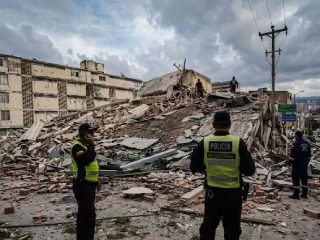 Death toll feared to reach 10,000 to 1 lakh : Venezuela earthquake
 U.S. grants 60-day sanctions relief to Iran
 We must stand firmly against Hinduphobia !