
The Ahmedabad High Court's judgment demonstrates that strategic patience, institutional endurance and constitutional legitimacy are not merely attributes of a mature democracy; they are enduring instruments of national power that strengthen credible deterrence against terrorism.
At a Glance• Gujarat High Court upheld 38 death sentences and 11 life sentences in the 2008 Ahmedabad serial blasts case.• The judgment came nearly 18 years after the attacks.• The article argues that institutional resilience is itself an instrument of national power.• Democratic legitimacy strengthens long-term deterrence against terrorism.• Justice is measured not only by punishment, but also by due process and support for victims. |
More Than a Terror Verdict
The Gujarat High Court’s judgment of 7 July 2026 is far more than the confirmation of 38 death sentences and 11 life sentences in the 2008 Ahmedabad serial bomb blasts case. It is a strategic milestone in India’s evolution as a resilient democracy. The verdict illustrates a larger truth: a nation’s strength is measured not only by the force it can deploy against terrorism, but equally by the credibility of the institutions that investigate, prosecute and ultimately deliver justice.
Terrorism is designed to create fear, undermine public confidence and project the state as incapable of protecting its citizens. Democracies respond differently. Their enduring strength lies in converting strategic patience, institutional endurance and constitutional legitimacy into credible deterrence against terrorism.
The 2008 Ahmedabad Blasts: Eighteen Years to Justice

A horrific scene from the 2008 Ahmedabad Blasts
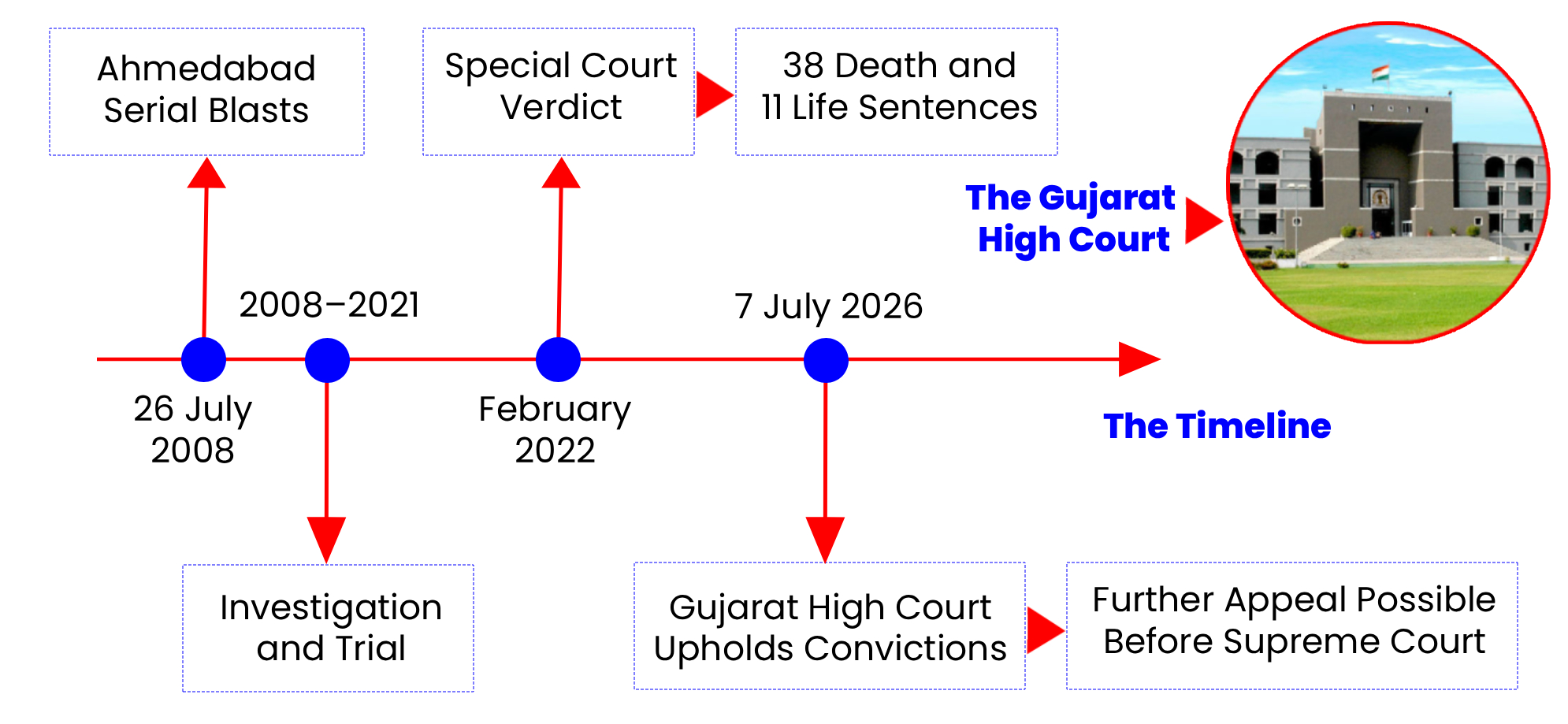
On 26 July 2008, twenty-one coordinated bomb blasts ripped through Ahmedabad’s crowded markets, public spaces and hospitals within seventy minutes, killing 56 people and injuring more than 200. The banned Indian Mujahideen claimed responsibility, describing the attacks as retaliation for the 2002 Gujarat riots. In February 2022, a Special Court convicted 49 of the 78 accused, awarding death sentences to 38 and life imprisonment to 11.
On 7 July 2026, a Division Bench of the Gujarat High Court dismissed the appeals of all the convicts, upheld every death sentence and every life sentence, and directed enhanced compensation for the victims’ families. The convicts retain the constitutional right to appeal before the Supreme Court. That does not diminish the significance of the judgment; rather, it reinforces the constitutional due process that distinguishes democratic justice from arbitrary punishment.
The judgment is historically significant. The Rajiv Gandhi assassination case witnessed 26 death sentences by a trial court, but the Supreme Court eventually confirmed only four. The Ahmedabad case is unprecedented in post-Independence India: never before has a higher court upheld such a large number of death sentences in a single terrorism trial. History, however, is likely to remember this judgment not merely for the number of death sentences it upheld, but for the institutional consistency, constitutional resolve and strategic patience it affirms.
Why Strategic Patience Is a National Strength

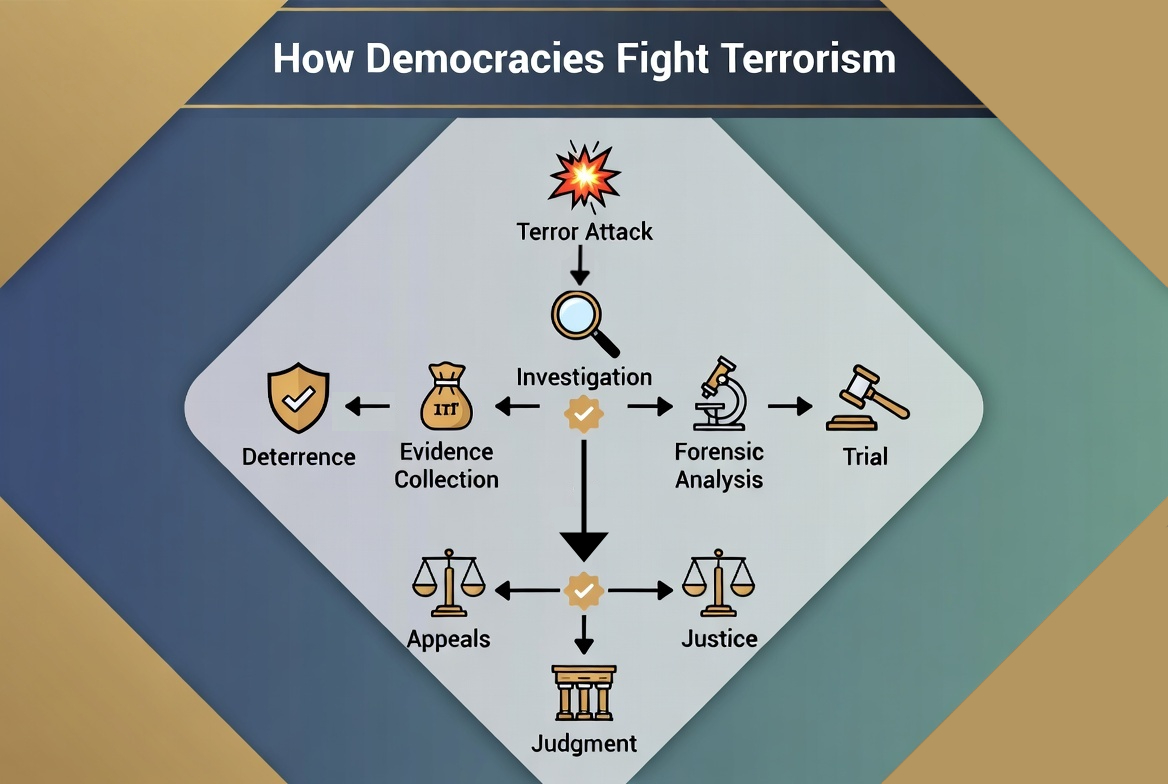
Military operations may neutralise terrorists within hours or days. Constitutional justice demands meticulous investigation, preservation of evidence, forensic scrutiny, witness protection, fair trial and multiple layers of judicial review. Democracies accept this burden because legitimacy strengthens outcomes.
India’s judicial system has, quite rightly, been criticised for delays, mounting pendency and, at times, judgments that have attracted legitimate public criticism. Those criticisms remain valid. Precisely for that reason, the Ahmedabad verdict deserves attention. Despite the extraordinary complexity of a mass-casualty terrorism case spanning nearly two decades, the investigation, prosecution and appellate scrutiny remained institutionally coherent, culminating in an unusually comprehensive affirmation by the High Court. The significance of the judgment lies not in denying the imperfections of the system, but in demonstrating what India’s institutions can achieve when they function at their constitutional best.

Beyond the Courtroom: The Strategic Message

The importance of the judgment extends well beyond criminal law.
It validates one of India’s largest terrorism investigations, also reflects the robustness of the investigation conducted by the Gujarat Crime Branch, and reinforces the judicial application of the “rarest of rare” doctrine in an exceptional mass-casualty case. Equally important, it sends a message far beyond those convicted. Terrorists, their handlers, financiers and hostile state sponsors closely observe whether democratic states possess the institutional resolve to pursue accountability over decades.
Why This Verdict MattersThis judgment is significant because it:
|
Deterrence begins with security forces; it is completed by credible institutions.

The NIA during the investigations
The verdict also strengthens public confidence. Counter-terrorism is not directed only at terrorists; it reassures citizens that India remembers, investigates, prosecutes and ultimately delivers justice. The direction to enhance compensation also reminds us that justice is measured not only by punishment, but by the State’s continuing responsibility towards victims.

What Makes Democracies Different?
Democratic states frequently confront a difficult balance between security, civil liberties and due process. The United States continues to grapple with unresolved legal proceedings arising from the 9/11 attacks more than two decades later. Spain after the 2004 Madrid bombings, the United Kingdom after the 2005 London bombings, and France following the 2015 Bataclan attacks all illustrate the complexity of sustaining constitutional justice while combating terrorism.
India’s experience belongs within this broader democratic context. The Ahmedabad verdict demonstrates that mature constitutional democracies derive enduring legitimacy not from the speed of punishment, but from the credibility of the process through which justice is achieved.
Democratic Responses to Terrorism (A comparative table)
| Country | Incident | Key Challenge |
| India | Ahmedabad Blasts (2008) | Long judicial process and constitutional review |
| United States | 9/11 | Extended legal proceedings |
| Spain | Madrid Bombings (2004) | Balancing security with civil liberties |
| United Kingdom | London Bombings (2005) | Counter-terrorism reforms |
| France | Bataclan Attacks (2015) | Security vs democratic freedoms |
The Verdict’s Long-Term Significance
The Ahmedabad verdict should not be viewed merely as the culmination of one terrorism trial. It represents the maturation of India’s institutional capacity to confront terrorism through both security and law. Over the past two decades, India has steadily strengthened its counter-terrorism architecture through better intelligence coordination, specialised investigative agencies, improved forensic capabilities and more robust legal processes. The judgment is one visible manifestation of that broader institutional evolution.

The evolution of nations is often measured by wars won and economies built. Equally important is the quiet strengthening of institutions that preserve justice, sustain public confidence and deny terrorism its intended psychological victory.
The significance of the verdict, therefore, lies not in the number of death sentences it upholds, but in what they represent: the capacity of a constitutional democracy to sustain institutional resolve across eighteen years without abandoning the principles that distinguish the rule of law from the rule of fear.
Terrorism seeks immediate psychological victory; democracies secure enduring strategic victory through institutions that remain resolute across decades.
FAQ (Frequently Asked Questions)Q1 – What happened in the 2008 Ahmedabad serial blasts?A1 – Coordinated bomb explosions across Ahmedabad on 26 July 2008 killed 56 people and injured more than 200.Q2 – What did the Gujarat High Court decide?A2 – On 7 July 2026, it upheld all 38 death sentences and 11 life sentences awarded by the Special Court, while noting that the convicts retain the right to appeal to the Supreme Court.Q3 – Why does the author describe the verdict as a strategic milestone?A3 – It demonstrates how democratic institutions, due process, and judicial endurance contribute to long-term national resilience against terrorism. |
About the Author

Brig. (Retd.) Sanjay Agarwal is an Indian Army veteran, strategic affairs analyst, and former Security Advisor in the Ministry of Home Affairs, Government of India. He has also served as Advisor to the Government of Seychelles. His writings focus on national security, maritime strategy, counter-terrorism, and India’s strategic interests.
 BJP-led Union Govt launches skill training initiative for minority youth in secular India
 We will fight till the end to recover the temple land and protect devotees’ faith ! : Adv. Pujya Suresh Kulkarni
 Maharashtra Muslim Conference puts up banners saying ‘Allah Deve Allah Dilave’ during Wari in Pune
 Muslims in Chhattisgarh will now require Waqf Board approval to marry non-Muslims
 Forty-seven Muslim accused in cow slaughter cases voluntarily report to a police station in Saharanpur (Uttar Pradesh) !
 It revealed that 181 colleges in Maharashtra lack basic educational facilities !