
Second major victory for Hindus after Shriram Janmabhoomi
Major verdict by the Indore Bench of the Madhya Pradesh High Court
Suggestion to Muslims to request the Government for land at another location
Direction to the Union Government to bring back the idol of Goddess Shri Vagdevi kept in British museum
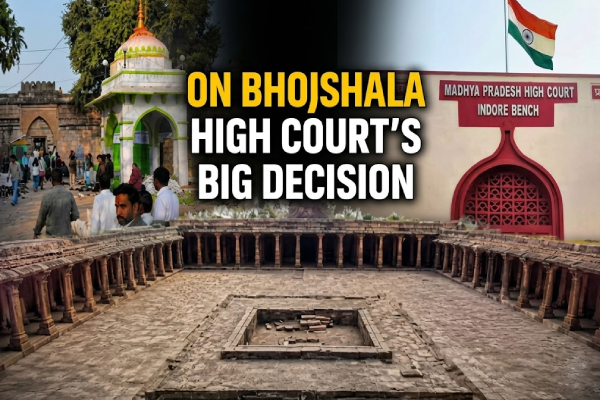
Indore (Madhya Pradesh) – On 15th May, the Indore Bench of the Madhya Pradesh High Court ruled that the famous Bhojshala at Dhar in Madhya Pradesh is a temple of Goddess Shri Vagdevi, that is, Goddess Saraswati, belonging to Hindus. The Bench stated, “Although certain rules had been imposed upon this place over the course of time, it has consistently been observed that this place remained a site of worship. The historical material found at this site proves that it was a centre of Sanskrit education associated with King Bhoj. It indicates the existence of a temple dedicated to Goddess Shri Vagdevi Saraswati at Dhar. Therefore, the religious character of this site is recognised as ‘Bhojshala’, being a temple of Goddess Vagdevi Saraswati.”
Muslims had been referring to it as the ‘Kamal Maula Mosque’. The Court directed the Muslim side to seek separate land from the Government for a mosque. Advocate Vishnu Shankar Jain represented the Hindu side in Court. After the verdict, he reacted by saying, “May Dharma triumph and Adharma be destroyed.”
Now Kashi and Mathura remain – Hindu Janajagruti Samiti
Mumbai – The historic verdict of the Madhya Pradesh High Court regarding Bhojshala is not merely the victory of a structure, but a grand triumph of historical truth suppressed for centuries and of the struggle for liberation of temples encroached upon by foreign Islamic invaders. Although the struggle for the liberation of Bhojshala has succeeded today, a major contribution in this struggle was made by Mr Nawal Kishore Sharma, chief of the Bhojshala Liberation Movement, and Hindu Janajagruti Samiti. The Samiti wholeheartedly welcomes this historic verdict and proclaims the resolve that “…Now Kashi and Mathura remain to be liberated!”
Result of the agitation and Hindu convention organised by Hindu Janajagruti Samiti
For the liberation of Bhojshala at Dhar, Hindu Janajagruti Samiti not only conducted agitations on the streets, but also carried out widespread awareness campaigns at the national level. Through the national platform of the ‘Vaishwik Hindu Rashtra Mahotsav’ (All-India Hindu Rashtra Convention) held annually in Goa, legal and strategic resolutions regarding this issue were passed every year to determine the direction of the struggle. Devout Hindu organisations across the country had continuously appealed to the Madhya Pradesh Government and the Union Government regarding this matter. With this historic verdict delivered by the Court today, justice has been rendered to the sentiments of crores of Hindus and to Samiti’s prolonged agitation.
Struggle for Kashi and Mathura will continue until encroachments by invaders are removed
On this occasion, the national spokesperson of the Samiti, Mr Ramesh Shinde, said that Hindus in India have not had merely one or two temples encroached upon. Foreign invaders and religious extremists took advantage of tolerance of Hindus and illegally encroached upon thousands of temples, falsely claiming ownership over them. The verdicts in Ayodhya and Dhar (Bhojshala) have proved that the veil of falsehood cannot survive for long. Now the time has come for all encroached sites, from the Gyanvapi at Kashi to the Shrikrishna Janmabhoomi at Mathura, to be liberated.
We will challenge the verdict in the Supreme Court; Muslim side claims
After the verdict, advocate Arshad Warsi from the Muslim side said that they were not satisfied with the verdict. “We will approach the Supreme Court against this. We are awaiting the complete copy of the verdict.” He also stated that the Court had delivered this verdict after accepting the facts presented by the Archaeological Survey of India (ASI).
Similarity with the Babri case verdict; the Supreme Court will set aside the order!: Asaduddin Owaisi
“The Supreme Court will overturn this order. Glaring similarities with the Babri Masjid case,” Asaduddin Owaisi posted on X. (Everyone knows that the Supreme Court had ruled in favour of Hindus in the Shriram Janmabhoomi case. Therefore, even if Muslims approach the Supreme Court in this matter, it is evident from the archaeological evidence that the Court will rule in favour of Hindus here as well! – Editor)
Principles laid down by the Court
The Union Government should decide how the temple is to be managed
This historical and protected site is a temple dedicated to Goddess Saraswati. The Union Government and the ASI should decide how the Bhojshala temple is to be managed. According to the law of 1958, the complete management of this property will remain under the ASI.
Right to offer Namaz annulled
The Court also set aside the 2003 order of the Archaeological Survey of India. Due to this order, Hindus had been denied the right to worship at Bhojshala. The Court also annulled the order granting Muslims the right to offer prayers there.
Heavy security arrangements at Dhar
In the backdrop of the verdict, the district administrations of Indore and Dhar had deployed heavy Police security there. As the day of the verdict was a Friday, Muslims had arrived at Bhojshala in the afternoon as usual for Namaz prayers. During this time, the administration appealed to the people to maintain peace. The Superintendent of Police stated that security in Dhar city had been organised at 12 levels. Reserve Police Forces and Rapid Action Forces had been kept on alert.
Hindus had permission to worship on Tuesdays
Since 2003, Hindus had been permitted to worship there every Tuesday and on Vasant Panchami, while Muslims had been permitted to offer Namaz there on Fridays. On other days, the area remained open to tourists. In 2013 and 2016, as Vasant Panchami and Friday had fallen on the same day, tension had arisen there.
Reactions of eminent personalities after the historic Bhojshala verdict
We have reclaimed what was ours: Advocate Vishnu Shankar Jain
The verdict delivered in favour of Hindus regarding Bhojshala is extremely significant. After a prolonged struggle, Hindus have regained the right to worship in that place. The destruction of the Shriram Temple by Babur took place in 1528. The Bhojshala matter is even older than that, dating back to the 11 th century. The Court’s verdict has once again proved that the pen is mightier than the sword.
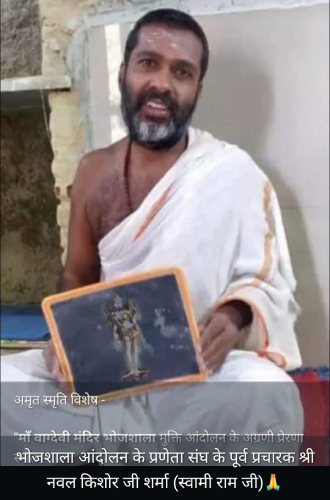
Gurudev stood behind us in the form of a divine power: Former chief of the Bhojshala Liberation Movement, Swami Ram Chaitanyaji (Nawal Kishore Sharma)
This is a divine spiritual endeavour; when no one stood with us and everyone had abandoned us, companions like you (Hindu Janajagruti Samiti) and HH Gurudev (Sachchidananda Parabrahman (Dr) Jayant Athavale), in the role of guides and bestowers of blessings, stood firmly behind us in this Yajna of Mother Bhagwati. Words are insufficient to express gratitude for this. HH Gurudev stood behind us in the form of a divine power; this verdict is the grace (blessing) of that very power! |
Bhojshala is now completely a Hindu temple: Petitioner Kuldeep Tiwari
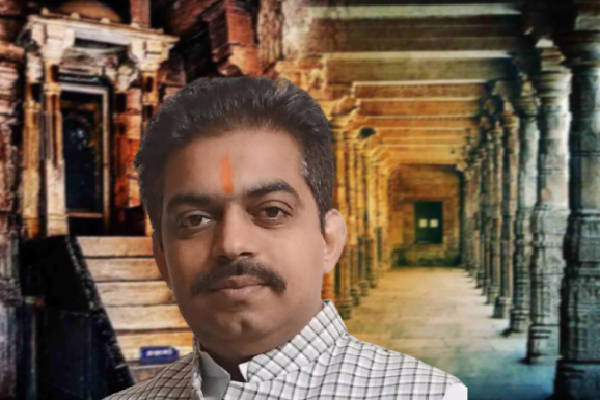
Lucknow (Uttar Pradesh) – Expressing happiness over the historic verdict in the Bhojshala case, the principal petitioner in the matter and a devout Hindu from Lucknow, Mr Kuldeep Tiwari,
elaborated on the evidence presented before the Court and the detailed aspects of the verdict. Speaking to a representative of Sanatan Prabhat, he said that this verdict is a victory achieved on the basis of logic and facts.
Two petitions and the legal battle
Providing information about the matter, Tiwari said that two petitions had been filed on their behalf. The first petition was ‘Kuldeep Tiwari versus Union Government’ (No. 10484), and the second was ‘Hindu Front for Justice versus Union Government’ (No. 10497). Both petitions had been filed on the same day, 2 nd May 2022.
Historical and scriptural evidence
Speaking about the evidence submitted before the Court, Tiwari elaborated that this battle continued for 4 years. During this period, the Hindu side presented gazette notifications of the Madhya Pradesh Government, legal documents and several important books before the Court. “We submitted the book ‘Samarangan Sutradhar’, written by King Bhoj, before the Court. This book is based on how the architecture of the Parmar dynasty should be. It clearly explains the design of idols, temple architecture and the structure of buildings,” Tiwari stated.
He further said, “Bhojshala was not merely a temple, but also a renowned Sanskrit university (Saraswati Kanthabharan), where more than 500 Acharyas imparted education. King Bhoj is regarded as the blessed son of Goddess Saraswati, and he himself composed 84 scriptures. We presented many pieces of evidence such as ‘Prabandha Chintamani’, written by Merutung in 1305, and ‘Art of Parmar of Malwa’, all of which were accepted by the Court.”
Historic verdict of the Court
While explaining the Court’s verdict, Tiwari informed that hearings in the matter were conducted for approximately one and a half months, for 2 hours every day. The Court clearly stated that, based on the evidence, it is proven that Bhojshala is indeed a Hindu temple. The Court annulled the 2003 order of the ASI, under which Muslims had been granted permission to offer Namaz there. The Court declared that order unconstitutional and has now completely prohibited Namaz there. Expressing satisfaction over the verdict, Tiwari said, “Now this has become completely a Hindu temple; Muslims have no connection with it whatsoever.”
Bhojshala verdict is not merely about a temple, but a ‘civilisational statement’: Author Sandeep Singh
Mumbai – In the backdrop of the Bhojshala verdict, noted writer on temples, Sandeep Singh, expressed strong views to Sanatan Prabhat regarding Hindu heritage and temple restoration. According to Sandeep Singh, author of the books ‘Temple Economics’ and ‘A Decade for Mandir’, the liberation of Bhojshala is not merely the recovery of a place, but a “civilisational statement”.
Singh further said,
Abandon passivity
Hindus must now stop remaining mere spectators. The time has come for Hindus to stand firmly for the protection of their heritage, identity and sacred sites.
Reclaim the temples
Every temple that was destroyed, encroached upon or where devotees were denied entry must be reclaimed and reconstructed.
Victory of historical truth
Distortions in history can no longer be concealed. The truth regarding temples, foreign invasions and cultural destruction is now coming before the public.
Hindu unity is essential
Divisions among Hindus on the lines of caste, region or language weaken the continuity of our civilisation. Therefore, Hindu unity is the need of the times for the protection of civilisation.
Revival of Dharma
The restoration of temples is not merely a religious act. It is a necessary step for re-establishing Dharma, awakening cultural self-confidence, attaining historical justice and preserving national self-respect.
Arguments presented before the Court
1. The Hindu side had argued that the ‘Places of Worship Act 1991’ does not apply to Bhojshala. It is a protected monument under the ASI. The name of Bhojshala is recorded in the list under the Ancient Monuments and Archaeological Sites and Remains Act 1951. The verdict delivered in the Advocate Ashwini Upadhyay case in 2024 cannot be applied to the Bhojshala matter.
2. A demand had been made to annul the order issued by the Archaeological Survey of India on 7 th April 2003. The Court was requested to determine the religious character of Bhojshala and hand it over completely to the Hindu community. This would enable uninterrupted worship of Goddess Saraswati and performance of Havan throughout the year.
3. Advocate Shobha Menon, representing the Muslim side, stated before the Court that it is still not clear whether Bhojshala is a temple, a mosque or a Jain school. The authority to determine the religious character of the disputed site lies with the civil court. The High Court is hearing the matter under writ jurisdiction in accordance with Article 226.
4. The Jain community stated that the idol claimed to be that of Goddess Shri Vagdevi is actually of Goddess Ambika, the revered Deity of the Jain community. A similar idol to the one found at Bhojshala exists in the temple of Goddess Ambika at Sehore. It should therefore be declared a Jain pilgrimage site.
Chronology of the legal battle
In 2022, Ranjana Agnihotri and others, on behalf of ‘Hindu Front for Justice’, filed a petition in the High Court seeking determination of the religious character of Bhojshala and complete rights for the Hindu community.
The petition included demands such as the right to perform regular worship, prohibition of Namaz prayers in the area, establishment of a trust, and bringing back the idol of Goddess Shri Vagdevi kept in the British Museum.
Survey conducted by the ASI following Court orders
In 2024, the Archaeological Survey of India conducted a scientific survey of the Bhojshala area for 98 days. Thereafter, on 23 rd January 2026, on the occasion of Vasant Panchami, the Supreme Court permitted day-long worship there. Regular hearings commenced in the High Court from 6 th April and continued until 12 th May.
Arguments made by the Hindu side
Advocates representing the Hindu side argued that Bhojshala is a temple of Goddess Saraswati and an ancient centre of learning, citing historical documents, the ASI’s findings, inscriptions, architectural remains and the tradition of worship on Vasant Panchami.
Advocate Manish Gupta referred to the text ‘Samarangan Sutradhar’ written by Parmar King Bhoj and stated that the structure of Bhojshala matches the standards of temple architecture described in that text.
Muslim side raised questions regarding the survey report
The Muslim side argued before the Court that the area has long been used as the Kamal Maula Mosque and that the authority to determine the religious character lies with the civil court. Advocate and Congress leader Salman Khurshid questioned the ASI’s report, stating that the photographs and videography made available during the survey were unclear. Unlike the Ayodhya case, no installed idol exists at Bhojshala.
History of Bhojshala
The origins of this structure date back to the 11 th century during the reign of the great Parmar dynasty king, Emperor Bhoj (1000–1055). King Bhoj was a great patron of learning. He established a grand college (Sanskrit institution) and a Saraswati temple at Dhar, where students from distant places came for education. In the 14 th century, Alauddin Khilji and later the Muslim Sultans of Malwa took control of the area. In 1401, Dilawar Khan Ghori, and later in 1514 Mahmud Shah Khilji, attempted to convert the temple into a mosque by altering the structure using the temple’s pillars and materials.
 Minor Hindu Girl Thrown from Fourth Floor by Shahnawaz for Resisting Molestation: Girl Dies
 Teacher conducting SIR process assaulted by three religious fanatics !
 District Court Lifts Stay on Chemical Coating of the Shri Vitthal–Rukmini murti at Pandharpur !
 Three Hindus arrested for consuming mutton and alcohol on holy Saryu in Ayodhya
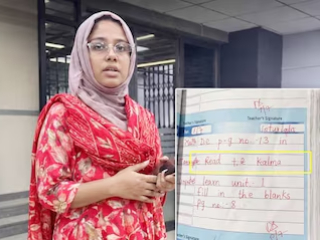 Teacher dismissed by school in Bhagyanagar (Telangana) for asking a Hindu student to memorise the ‘Kalma’ as homework !
 Karnataka to ban the sale of pizza-burger near schools