
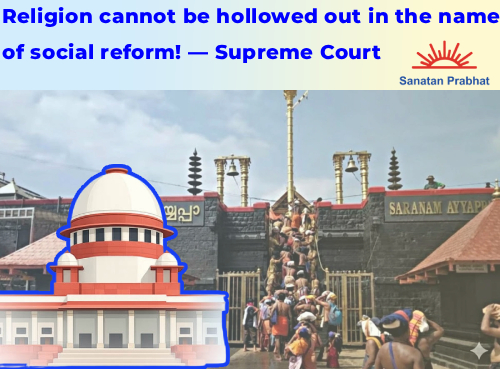
New Delhi – Hurting faith of millions of people is one of the most difficult tasks. The Supreme Court observed during the hearing of Sabarimala Temple case that no religion can be hollowed under the guise of social welfare and reforms. The court made the observation while hearing arguments by senior advocate Abhishek Manu Singhvi on the interrelationship between the right of a religious institution to manage its own affairs under Article 25(2)(b) and Article 26(b). Article 25(2)(b) allows the State to make laws for social welfare and reforms or to keep public Hindu religious institutions open to all classes and communities of Hindus.
🚩 “Religion cannot be hollowed out in the name of social reform.” – Supreme Court of India in the Sabarimala case.
Sabarimala Temple is not a ‘restaurant’! argued Advocate Singhvi for the Travancore Devaswom Board.
Courts cannot decide what is or isn’t an essential religious… pic.twitter.com/Ceq2MY7agK
— Sanatan Prabhat (@SanatanPrabhat) April 16, 2026
It is not the job of the courts to decide about necessity of a religious custom
Arguing on behalf of the Travancore Devaswom Board, Advocate Singhvi said that although under Article 25(2)(b), all sects of Hindus have the right to seek admission to public religious institutions, a religious sect has the right to regulate the conduct of religious rituals under Article 26(b). The purpose of Article 25(2)(b) is not to destroy the existence or identity of any religion. Laws passed under it should not affect the fundamental practices of a religion. Constitutional protection cannot be limited to essential religious practices only, and it is not the function of the courts to decide about the requirement of any practice or custom.
Sabarimala temple is not a ‘restaurant’! – Travancore Devaswom Board
Abhishek Manu Singhvi, advocate for the Travancore Devaswom Board, argued that it is not a case of a toy shop or a restaurant. This is a temple dedicated to a Deity who practised celibacy throughout His life. The age of women between 10 and 50 years is against the nature and identity of this Deity. There are approximately 1,000 Ayyappa temples in India. If women want to have ‘Darshan’, they can go to any of those temples. Why should they come to this particular temple?
What is the case ?
In 1991, the Kerala High Court had imposed a ban on the entry of women between the ages of 10 and 50 in the Sabarimala Temple. The Supreme Court lifted the ban in 2018, declaring it to be discriminatory. Subsequently, based on the review petitions filed, a decision has been given on 7 important constitutional questions, which are presently under deliberations.
 Terrorist arrested in Jammu and Kashmir ahead of the Amarnath Yatra
 More than 13,000 illegal Bangladeshi infiltrators in Karnataka !
 Claim of a conspiracy to Islamise the Dattapeetha premises at Chikkamagaluru (Karnataka) !
 9 incidents of love jihad exposed in various states in the last 24 hours
 Licences of 6 hotels, bakeries and clubs suspended in Mumbai; 19 people arrested
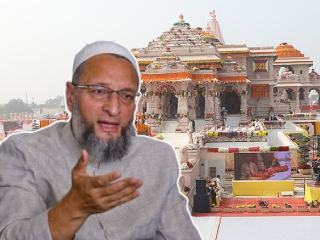 “If there had been a Muslim in the Shri Ram Janmabhoomi Teerth Kshetra Trust, he would have been ‘encountered’ over the theft” : Asaduddin Owaisi