
Karnataka Government’s decision to curb rising ‘digital addiction’ among students
|
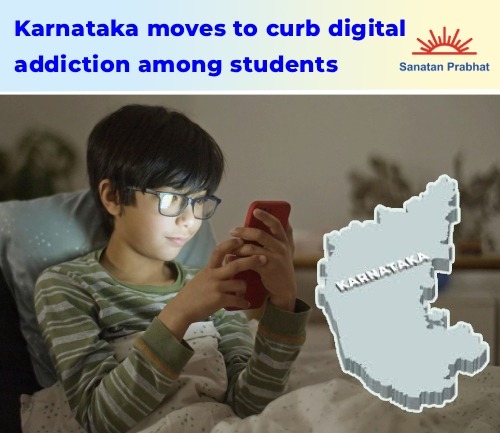
Bengaluru (Karnataka) – To tackle the growing problem of digital addiction, the Karnataka government has prepared an important draft policy regarding digital usage for students of Classes IX to XII. The draft recommends limiting students’ screen time (apart from studies) to one hour per day and stopping internet usage after seven p.m.
According to the government, approximately 25% of adolescents are addicted to the internet, leading to issues such as lack of sleep, anxiety, and reduced attention span. In this context, the policy has been designed with a focus on students’ physical and mental health.
Karnataka moves to curb digital addiction among students 📵📚
➡️ Screen time capped at 1 hr/day
➡️ No internet after 7 PM
➡️ Policy for Classes 9–12⚠️ Govt says ~25% teens are addicted
Proposals include 👇
✔️ Digital detox days
✔️ Mental health support
✔️ Parental & teacher… pic.twitter.com/nn8bXtLah0— Sanatan Prabhat (@SanatanPrabhat) March 25, 2026
Key provisions of the draft:
Students must stay away from screens at least one hour before bedtime. A ‘child plan’ concept for mobile usage has been suggested, which includes limited features, audio-only options, and automatic internet shutdown after a fixed time. Emphasis is also placed on developing age-appropriate, safe devices and operating systems.
‘Digital well-being’ (ensuring healthy and balanced digital use) and online safety will be included in the school curriculum. Students will be educated about cyberbullying (harassment through the internet or social media), privacy, and responsible online behaviour. Every school will be required to implement its own digital usage policy. Initiatives like ‘Digital Detox Day’ and ‘Tech-Free Time’ will also be introduced.
Greater focus will be placed on students’ mental health. Counselling systems in schools will be strengthened, and teachers will be trained for this purpose.
The roles of teachers and parents will be clearly defined. Teachers will monitor and guide students’ digital behaviour, while parents are expected to set screen time limits at home and establish ‘no-phone zones’.
Guidelines for the use of AI will be developed. Schools will set rules for AI usage, regulate its use in homework, and create systems to prevent copying.
Social media restrictions for minors were already in place.
The Karnataka government had already announced a ban on social media usage for children below 16 years of age, making it the first state in the country to take such a step.
Editorial Perspectives
|
 Terrorist arrested in Jammu and Kashmir ahead of the Amarnath Yatra
 ‘We will cut off the hands of those who stop our water !’ : Pakistani Minister Musadik Malik
 More than 13,000 illegal Bangladeshi infiltrators in Karnataka !
 Claim of a conspiracy to Islamise the Dattapeetha premises at Chikkamagaluru (Karnataka) !
 9 incidents of love jihad exposed in various states in the last 24 hours
 Licences of 6 hotels, bakeries and clubs suspended in Mumbai; 19 people arrested