
A frustrated Trump continues bullying on the 17th day of the war
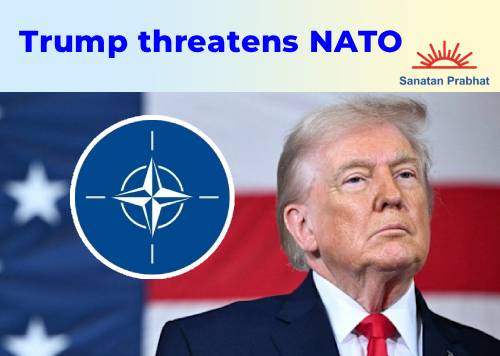
Washington/Tel Aviv/Tehran – It has been 17 days since the war began. The United States has now started urging NATO member States to join the war by issuing a stern warning. A frustrated US President Donald Trump warned that if NATO countries do not help the US in reopening the Strait of Hormuz, then NATO will face a ‘very bad’ future. If European countries fail to support the US in the fight against Iran, they will face serious consequences.
Trump also warns China
Trump has also warned China, saying that he could postpone the summit with Chinese President Xi Jinping scheduled later this month, if China does not help keep the Strait of Hormuz open. Trump is scheduled to visit China on March 31st.
Pope Leo appeals to end the war
Pope Leo, the supreme leader of Christians, appealed that the situation in the Middle East is terrible and the war must stop immediately. All should stop the violence and start a dialogue. I express my condolences to those who have lost family members in the attacks on schools, hospitals and homes.
Thousands of Iranian citizens seeking refuge in neighbouring Afghanistan or Pakistan: United Nations
Thousands of Iranians have fled the country, seeking refuge in neighbouring Afghanistan and Pakistan. Homes and essential services have been destroyed in many Iranian cities, forcing people to seek safety. Of these, an estimated 32,000 have reached Afghanistan, while about 4,000 have reached Pakistan, according to the United Nations.
Japan and Australia ignore Trump’s appeal
Trump has called on allies to send warships to help control the situation in the Strait of Hormuz and deal with Iran. Japan and Australia have rejected this call.
1. Australia: The Australian Navy has said it has no plans to send ships, defying US pressure. Cabinet Minister Catherine King said that while the route is vital, Australia has not received any formal request. There are currently no plans to deploy troops there.
2. Japan: Japan said it has not approved any military action to protect maritime security. Addressing the Japanese National Diet, Prime Minister Sanae Takaichi said no decision has been made on sending warships, and Japan can act independently within the legal framework.
3. South Korea: South Korea took a cautious stance, saying that discussions with the US are ongoing and the situation will be thoroughly examined before taking any decision.
4. Britain: Prime Minister Keir Starmer has discussed with Trump the reopening of the Strait of Hormuz to reduce disruptions to global maritime traffic.
Netanyahu alive, broadcasts video
Iranian and Pakistani media had spread rumours that Netanyahu was killed in an Iranian attack. Similarly, a false claim was made that an Indian journalist named Aditya Raj Kaul had shared information about Netanyahu’s whereabouts on social media. Therefore, it was said that Netanyahu had been killed. Putting an end to all the rumours, Netanyahu released a video of himself. He is seen laughing and joking in a coffee shop in Tel Aviv in this video. He is, in a way, ridiculing all the rumours. ‘The support of the Israeli people gives me, the Government, the Israeli Defence Forces, the Mossad and our various institutions strength. We are currently doing some things that I cannot reveal now, but we are definitely taking action. We are attacking Iran and Lebanon very strongly.’
Long history of cooperation between India and Iran: Dr Jaishankar
Indian External Affairs Minister Dr S. Jaishankar said in an interview that India is engaging in direct and decisive dialogue with Iran to ensure the safe passage of Indian-flagged ships. Each Indian ship is being granted permission on an individual basis; no new formal agreement has been signed between India and Iran for this purpose.
Dr Jaishankar further said that India has not offered any concession or benefit to Iran in exchange for the safe passage of Indian ships. India and Iran have a long history of cooperation, and on this basis, India has taken this initiative. This is not a ‘give and take’ arrangement, Jaishankar asserted.
Diplomacy is a more effective tool than military action: Dr Jaishankar
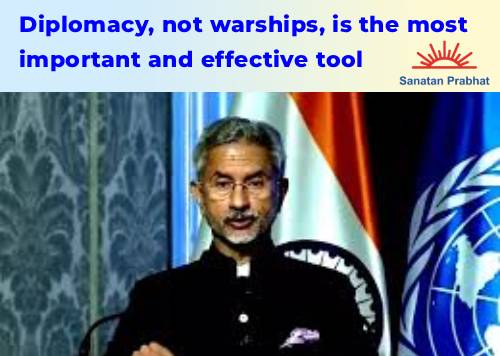
New Delhi – Dr S. Jaishankar has suggested a solution to the US in very suggestive terms to resolve the crisis in the Strait of Hormuz. Dr Jaishankar firmly stated that diplomacy, not warships, is the most important and effective tool to reopen the Strait of Hormuz.
Dr Jaishankar, in an interview with a media outlet, said that from India’s perspective, it would be preferable to try to solve mutual coordination, but that does not seem to be happening at the moment. I believe that if other stakeholders are also included in this process, it will be in the wider interest of the world.
The reason behind Iran’s survival of the war
America worried about naval mines in the Strait of Hormuz
Trump has said that it is “absolutely imperative” to destroy Iran. He said that Iran has no conventional navy, no anti-aircraft capability, no capable air force, yet it is fighting. It can do so because Iran has planted mines in its waterways.
Oil prices crossed $100 (Rs. 9,233) per barrel last week. This is the first time since 2022. If the Strait of Hormuz is not reopened soon, these prices could skyrocket to $150 (Rs. 13,850) per barrel. This could cause widespread chaos around the world, including in the United States.
 ‘We will cut off the hands of those who stop our water !’ : Pakistani Minister Musadik Malik
 India prepares to seek Pakistan’s reinstatement to the FATF grey list
 “If I reveal the names of the powerful people involved in the Shri Ram Temple donation theft, they will kill me” : Bageshwar Dham chief Pandit Dhirendra Krishna Shastri
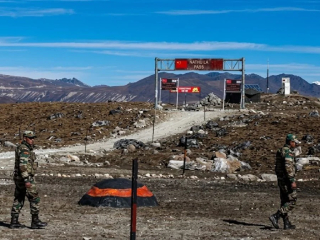 No Chinese military incursion into Arunachal Pradesh : Indian Army clarifies
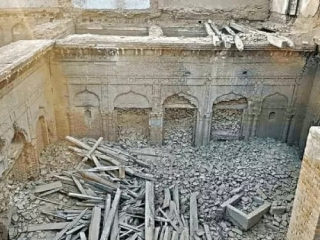 Attempt to demolish 125-year-old Gurdwara in Pakistan !
 Major win for Hindu unity : Maharashtra Government suspends the controversial ‘Devasthan Inam Abolition Draft Act’