
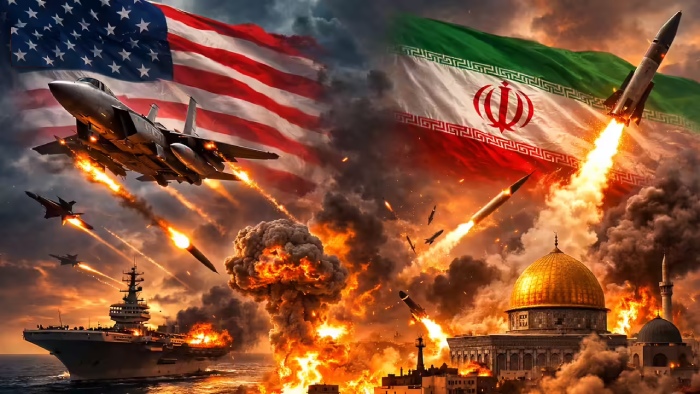
Tehran (Iran) / Washington DC (USA) / New Delhi – Iran’s Islamic Revolutionary Guard Corps has said that its country is capable of fighting a six-month war against the US and Israel. Military spokesman Ali Mohammad Naini said, “Both the Iranian army and the Revolutionary Guard are capable of a long-term conflict.” He claimed that they have targeted more than 200 sites related to US and Israeli military bases and facilities in the region.
Israel is destroying Iran’s oil reserves
The war between the US, Israel and Iran continued for the 9th day. On 9th day, the US and Israel attacked Iran’s oil storage facilities. According to an Israeli daily, 30 Iranian fuel tanks and several oil depots were targeted. The resulting fire created a cloud of smoke and darkness in the atmosphere.
Highlights of the war* 1,483 people have died so far * 1,765 Israelis injured * 6,668 civilian areas have been targeted in Iran so far * 5,535 houses and 1,041 shops were damaged in the war * 14 medical centres and 65 schools attacked |
Difficult for the US to change Iran’s current Government
An intelligence report from the US National Intelligence Council said that even a US-led ground invasion of Iran would not make it easy for the US to overthrow the current Government. Intelligence agencies have expressed doubts that the war could be over in 4 to 6 weeks.
This report was prepared before the invasion of Iran. It also states that even if the current Government is weakened, the chances of the country’s scattered opposition forces gaining power are slim.
Will kill you if you attack the American people : USA
US Defense Secretary Pete Hegseth has warned that if you kill Americans or threaten them anywhere in the world, we will find you and kill you.
Iran’s attacks on neighbouring countries continue even after apology; Iranian military unhappy with Iranian President’s apology
Internal conflict has erupted in Iran after Iranian President Masoud Pezeshkian apologized for Iran’s attacks on neighbouring countries and announced stopping them. There has been a split among the ruling leaders. Pezeshkian’s announcement has angered hardliners in Iran. Hence, Iran has continued to attack neighbouring countries even after Pezeshkian’s apology.
After controversy over Pezeshkian’s apology, his office clarified, saying, “The Iranian military will give a befitting response to any attacks from American bases.” A few hours later, the president’s ‘X’ account reposted his earlier statement; however, the word “apology” was removed. Pezeshkian said, “The enemy has had misconception about my words, who wants us and our neighbouring countries to remain in a state of war and seeks to create conflict between us. Iran considers neighbouring countries as ‘brothers’ and wants to maintain strong relations with them. When we say we will respond to the attacks, it does not mean we have a dispute with any of our neighbours or wish to trouble its people.”
Radical religious leader and MP Hamid Rasaee expressed his displeasure, saying, “Pezeshkian, your position was unprofessional, weak and unacceptable.” Judiciary Chief Mohseni Ejei also objected to Pezeshkian’s statement. “Geography of some countries in the region is being used openly and covertly at the disposal of the enemy. The heavy attacks on these targets will continue,” he explained.
Senior commanders unhappy with Pezeshkian’s apology
Iran’s Revolutionary Guards also responded. “Our drones attacked the US Air Command Centre at Al-Dhafra Air Base near Abu Dhabi, the capital of the United Arab Emirates. There was also an attack in Dubai, killing one person. There were also attacks in Bahrain and Qatar,” they said. Pezeshkian’s apology has angered many senior commanders of the Revolutionary Guards.
The US and Israel prepare to gain control over Iran’s nuclear stockpile
The US and Israel are discussing the possible deployment of special forces to secure Iran’s enriched uranium stockpile. The aim is said to be to take control of Iran’s stockpile of about 450 kg of enriched uranium. The information came to light in a report by the American media ‘Axios’. According to the report, this operation could be carried out in the next phase of the current war. The aim is to secure Iran’s nuclear stockpile. This campaign against Iran’s nuclear stockpile can only begin when Iran’s military capabilities are completely weakened.
Trump has already made it clear that Iran will not be allowed to build a nuclear bomb under any circumstances.
US troops will land on Iranian soil
Axios, citing sources, said that if the operation were to proceed, American or Israeli troops could land directly on Iranian soil. They would have to reach the heavily guarded underground nuclear facilities and take control of the uranium stockpile there.
Don’t need people who join the war after we’ve won : Trump criticizes British Prime Minister Starmer
Britain had earlier refused to allow the US to use its bases; but now Britain is seriously considering deploying two aircraft carriers in the Middle East. US President Donald Trump criticized saying that the United Kingdom, which was once our great ally, perhaps the greatest of them all, is finally seriously considering sending two aircraft carriers to the Middle East. That’s fine, Prime Minister Starmer, we don’t need them any longer; but we will remember this. We don’t need people who join war after we’ve won.
Major water crisis may arise
The populations of many countries in the Gulf region depend on desalination projects, which involve removing the salt from seawater and purifying it for drinking. Now, these projects could be targeted by missiles or drones. Bahrain has claimed that Iran attacked one such desalination project.
Hundreds of desalination projects have been built on the coast of the Persian Gulf. These projects separate the salt from seawater and produce potable water. If these projects are damaged, severe water shortages can occur in many large cities in the Gulf region. A large part of the water requirements of the Gulf countries is met through this desalination technology. In Kuwait, about 90 percent of drinking water is obtained through desalination. In Oman, this figure is 86 percent, while in Saudi Arabia, 70 percent of drinking water is produced through desalination. This technology is called ‘reverse osmosis’.
Water industry expert Ed Cullinan said that desalination systems depend on the following components – water intake systems, purification facilities and energy supply. If any of these components are damaged, the entire system can come to a standstill.
Massive explosion near the US embassy in Oslo (Norway)
A large explosion was heard near the US embassy in Oslo, the capital of Norway, in Europe. There is no immediate information about the cause of the explosion or the people involved. Police are working with the embassy. There are no immediate reports of casualties.
More than 52 thousand Indians returned from Gulf countries
The Ministry of External Affairs said that between March 1st and 7th, 2026, more than 52,000 Indians safely returned to India from the Gulf countries. Of these, 32,107 were brought back by Indian airlines, while the rest were brought back by foreign commercial aircraft.
 ‘We will cut off the hands of those who stop our water !’ : Pakistani Minister Musadik Malik
 India prepares to seek Pakistan’s reinstatement to the FATF grey list
 “If I reveal the names of the powerful people involved in the Shri Ram Temple donation theft, they will kill me” : Bageshwar Dham chief Pandit Dhirendra Krishna Shastri
 No Chinese military incursion into Arunachal Pradesh : Indian Army clarifies
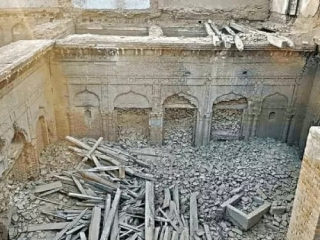 Attempt to demolish 125-year-old Gurdwara in Pakistan !
 Major win for Hindu unity : Maharashtra Government suspends the controversial ‘Devasthan Inam Abolition Draft Act’