
Writer and scientist Dr Anand Ranganathan questions the judges
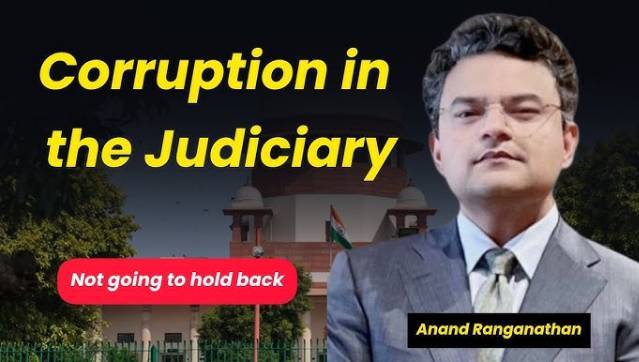
New Delhi – After the Supreme Court banned an NCERT textbook for publishing content on corruption in the judiciary, outspoken nationalist writer, devout Hindu and scientist Dr Anand Ranganathan released a video on his ‘X’ account. Through the video, he raised a fundamental question: “Justice may be blind, but judges are not. Does the massive corruption within the Indian judicial system go unnoticed by them ?”
Is the massive corruption in the Indian judicial system not visible? – Dr. Anand Ranganathan (@ARanganathan72) questions transparency in India’s judiciary after the Supreme Court of India banned an NCERT text on judicial corruption.
“Justice is blind, not the judges. Is… https://t.co/6XVAIJvjtL pic.twitter.com/zsOQGn3odT
— Sanatan Prabhat (@SanatanPrabhat) March 2, 2026
Key points raised by Dr Anand Ranganathan
- What action is taken when bags of cash are found at the residences of judges? They are merely transferred to another city.
- More than 5 crore 40 lakh cases are pending in Indian courts. At the current pace, it may take 323 years to clear the backlog. Of these, 1 lakh 82 thousand cases are over 30 years old. Many involve rape and child sexual offences. Additionally, 76 per cent of prison inmates are undertrials (their hearings are ongoing), resulting in them languishing in jail for years.
- In India, there are only 20 judges per 10 lakh population. About 32 per cent of High Court posts and 21 per cent of total judicial posts remain vacant.
- The system where ‘judges appoint judges’ requires serious reconsideration and reform. Approximately 50 per cent of High Court judges and 33 per cent of Supreme Court judges are related to senior members of the judiciary.
- Supreme Court judges themselves have acknowledged corruption in the higher judiciary. Yet, under Article 235 and the 1997 declaration, no one outside the judiciary can investigate judicial corruption. Between 2017 and 2021, 1,631 complaints related to judicial corruption were received. These were forwarded to the Chief Justice of India or the Chief Justices of the respective High Courts.
- Only 12 per cent of judges in India have declared their assets.
- In 1993, Supreme Court judge V Ramaswami faced allegations of financial irregularities and misuse of public funds. Although a parliamentary inquiry committee found him guilty, the impeachment motion ultimately failed in the Lok Sabha due to lack of sufficient majority.
List of judges accused of corruption
Dr Ranganathan read out a list of judges accused of corruption over the past few decades:
2003 – Justice Shamit Mukherjee, Delhi High Court
2011 – Justice Soumitra Sen, Calcutta High Court
2011 – Chief Justice P D Dinakaran, Sikkim High Court and former judge of Karnataka High Court
2014 – Justice P P Inamdar
2015 – Justice A D Acharya
2016 – Justice Rachna Tiwari Lakhanpal
2025 – Justice Yashwant Varma
All of them faced allegations of corruption and financial compromise in delivering favourable verdicts. Action was also taken against them.
Several judges have highlighted corruption within the judiciary – Dr Ranganathan
Many judges of the High Courts and the Supreme Court have spoken about corruption within the Indian judicial system. Former Chief Justice Venkataraman stated that 90 per cent of High Court judges were involved in corruption. Justice S P Bharucha, Justice Michael Saldanha, Justice J Chelameswar, Justice V R Krishna Iyer, Justice Ganguly and Justice Uma Pal have, at various times, spoken about the extent of corruption in the judiciary and how it has weakened the system.
Former Chief Justice Markandey Katju had stated that three Chief Justices had postponed cases under political pressure and that the judiciary had protected corrupt judges within its ranks. Former Chief Justice J S Verma had said that the claim that not even a single Supreme Court judge was corrupt was false. Former Chief Justice Ranjan Gogoi also stated that the judiciary itself had a role in corruption.
 Terrorist arrested in Jammu and Kashmir ahead of the Amarnath Yatra
 More than 13,000 illegal Bangladeshi infiltrators in Karnataka !
 Claim of a conspiracy to Islamise the Dattapeetha premises at Chikkamagaluru (Karnataka) !
 9 incidents of love jihad exposed in various states in the last 24 hours
 Licences of 6 hotels, bakeries and clubs suspended in Mumbai; 19 people arrested
 “If there had been a Muslim in the Shri Ram Janmabhoomi Teerth Kshetra Trust, he would have been ‘encountered’ over the theft” : Asaduddin Owaisi