
Chief Justice angered over NCERT lesson on judicial corruption
(NCERT stands for National Council of Educational Research and Training)
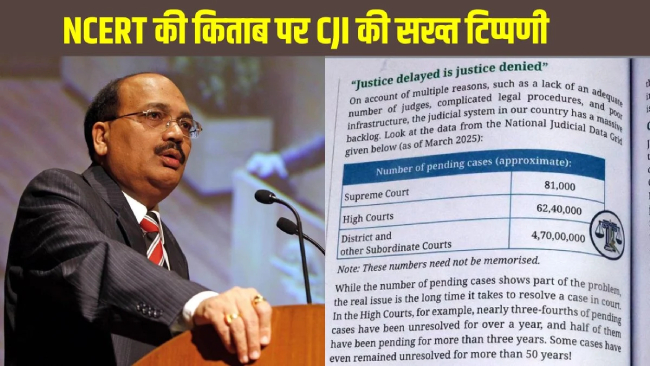
New Delhi – No one will be permitted to malign or defame the judiciary, and appropriate action will be taken in this matter. Under no circumstances will this be tolerated. No matter how influential a person may be, the law will take its course. “I know very well how to deal with such situations,” Chief Justice Suryakant warned.
The National Council of Educational Research and Training (NCERT) has included a lesson on corruption in the judicial system in the new Class 8 Social Science textbook. Earlier, the chapter focused more on the structure and role of the judiciary. The Chief Justice has strongly objected to this change.
The new textbook states that “corruption in the judicial system” and the “huge backlog of pending cases” are among the major challenges faced by the judiciary. When advocates brought this to his attention, Chief Justice Suryakant said that he is fully aware of the issue. He has received several phone calls and messages in this regard. Many judges are distressed by this content. “I have already issued directions and am taking suo motu (on my own initiative) cognizance of this matter,” he said.
The chapter also mentions the number of pending cases: 81,000 in the Supreme Court, 62.4 lakh in the High Courts, and 4.7 crore in the district and subordinate courts.
“No one will be allowed to defame the Judiciary!”
The Supreme Court of India has reportedly taken strong objection to a chapter in the revised NCERT Class 8 Social Science book mentioning judicial corruption, case backlogs & judge shortages.
Govt sources say the reference to… pic.twitter.com/PJ6amlQDDp
— Sanatan Prabhat (@SanatanPrabhat) February 25, 2026
What information has been included in the new lesson ?
The lesson states that judges are bound by a code of conduct that governs not only their behaviour inside the courtroom but also outside it. The book also explains the constitutional provisions for removing judges from office in serious cases. It notes that Parliament can remove a judge from office by passing an impeachment motion.
The chapter further states that people encounter corruption at various levels of the judicial system, and that the poor and needy may face difficulties in the process of obtaining justice. It adds that both state and central governments are making efforts to strengthen public trust by bringing transparency into governance, including the use of technology and swift action against cases of corruption.
 Terrorist arrested in Jammu and Kashmir ahead of the Amarnath Yatra
 More than 13,000 illegal Bangladeshi infiltrators in Karnataka !
 Claim of a conspiracy to Islamise the Dattapeetha premises at Chikkamagaluru (Karnataka) !
 9 incidents of love jihad exposed in various states in the last 24 hours
 Licences of 6 hotels, bakeries and clubs suspended in Mumbai; 19 people arrested
 “If there had been a Muslim in the Shri Ram Janmabhoomi Teerth Kshetra Trust, he would have been ‘encountered’ over the theft” : Asaduddin Owaisi