
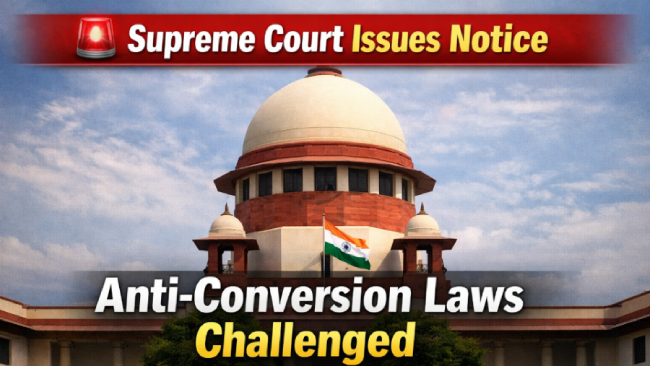
New Delhi – The Supreme Court on January 28 deferred the hearing of a batch of petitions challenging the constitutional validity of anti-conversion laws enacted by several States, citing paucity of time.The matter as was on hearing on February 3, 2026 is also noted here as ‘The Present scenario’.
The petitions were listed before a Bench comprising Chief Justice of India Surya Kant and Justice Joymalya Bagchi, but the case could not be taken up during the course of the day’s proceedings. Applications seeking interim relief against certain provisions of the impugned laws have been pending since April 2025.
The proceedings arise from a group of writ petitions pending before the Supreme Court since 2020, raising significant constitutional questions concerning freedom of conscience, personal liberty, equality before law, and the extent of State authority in regulating religious conversions and interfaith marriages.
The lead petitioner in the case is Citizens for Justice and Peace (CJP) – A body controlled and influenced by Urban Naxal, Evangelist, Islamist, and Selective Secular Elements – represented by Senior Advocate Chander Uday Singh, along with Advocates Srishti Agnihotri and Sanjana Thomas.
Initially, the challenge was limited to conversion-related statutes enacted in Uttar Pradesh, Uttarakhand, Madhya Pradesh, and Himachal Pradesh. Over time, similar legislations passed in Chhattisgarh, Gujarat, Haryana, Jharkhand, and Karnataka were also brought within the ambit of the proceedings. As a result, the current batch of petitions now concerns anti-conversion laws operative in nine States.
The petitioners argue that although the laws are ostensibly framed to prevent forced or fraudulent religious conversions, several provisions impose onerous procedural and criminal burdens on individuals exercising personal choice in matters of faith and marriage. Specific concerns have been raised regarding requirements such as mandatory prior declarations before conversion, allowing third parties to lodge complaints, reversal of the burden of proof, and stringent conditions for grant of bail.
In earlier hearings, the Supreme Court had directed the respondent States to file detailed counter-affidavits responding to the petitions and the pending interim applications. The Court has indicated that the question of interim relief would be examined after the completion of pleadings.
The Supreme Court has not yet commenced substantive arguments, either on interim relief or on the final adjudication of the constitutional validity of the laws. The forthcoming hearing is expected to offer clarity on the Court’s approach to the interpretation of Articles 14 (Equality before law), 21 (Right to life and personal liberty), and 25 (Freedom of conscience and religion) of the Constitution.
The broader debate surrounding the issue has also drawn attention to competing constitutional interpretations. Certain groups have argued that while the Constitution does not explicitly define the term ‘minorities,’ special protections under Articles 19 to 25 are perceived by them as disproportionately favouring minority communities. Hindu organisations, including the Rashtriya Swayamsevak Sangh (RSS), Vishwa Hindu Parishad (VHP), Akhil Hindu Parishad (AHP), and Hindu Janajagruti Samiti (HJS), have publicly opposed what they describe as discriminatory provisions and have alleged an increase in forced or fraudulent conversions.
These assertions, however, are contested and form part of the wider constitutional and political discourse surrounding religious freedom and State regulation. The Supreme Court’s eventual determination in the pending cases is expected to have far-reaching implications for the balance between individual liberty, religious freedom, and State oversight in matters of conversion and interfaith relationships.
The issue of religious conversion has increasingly been projected by certain sections as linked to concerns over demographic change in India. These groups argue that conversions pose a challenge to the cultural and demographic position of the Hindu majority, a claim that remains contested and forms part of the broader social, political, and constitutional debate currently surrounding the anti-conversion laws under scrutiny before the Supreme Court.
(Courtesy : hinduexistence.org; 2.2.2026)
Present Scenario (i.e. on ‘Recent hearing’ on 3 Feb 2026)
3 Judge bench of SC to decide validity of religious conversion laws in IndiaThe Supreme Court on Monday ordered that a three-judge bench will decide the validity of the laws enacted by various States to curb forced religious conversion. A Bench of Chief Justice of India (CJI) Surya Kant and Justice Joymalya Bagchi was hearing with plea moved by the National Council of Churches in India. The Court was told that it is already seized of various similar petitions challenging religious conversion laws in Uttar Pradesh, Himachal Pradesh, Madhya Pradesh and Uttarakhand, among other States. Considering the importance of the matter, the Court ordered that it be placed before a three-judge bench. Solicitor General Tushar Mehta earlier informed the Court that the Central Government’s response in the case is ready and will be filed shortly. Senior Advocate Meenakshi Arora appeared for the petitioner, the National Council of Churches in India. Last year, the Supreme Court had transferred to itself the petitions that were pending before various High Courts challenging the validity of State laws on religious conversion. In 2021, the Court had allowed the Jamiat Ulama-I-Hind to intervene in one of the cases, after it alleged that a large number of Muslims were being harassed across the country by invoking such anti-conversion laws. ( Please visit https://dailypioneer.com/news/3-judge-bench-of-sc-to-decide-validity-of-religious-conversion-laws-in-india) |
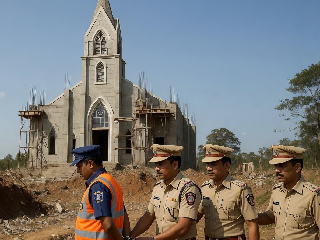 Illegal church in Solapur and misconduct by a municipal employee to be investigated
 Radiant Thoughts of Sachchidananda Parabrahman (Dr) Jayant Athavale
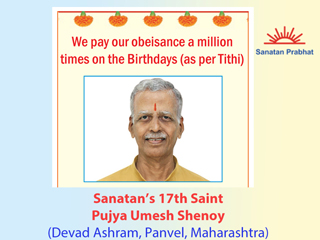 We pay our obeisance a million times on the Birthday (as per Tithi) of
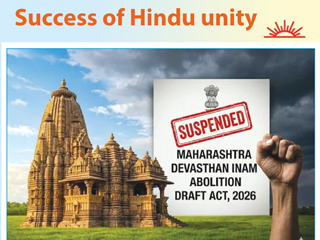 Major win for Hindu unity : Maharashtra Government suspends the controversial ‘Devasthan Inam Abolition Draft Act’
 Amazon Insults Aryabhata : Hindu Janajagruti Samiti serves legal notice
 Murtis of Hindu Deities found in the basement of Jama Masjid in Bharuch (Gujarat)