
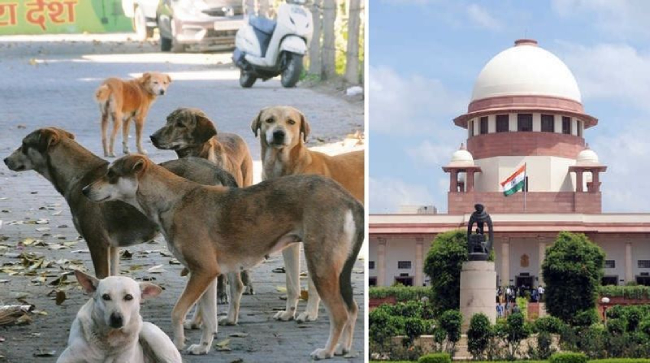
New Delhi – The Supreme Court of India has ordered that stray dogs be immediately removed from all public places such as educational institutions, hospitals, sports complexes, bus stations and depots, and railway stations. The dogs must be placed in designated shelters set up for them. The Court also directed that these dogs should be sterilised and vaccinated before being relocated. The Supreme Court further directed that this order will apply nationwide. The Chief Secretaries of all states and union territories, along with the heads of the National Highways Authority of India and the Union Minister for Road Transport, must submit a compliance report within eight weeks to the Court.
🚨 Supreme Court Orders Removal of Stray Dogs from Public Places
Dogs to be sterilized, vaccinated & kept in shelters, not released back. Report due by Jan 13, 2026.
📌Why does the Supreme Court even need to step in with such an order? Why do Governments of all parties fail to… pic.twitter.com/h7dzY3c6Ld
— Sanatan Prabhat (@SanatanPrabhat) November 7, 2025
Stray dogs must not be released back where they were caught
The Supreme Court said, ‘After careful consideration, we have decided that stray dogs caught from a public place should not be released back at the same location, as doing so would defeat the very purpose of reducing public nuisance and distress caused by such dogs’. The Court made this clarification while rejecting the argument that dogs should be released after sterilisation.
The Court directed that the administration must prepare a list of all such public places within the coming weeks and take appropriate action. The Court also ordered that a progress report be submitted by 13th January 2026.
Fences and barriers must be built to prevent stray dogs’ return
Local administrative bodies and their heads must ensure that all necessary measures are completed under the guidance of the district administration. The Court ordered that protective fences, walls, gates, or similar structures be installed where stray dogs are removed, to prevent them from returning and creating a nuisance again.
Government institutions also made responsible
The Supreme Court assigned responsibility to government institutions as well. The management of educational institutions, hospitals, sports complexes, bus depots, and railway stations must appoint an officer to oversee this campaign. That officer will be responsible for ensuring that the premises remain clean and free of stray dogs.
Mandatory verification every three months
The Court ordered that the name and details of the appointed officer be permanently displayed at the institution’s entrance and reported to the local administration. Local authorities must conduct on-site inspections at least once every three months to confirm that stray dogs are not inhabiting these premises. If the administration fails to carry out these duties, it will be recorded as a serious lapse, the Court warned.
Plan for other stray animals as well
The Court also directed that municipal corporations, transport departments, public works departments, union territories, and the National Highways Authority of India work jointly to identify stretches of highways and expressways where stray cattle, bulls, or other animals frequently appear. Administrative bodies must take immediate steps to relocate these animals to proper shelters, the Supreme Court ordered.
Editorial Perspectives
|
 Terrorist arrested in Jammu and Kashmir ahead of the Amarnath Yatra
 More than 13,000 illegal Bangladeshi infiltrators in Karnataka !
 Claim of a conspiracy to Islamise the Dattapeetha premises at Chikkamagaluru (Karnataka) !
 9 incidents of love jihad exposed in various states in the last 24 hours
 Licences of 6 hotels, bakeries and clubs suspended in Mumbai; 19 people arrested
 “If there had been a Muslim in the Shri Ram Janmabhoomi Teerth Kshetra Trust, he would have been ‘encountered’ over the theft” : Asaduddin Owaisi