
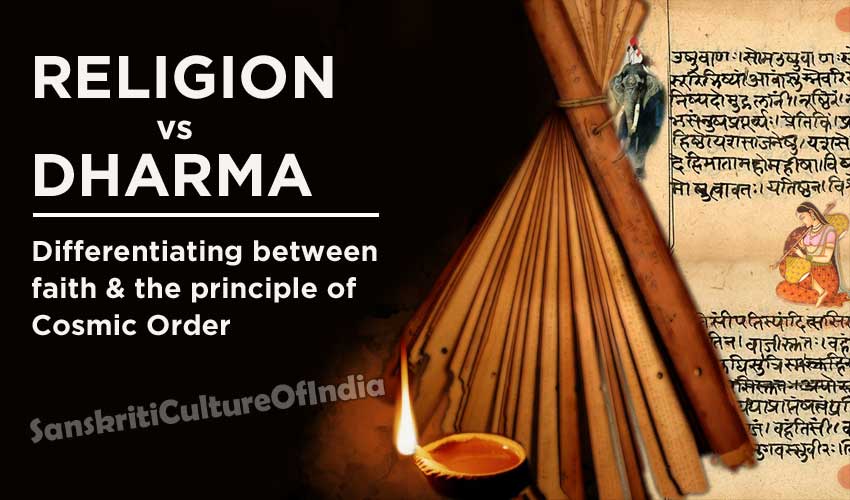
Sanskrit is the mother of all Indian languages and is a ‘non-translatable’ language; that is, Sanskrit words cannot be accurately translated into other languages. Certain terms are so unique that no translation is possible at all – especially into non-Indian, foreign languages. English, in particular, lacks the capacity to capture the essence of many Sanskrit expressions. When translations are forced, the meaning not only shifts but also becomes diluted and narrow. Words like ‘Dharma’ and ‘Adharma’ are classic examples – any English equivalent turns them into distortions. In fact, because of Sanskrit’s intrinsic untranslatability and the Orientalist lens of English linguists, the translations that do exist have often generated deep misunderstandings and misconceptions.

Orientalist Misrepresentation
According to Edward Said, Orientalism is the Western academic practice of studying Eastern culture through the lens of a self-proclaimed Western cultural superiority. Its real aim was to conquer, reshape, or ‘civilize’ the East in accordance with Western norms. Yet, Orientalist methods often-indeed, almost always – misrepresented Bharatiya knowledge traditions. Translating Sanskrit words and concepts into Western (non-Indian) languages and thought systems inevitably led, whether consciously or unconsciously, to distortions. Orientalists studied colonized cultures not for understanding, but as a tool of domination. In fact, the central objective of Orientalism was ‘to collect knowledge of the East, to enclose it, to domesticate it, and thus to transform it into a mere appendage of European learning.’ The British colonial rulers carried this out with chilling precision : They dismantled the gurukuls that carried forward India’s Bharatiya knowledge tradition and replaced them with Macaulay’s English education system. Since then, generation after generation of Indian intellectuals has been force-fed inappropriate / incorrect English meanings of Sanskrit words.
The Colonial Distortion of ‘Dharma’
Since colonial times, it has become a kind of intellectual ‘fashion’ to equate ‘Dharma’ with ‘religion,’ and to translate ‘mazhab (creed/sect) as Dharma, and to sing the hollow chorus of ‘all religions are the same.’ This distortion is the direct product of Macaulay’s English education system and the colonial mindset. In reality, this fashion is nothing but the calculated outcome of Orientalist cunning – an intellectual deception by religious expansionists – directed against the Hindu society and the Dharma-based Indian Nation. Tragically, this deception has spread so widely that not only the ordinary Hindu masses, but even learned Sanatanis often accept it uncritically and thoughtlessly.
The truth, however, is that neither ‘religion’ nor ‘mazhab’ comes anywhere close to the concept of ‘Dharma’. Dharma is the eternal order of righteous duties and actions for the welfare of the entire cosmos, arising directly from the Creator – Brahma Himself. In contrast, ‘religion’ is essentially a system of ‘faith’ in a Prophet (a supposed Divine messenger), coupled with the political strategy of establishing the imagined global supremacy of white races. Similarly, ‘mazhab’ is rooted in the mission of Prophet Muhammad (claimed as the last Prophet), designed for the expansion and protection of the Arab empire. Both ‘religion’ and ‘mazhab’ emerge from the same source – and both are inspired not by Brahma, but by the opposite principle, the imagined Abrahma (Abrahamic).
Dharma is multi-meaningful, but religion and mazhab are Meaningless
Both ‘religion’ and ‘mazhab’ are fundamentally opposed to Dharma – they are anti-Dharma, anti-Brahma, and anti-Vedic. For this reason, they must be understood as ‘Adharma’. While they resemble each other, neither of them can ever be regarded, in any sense, as synonymous with Dharma. Consider this : when we use terms like Rajadharma (the duty of the king / state / ruler) or Rashtradharma (the duty towards the Nation), there is no word in any other language in the world that can express this meaning.
Rajadharma means the duty of the state, the duty of the king, and the moral responsibility to rule justly. This meaning is never conveyed by ‘religion’ or ‘mazhab. That is precisely why no expression such as ‘Raj-religion’ or ‘Raj-mazhab’ exists in the literature of any so-called religious-mazhabi language. The same holds for Rashtradharma, which conveys duty towards the Nation. Neither ‘religion’ nor ‘mazhab’ has the capacity to express this; therefore, words like ‘Nation-religion’ or ‘Nation-mazhab’ are simply absent. Similarly, in the case of Pitradharma (a father’s duty) and Putradharma (a son’s duty), the sense of responsibility conveyed by Dharma has no equivalent in ‘religion’ or ‘mazhab’. From this alone, the truth becomes self-evident : ‘Religion’ and ‘mazhab’ can never be synonyms for Dharma. Even the English dictionary does not define ‘religion’ as Dharma. The true English expression for Dharma is ‘Dharma’ itself, not ‘religion.’ Another important fact must be noted : Just as the opposite of Dharma is adharma, the opposite word of ‘religion’ is not ‘non-religion’ nor is the opposite of ‘mazhab’, ‘a-mazhab.’ This too proves beyond doubt that ‘religion’ and ‘mazhab’ can never be considered equivalents of ‘Dharma’.
Dharma is a Universal Welfare Concept; Religion/Mazhab are Not
Dharma never inspires hostility or enmity toward anyone. On the contrary, it instills the spirit of universal welfare, reminding all human beings that they are creations of the Divine and teaching the ideal of Vasudhaiva Kutumbakam – the world as one family, and that the Earth is everyone’s mother. It ensures that life is lived with righteous conduct, noble thought, and sacred duty in harmony with the cosmic order. By contrast, ‘religion’ – which, in essence, refers to Christianity – claims God as the sole Creator of the universe and Jesus Christ as His ‘only begotten son.’ On that basis, it declares its followers to be the sole heirs of the entire Earth, while condemning non-Christians and Idol-worshippers as accursed, destined to live in subjugation and servitude.
The case of ‘Mazhab’ – which is none other than Islam – is even more striking. It views non-Muslims as enemies, unbelievers, or kafirs, legitimizing their killing and sanctioning the seizure of their women and property as ‘maal-e-ganimat’ (spoils of war). Neither of these concepts seeks the welfare of the entire world. What both of them desire, unequivocally, is global domination – and not merely desire it, but openly proclaim it, considering the eradication of non-Christians and non-Muslims their mazhabi (religious) duty.
Religion and Mazhab are devoid of the Basic Elements of Dharma
Religion and Mazhab are utterly devoid of the essential elements of Dharma. Dharma awakens compassion not only toward fellow human beings but also toward all living beings. It teaches reverence for cows as mothers and celebrates even the worship of serpents. In contrast, ‘religion’ and ‘mazhab’ not only disregard such sentiments but even sanction practices like cow slaughter and beef consumption. From the individual to the collective, the conduct that promotes universal welfare is Dharma – but this spirit is wholly absent in ‘religion’ and ‘mazhab’. To call them Dharma is either intellectual folly or deliberate deceit.
This intellectual folly often hides behind the excuse of ‘faith’ or ‘belief’. If someone wishes to label a particular belief or faith as a ‘religion’ or a ‘mazhab’, there is no objection. But to call it ‘Dharma’ is deeply objectionable.
Dharma is not mere belief or blind faith; it is faith and reverence grounded in reason and science, manifesting in universally beneficial conduct, noble thought, and the highest moral duties.
It is defined by ten foundational principles : Truth, self-restraint, forgiveness, non-violence, austerity, charity, purity, peace, non-stealing, and celibacy. With rare exceptions, neither ‘religion’ nor ‘mazhab’ upholds these principles. How then can they ever be equated with Dharma ?
Dharma is the totality of human values, duties, ethics, and sacred restraints. It is the spiritual discipline that seeks to understand the all-pervading, unseen, supreme regulating power that governs from the individual to the cosmos, from the body to the universe, and to unite with it, attaining freedom from the cycle of ‘birth-death’ and ‘rebirth’ and ultimately achieving ‘Moksha’ (liberation/release). In other words, Dharma is the eternal spiritual path, the journey that transforms man (Nar) into the Divine (Narayana). It is Sanatan, and encompasses various traditions and sects such as Jain, Buddhist, Sikh, Shaiva, Shakta, and Vaishnava.
The Indian maxim ‘Sarva Dharma samabhav’ and ‘All Dharma paths are equal’ – refers to these sects within the Dharmic fold, for they all uphold the essential elements of Dharma and lead to liberation from rebirth and attainment of Moksha. In contrast, ‘religion’ and ‘mazhab’ have no relation to rebirth or liberation. They are entirely devoid of spiritual science and exist merely as mechanisms of control, built on divisions among humans and the subjugation of others. Dharma, by its very nature, is the collection of virtues, duties, ideals, and principles that are to be adopted and lived, not a bundle of private ‘faith’ or blind dogmas imposed upon others.
Dharma is Benevolent to All; Religion and Mazhab are always Divisive
Dharma is universally benevolent, while religion and mazhab are inherently divisive.
Dharma ensures the welfare of all – humans, non-human beings, and the entire cosmos. It cultivates gratitude and reverence toward rivers, mountains, forests, the sky, space, the earth, fire, air, the sun, the moon, the stars, and the universe itself. But ‘religion’ and ‘ mazhab’ divide humanity, for they reject coexistence with non-religionists and non-believers. Dharma is naturally accepted, while religion and mazhab are spread only through coercion. Their growth has historically come from imposing their faith (faith in Christianity, iman in Islam) upon others by force.
Christianity, as ‘religion’, and Islam, as ‘mazhab’, are both instruments of global domination, because they were built upon non-religious and Abrahamic concepts. To achieve this global dominance, they have unleashed waves of violence, terror, and oppression what Christianity glorifies as ‘crusades’ and Islam sanctifies as ‘jihad’. Both faiths justify these campaigns through their respective ‘heavenly books’ the Bible and the Quran. The result is clear : Religion inspires crusades, and mazhab inspires jihad, under which non-religionists, non-Muslims, and ‘Idol-worshipping’ Dharmic peoples have been plundered, massacred, raped, and persecuted.
Dharma vs. Religion-Mazhab : The Supreme Difference
Dharma has never been imposed upon anyone, nor has it ever relied on violent campaigns for propagation. It is not governed by a ‘single book’, nor dictated by a single messenger or Prophet. Dharma is infinitely spread across and through numerous texts, Scriptures, and treatises, and it is not the creation of any one individual – it is inspired by and emanates directly from Brahma, the Creator of the entire Universe. A practitioner who has fully internalized Dharma – whether a Sage, Saint, Yogi, or Ascetic – is endowed with extraordinary, transcendent powers of ‘entering another body’ and spiritual mastery, making them superior to the founders and propagators of ‘religion’ and ‘mazhab’ in every respect.
Need for a Legal Initiative to Prevent this Intellectual Trickery
In such a situation, it has now become necessary that we consider a ban on calling ‘religion’ and ‘mazhab’ as ‘Dharma’. Just as selling alcohol as milk or tricking someone into drinking it is a crime, similarly, we should consider some strictures against calling religion and mazhab as Dharma. This cunning equivalence of violent and monopolist ‘faiths’ with Dharma is not just misleading but akin to a criminal act. Otherwise, this cunning sleight-of-hand by global religious powers as part of their expansionist conspiracy, and the way the Indian Government is bent on pushing Dharma into the bloody jaws of religion-mazhab in the name of secularism, the very existence of Dharma is threatened. A prominent Indian lawyer, Ashwini Upadhyay, has strongly objected to referring to religion and mazhab as Dharma and filed a public interest litigation (PIL) in the Delhi High Court, seeking clear, separate definitions. The petitioner has requested the Court to direct the Government of India and all State Governments to explicitly distinguish between Dharma for Hindus and religion and mazhab for Christians and Muslims in all official records, documents, and forms, noting that failing to do so causes significant harm.
Additionally, he has asked the Court to instruct Governments to include a chapter titled ‘Dharma and Religion-Mazhab’ in primary and secondary school curricula to dispel the prevailing confusion. Encouragingly, the Court has not only admitted the petition but has also begun hearing it. The Bench has sought responses from the Indian and Delhi Government. Unfortunately, even after a year, neither Government has provided a reply. What is even more disheartening is that, despite the court’s seriousness in addressing this issue, the BJP-led Governments remain indifferent.
(Courtesy : Excerpts from an Article by Manoj Jwala posted on indiafacts.org; 21.9.2025)
(Manoj Jwala is a writer, researcher, and investigator based in Jharkhand, India.)
 Karnataka: Religious fanatics breaks farmer’s hand over bursting firecrackers in front of a mosque !
 Radiant Thoughts of Sachchidananda Parabrahman (Dr) Jayant Athavale
 We pay our obeisance a million times on the Birthday (as per Tithi) of
 Major win for Hindu unity : Maharashtra Government suspends the controversial ‘Devasthan Inam Abolition Draft Act’
 Amazon Insults Aryabhata : Hindu Janajagruti Samiti serves legal notice
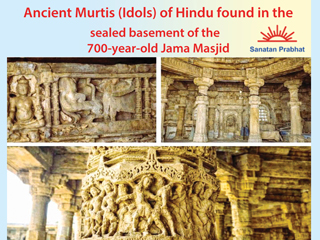 Murtis of Hindu Deities found in the basement of Jama Masjid in Bharuch (Gujarat)