
Mumbai Municipal Corporation’s Experiment!
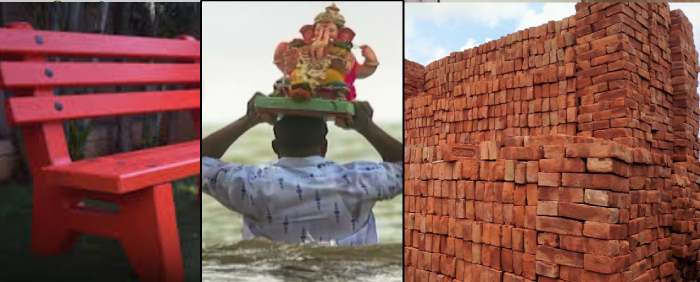
Mumbai, 5 June 2026 (News)– During the Ganesh festival in Mumbai, thousands of Plaster of Paris (POP) Ganesh idols are immersed in the sea and artificial ponds. Every year, the authorities collect POP material that has not dissolved in the water. In 2025 alone, Mumbai collected as much as 2,500 tons of POP from immersed Ganesh idols. The Administration has been faced with the question, ‘What is to be done with such a huge quantity of POP?’ As a solution, the Municipal Corporation of Greater Mumbai (BMC), with the assistance of the Nashik-based organisation Akarm Foundation, has carried out an experiment to manufacture benches for public gardens, bricks, and decorative objects from this recovered POP.
🚨 BMC plans to recycle PoP Shri Ganesh idols into benches, bricks, and decorative items.
However, the Dr. Anil Kakodkar Committee's 2025 report reportedly concluded that PoP does not cause pollution.
If PoP is not polluting, why the continued restrictions, artificial ponds,… pic.twitter.com/M8bWTG0pee
— Sanatan Prabhat (@SanatanPrabhat) June 5, 2026
“Actual implementation will take place only after the Government Committee’s report” – Pradeep Gawali, Deputy Commissioner, Environment and Climate Change Department, Municipal Corporation of Greater Mumbai (BMC)
The immersed Ganesh idols have been dismantled only after being ritually worshipped. On an experimental basis, 10 tons of POP were handed over to Akarm Foundation. During processing, large quantities of coconut husk, stones, wood, clay, cloth, and other materials were found mixed with it. As a result, only 3.5 tons of pure POP could be recovered from the original 10 tons. The Government has constituted a committee to determine how POP should be disposed of. The committee’s report is still awaited. Since this project was undertaken on an experimental basis, it will be decided later, based on Government guidelines, whether this method should be adopted on a larger scale.
What is the issue?
In 2025, the Bombay High Court directed the State Government to formulate a policy for the disposal of POP obtained from immersed Ganesh idols.
As a temporary measure, the Government proposed that large idols be immersed in the sea and Idols up to 6 feet in height be immersed in artificial ponds. An affidavit to this effect has been submitted to the court. To arrive at a long-term policy on POP disposal, The Government constituted a committee in March 2025 under the chairmanship of nuclear scientist Dr Anil Kakodkar. The committee’s report has not yet been received. Once received, the Government will present it before the court, and a final policy on POP will be determined based on the court’s directions.
Dr Anil Kakodkar committee report: POP does not cause pollution!Before forming the committee on POP disposal, the Government had also constituted another committee under the chairmanship of Dr Anil Kakodkar to study whether POP causes pollution. The committee submitted its report in 2025 and concluded that “POP does not cause any form of pollution.” On the other hand, the separate report on how POP should be disposed of is still pending. (If POP does not cause pollution, why is there such an extensive effort to find methods for its disposal? Why are artificial immersion ponds necessary? If there is no pollution risk, what prevents authorities from allowing Ganesh idols to be immersed in natural water bodies? – Editor) |
 More than 13,000 illegal Bangladeshi infiltrators in Karnataka !
 Claim of a conspiracy to Islamise the Dattapeetha premises at Chikkamagaluru (Karnataka) !
 9 incidents of love jihad exposed in various states in the last 24 hours
 Licences of 6 hotels, bakeries and clubs suspended in Mumbai; 19 people arrested
 “If there had been a Muslim in the Shri Ram Janmabhoomi Teerth Kshetra Trust, he would have been ‘encountered’ over the theft” : Asaduddin Owaisi
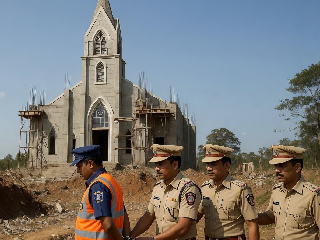 Illegal church in Solapur and misconduct by a municipal employee to be investigated