
A bold gamble on coal gasification could strengthen India's energy security—but only if technology and economics cooperate.
Key Highlights
|
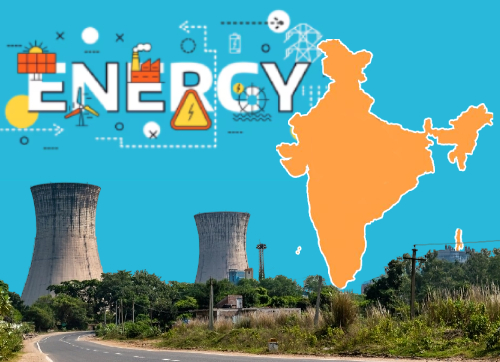
PM Modi has repeatedly urged Indians to reduce dependence on imports and build a more self-reliant economy. Atmanirbhar Bharat. Much of that discussion has focused on manufacturing, defence, semiconductors, other electronics and supply chains. Yet one of India’s deepest strategic vulnerabilities remains largely invisible to most Indians: dependence on imported energy. Any disruption in the supply of imported energy—whether due to war, sanctions, geopolitical tensions or price shocks—will hit our homes, farms and industry, ie, the entire economy.
It is against this backdrop that the Union Cabinet’s approval in May 2026 of a ₹37,500 crore coal gasification scheme may prove to be one of the most consequential energy initiatives of this decade. The new scheme provides momentum and greatly enhanced support to the existing National Coal Gasification Mission (2021) and a Rs. 8,500 crore scheme approved in Jan 2024 (under which 8 projects worth Rs. 6,233 crore are under implementation).
The challenge is real. More than half of India’s LNG requirements are imported. Significant quantities of urea, ammonia, methanol and coking coal are also sourced from abroad. The government’s own estimates indicate that imports of several such products cost the country approximately ₹2.77 lakh crore in FY2025. As recent developments in West Asia, the Russia-Ukraine conflict, and sanctions-related disruptions have demonstrated, global energy markets are increasingly vulnerable to geopolitical shocks. For a country of 1.4 billion people, such dependence is not merely an economic issue; it is a strategic concern.
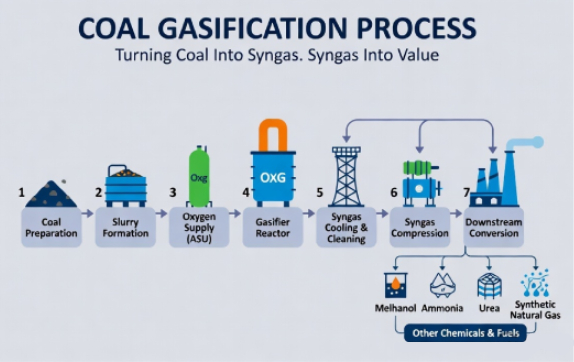
Coal Gasification Explained
Coal gasification is a process that converts coal into synthesis gas (syngas), which can then be used to manufacture fuels, fertilisers, and industrial chemicals.
Far beyond being only a household cooking fuel and a transportation fuel, natural gas is a critical input for fertiliser production, pharmaceuticals, steel, petrochemicals, glass, ceramics and numerous manufacturing processes. A sustained disruption in gas supplies would affect agricultural productivity, industrial output and even healthcare. This reality often escapes public attention because energy security debates tend to focus on petrol and diesel prices. In truth, natural gas quietly underpins large sections of India’s industrial economy.
The government’s answer lies in an idea that appears simple but is technologically sophisticated: coal gasification. Instead of burning coal directly, the process converts coal and lignite into synthesis gas, or syngas, a mixture of carbon monoxide and hydrogen. This syngas can then be used to produce ammonia, methanol, synthetic natural gas and a wide range of industrial chemicals. The recently approved scheme seeks to accelerate India’s coal gasification programme, support the national target of gasifying 100 million tonnes of coal by 2030, and incentivise approximately 75 million tonnes of gasification capacity through competitive bidding and targeted financial support.
The strategic logic is compelling. India possesses one of the world’s largest coal reserves—more than 400 billion tonnes. If even a fraction of these reserves can be converted into valuable industrial feedstocks, the country could significantly reduce imports of LNG, ammonia, methanol and other products. The government expects the scheme to mobilise investments of ₹2.5–3 lakh crore, create around 50,000 jobs and strengthen indigenous technological capabilities. At a time when nations are increasingly prioritising resilience over pure market efficiency, such investments can be viewed as strategic insurance against future supply disruptions.
However, enthusiasm must be tempered by realism. The biggest challenge is not the availability of coal but its quality. Much of India’s coal contains high ash content, lower calorific value and higher moisture compared with coal found in countries such as China, Australia or the United States. Technologies that work efficiently elsewhere may require significant adaptation for Indian conditions. Encouragingly, pilot projects and trials have demonstrated technical feasibility, but scaling such success across multiple commercial plants remains a formidable task.
The second challenge is economic viability. Coal gasification becomes attractive when imported gas prices are high. When global LNG prices fall, imported gas can become cheaper than domestically produced synthetic alternatives. China’s experience illustrates this dilemma. Several coal-to-gas projects generated handsome returns during periods of elevated energy prices but struggled when prices declined. Indian investors will therefore require confidence that policy support will remain stable over the long term. The Cabinet’s decision to extend coal linkage tenures up to 30 years is an important step in that direction.
Environmental concerns also deserve attention. Coal gasification is cleaner than direct coal combustion for several industrial applications, but it remains a coal-based technology. Managing emissions, water consumption, and waste streams will therefore be critical. Energy security cannot become an excuse for environmental neglect. The challenge for policymakers is to pursue both objectives simultaneously.
The significance of the coal gasification mission extends well beyond energy economics. At its core, it is an attempt to convert a domestic resource into strategic resilience. India has followed a similar path before. Investments in the nuclear programme, the space sector and in digital public infrastructure were all questioned initially because their benefits were neither immediate nor certain. Yet each eventually strengthened India’s strategic autonomy. Coal gasification deserves to be viewed through the same lens.
Coal gasification will not eliminate India’s dependence on imported energy. The objective is to reduce a critical vulnerability, diversify supply options and strengthen national resilience in an era of geopolitical turbulence.
The strategic logic is sound; the challenges are implementation challenges, not conceptual flaws. Technology, economics and environmental concerns will determine the pace of progress, but they do not diminish the strategic necessity of the effort. For a country that imports much of its energy despite possessing some of the world’s largest coal reserves, the ₹37,500 crore coal gasification mission is more than an energy project. It is an investment in India’s economic security, industrial self-reliance and long-term national power.
Article by Mr Sanjay Agarwal

A geopolitics analyst and Former Security Advisor, Ministry of Home Affairs, GoI
FAQs
|
 Khalistani terrorists blew up Air India’s ‘Kanishka’ aircraft in 1985; Canada admits
 Ban on Vat Pujan in the Mahatma Phule Wada premises withdrawn
 Ukraine launches hundreds of drones at 12 Russian regions !
 Denmark considers banning street prayers and the Islamic Adhan (Azaan)
 645 crimes against Hindus reported in Bangladesh over the past five months
 Owners of hotels, restaurants and dhabas violating regulations will not be spared : Commissioner Tukaram Mundhe