
Three-day ‘Jaipur Dialogue 2025’ commences

(Dignitaries releasing the Hindi edition of the book ‘Sabhi Dharm Samaan Nahin’ (All religions are not the same)
Jaipur (Rajasthan) – “We must realise that our enemies are not outside, but hidden within our own thought sphere,” stated eminent historian and Rajya Sabha MP (Presidential nominee) Meenakshi Jain. She pointed out that before Independence, historians wrote history truthfully, but after Independence, under Marxist influence, history was distorted. India’s original cultural perspective was removed, and a new perverted narrative was created. The authentic Indian history disappeared from the syllabi of universities like Delhi, JNU and Aligarh. Jain was speaking during the session on ‘Understanding the Enemy’ at the renowned ‘Jaipur Dialogue 2025’, being held from 7th to 9th November.
MP Meenakshi Jain inaugurated the conference by lighting the ceremonial lamp. On the first day, 14 sessions were held across various venues. During the event, the Hindi edition of Sanjay Dixit’s English book ‘All Religions Are Not The Same’, titled ‘Sabhi Dharm Samaan Nahin’, was released.
First session: Identifying the enemies of culture
The topic ‘India must identify the enemies of its culture’ was discussed by journalist Bhau Torsekar, Anupam Mishra, Omkar Chaudhary, Abhishek Tiwari and Baba Ramdas. The speakers said that many false narratives are being created to obstruct India’s progress, and exposing them is the true service to the nation.
Second session: Political developments in South Asia
This session focused on recent political movements in Bangladesh, Nepal and Sri Lanka. The speakers observed that the discontent among ‘Gen-Z’ (born between 1996 and 2010) and its exploitation by certain political groups in India is a matter of concern. They emphasised the need to stay alert to internal threats.
Third session: Anti-India infiltration through education
MP Meenakshi Jain, Esther Dhanraj, Prof Bharat Gupt, Abhas Maldahiyar, Nilesh Oak and Kundan Singh spoke on how foreign-funded think tanks are spreading anti-India ideas through education. They asserted that recognising and countering these ideological campaigns is a national responsibility.
Fourth session: Searching for internal enemies within the country
Sanjay Dixit, Nazia Khan, Abhijit Mitra, Abhijit Chavda, Pankaj Saxena and Avinash Dharmadhikari spoke on ‘Breaking India’ groups, ‘Tukde Tukde’ ideology, Naxal networks and Islamic influence. They revealed that anti-national networks are not limited to external forces but have also infiltrated administrative and cultural systems.
Session on corruption and governance
In the ‘Open Mic’ session, Avinash Dharmadhikari, Uday Mahurkar, Savio Rodrigues, Rahul Soor and Sanjay Dixit discussed corruption as the cancer of society and democracy. They said the cure lies in education and character-building. For ‘Nation First’ sentiment to take root within governance, policymakers must possess firm conviction and integrity.
Lack of civic discipline
Abhijit Iyer Mitra, Sushant Sareen and Garvit said that civic sense in India is still low — neither ordinary citizens nor public representatives exhibit it. Indiscipline such as jumping traffic signals, littering roads, and spitting in public reflects moral decline. Educated people misuse freedom of expression to insult deities, but hesitate to speak about other religions. Some students scribble obscene messages on toilets and historical sites, showing a weak mentality.
We must understand the timeline!
In the next session, Vedveer Arya, Nilesh Oak and Sanjay Dixit discussed Vedic chronology. They explained that over the last two to three centuries, our traditions have been distorted. The astronomical knowledge in the Vedas and the Mahabharata is both truthful and scientific. The presence of stellar calculations is a unique contribution of Indian civilisation, and Sanskrit verses provide logical explanations for textual timelines.
Sanatan Dharma and social media influence
Kartik Gaur, Vinod Kumar and Anuj Bhardwaj discussed how the slogan ‘Batoge to Katoge’ (If you divide, you will perish) may echo for centuries in India. They criticised social media influencers, filmmakers and YouTubers who claim to represent Hindutva but stray far from it. Hindutva, they emphasised, is entirely distinct from Christian and Islamic ideologies. Some journalists and historians also perpetuate these distortions, while others defame Hindutva through astrology or twist history and spirituality for popularity. The speakers said internal security must remain India’s top priority and added that it is time to reflect on whether freedom strengthens or weakens democracy.
Impact of social media on youth
In the final session, Priyank Kanoongo and Harsh discussed how certain foreign powers are influencing Indian youth through social media by promoting ‘live-in relationships’ and vulgarity to divert them from traditional values. With the average age of Indian youth being 29 and a young population of 90 crore, they stressed that developing indigenous, India-centric social media platforms is the need of the hour.
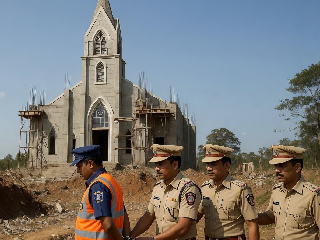 Illegal church in Solapur and misconduct by a municipal employee to be investigated
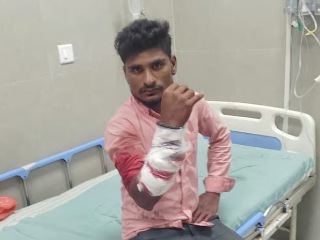 Karnataka: Religious fanatics breaks farmer’s hand over bursting firecrackers in front of a mosque !
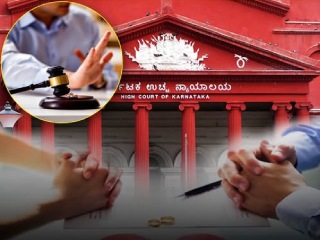 Wife earning more than her husband is not entitled to maintenance : Karnataka High Court
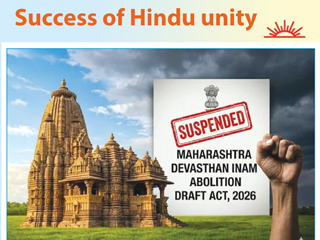 Major win for Hindu unity : Maharashtra Government suspends the controversial ‘Devasthan Inam Abolition Draft Act’
 Secularism and the ‘Hindu Rashtra’
 Gold jewellery seized by the police stolen from a police station in Kerala !