
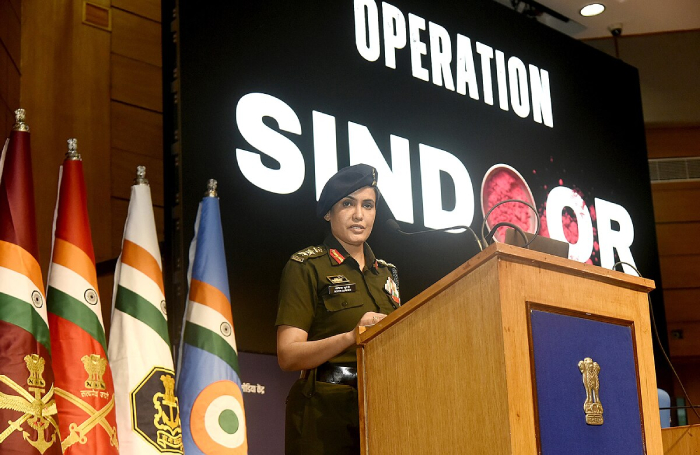
New Delhi – Colonel Sophia Qureshi of the Indian Army stated that Operation Sindoor has marked a major shift in India’s war strategy. The mission stands as evidence of India’s capability in multi-domain precision warfare. She added that Pakistan also engaged in information warfare during this period; hence, it is essential for the youth to enhance their digital literacy and remain alert to fake news. Colonel Qureshi was addressing the Chanakya Defence Dialogue: Young Leaders Forum held at the Manekshaw Centre, where she spoke on the topic “The Role of Youth in India’s War Strategy.”
On May 7th, as part of Operation Sindoor, India destroyed 9 terrorist bases in Pakistan and Pakistan-occupied Kashmir, in retaliation for the terrorist attack at Pahalgam on April 22nd.
While guiding the young audience, Colonel Qureshi said:
1. Under the leadership of the Army Chief, the Indian Army is now training youth in fields such as Artificial Intelligence and Cyber Technology. This is being done in collaboration with institutions like the Indian Institutes of Technology (IITs), the Defence Research and Development Organisation (DRDO), and other premier bodies.
2. You are the youth power of India. You are trained not only in firearms but also in firewalls. Today, wars are not fought merely with bunkers and bullets, but with bytes and bandwidth.
3. 65% of India’s population is under the age of 35, and this represents the nation’s strategic reserve. The energy, innovation, and responsibility of the youth play a vital role in national security and development. Around 53 conflicts are currently active across the world, including the Israel-Hamas conflict and the Russia-Ukraine war. These wars are being fought through technology; drones, cyber warfare, electronic warfare, and information warfare; by young minds.
4. India’s future lies in your hands. Whether you are a soldier, a teacher, a coder, or a designer, hard work always yields results.
 More than 13,000 illegal Bangladeshi infiltrators in Karnataka !
 Claim of a conspiracy to Islamise the Dattapeetha premises at Chikkamagaluru (Karnataka) !
 9 incidents of love jihad exposed in various states in the last 24 hours
 Licences of 6 hotels, bakeries and clubs suspended in Mumbai; 19 people arrested
 “If there had been a Muslim in the Shri Ram Janmabhoomi Teerth Kshetra Trust, he would have been ‘encountered’ over the theft” : Asaduddin Owaisi
 Illegal church in Solapur and misconduct by a municipal employee to be investigated