
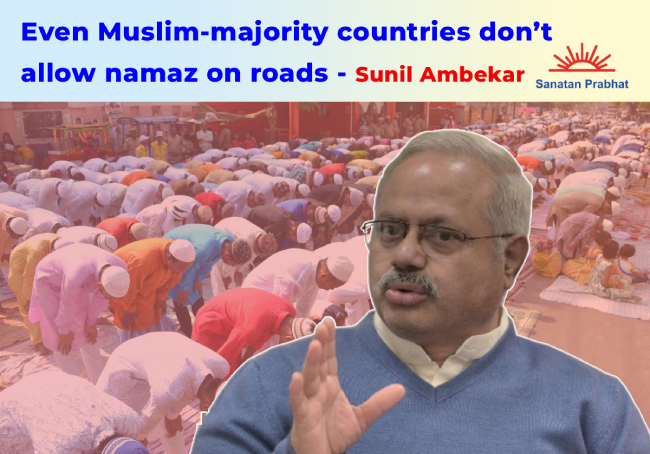
Chennai – “Even Muslim-majority countries do not allow prayers on roads and have designated places for worship,” Rashtriya Swayamsevak Sangh (RSS) national publicity in-charge Sunil Ambekar said in an interview with The Hindu.
🌍 Street Namaz Curbs: Not Just India, Even Islamic Countries Restrict
RSS leader Sunil Ambekar points out that even Islamic countries place restrictions on offering Namaz on public roads.
👉 Supports recent actions by various states to regulate the use of public spaces and… pic.twitter.com/ousa0oW7H4
— Sanatan Prabhat (@SanatanPrabhat) March 23, 2026
Ambekar made the statement while responding to questions on how incidents in BJP-ruled States — such as FIRs over namaz on roads, iftar on a boat in the Ganga, or the Char Dham temples asking for ‘Sanatani’ affidavits — impact the RSS’s message of unity in diversity.
1. “When the government restricts namaz on roads, it should be seen as a law-and-order decision, not a religious restriction,” he said. On the temple issue, he added, “Arrangements at places of worship are made for those who have faith in that religion. In a democracy, if people feel these arrangements are not right, they can voice their opinion. We have media to raise our voice.”
2. Addressing concerns around demographic change and population imbalance, Ambekar linked them to historical lessons. “Some people understand that even if their worship practices change, they still share the same ancestors and history. But a section felt that because their traditions were altered, the country no longer belonged to them. This contributed to the partition of India—a phenomenon also seen elsewhere, like Lebanon,” he said.
3. Commenting on demographic changes, he referred to history and said that some people understand that even if their mode of worship has changed, their ancestors and history remain the same. However, a section believes that due to a change in their traditions, this country no longer belongs to them. This mindset led to the partition of India.
4. Ambekar defended measures such as the Socio-Economic and Caste Census (SECC), the Citizenship Amendment Act (CAA), and the National Register of Citizens (NRC) as constitutional processes aimed at safeguarding national interest. “Illegal entrants face legal action, and the system allows review and correction for anyone wrongly excluded,” he said.
5. Answering a question on the Sangh’s views on youth-led protests in neighbouring countries like Nepal and Bangladesh, and how India has not faced similar situations, Ambekar said democracy allows them to protest.
6. On the RSS’ expansion as it completed 100 years in 2025, Ambekar said its network of shakhas now conducts around 88,000 daily sessions, engaging several lakh participants. A new divisional level has been introduced to decentralise the organisational structure and extend outreach to villages, tehsils, and mandals across India.
 Illegal church in Solapur and misconduct by a municipal employee to be investigated
 Karnataka: Religious fanatics breaks farmer’s hand over bursting firecrackers in front of a mosque !
 “If I reveal the names of the powerful people involved in the Shri Ram Temple donation theft, they will kill me” : Bageshwar Dham chief Pandit Dhirendra Krishna Shastri
 Wife earning more than her husband is not entitled to maintenance : Karnataka High Court
 Amazon Insults Aryabhata : Hindu Janajagruti Samiti serves legal notice
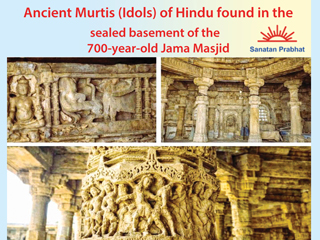 Murtis of Hindu Deities found in the basement of Jama Masjid in Bharuch (Gujarat)