
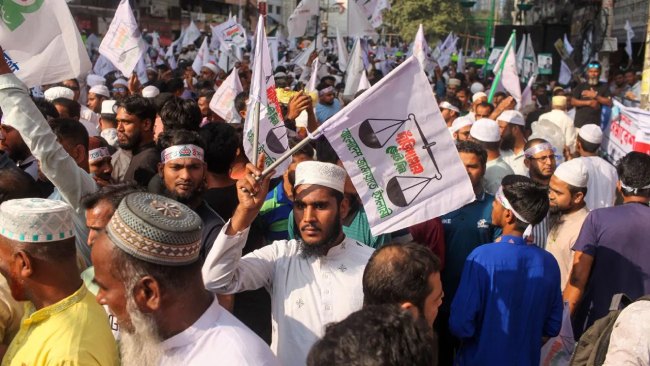
Dhaka (Bangladesh) – In Bangladesh’s general elections, Bangladesh Jamaat-e-Islami won a total of 68 seats, of which 51 are in areas adjoining the Indian border. Jamaat’s Ameer (party leader), Shafiqur Rahman, had assured that the party would maintain friendly relations with India. This statement was made keeping domestic and regional politics in mind. Through it, Jamaat sought to signal the importance it accords to India. On the eve of the elections, Rahman had given an interview to an Indian news channel in which he said that India is Bangladesh’s closest neighbour and that this is a priority for them.
Strong hold in 51 border constituencies
An examination of the 51 seats won by Bangladesh Jamaat-e-Islami shows that they are located in districts along the Indian border. This situation could be particularly concerning for the Indian states of West Bengal, Assam, Meghalaya, and Tripura. For several years, Jamaat has reportedly been working quietly in these districts. Even experienced leaders of the Awami League did not fully anticipate this trend. Strategic missteps are said to have given Islamic forces an opportunity to regain strength.
Among the 51 border-area seats won by Jamaat are: 4 in Nilphamari, 6 in Rangpur, 4 in Kurigram, 4 in Gaibandha, 3 in Chapainawabganj, 1 in Naogaon, 2 in Rajshahi, 3 in Kushtia, 2 in Chuadanga, 3 in Jhenaidah, 4 in Jessore, 2 in Khulna, 4 in Satkhira, 2 in Meherpur, 1 in Sherpur, 2 in Mymensingh, 1 in Sylhet, 1 in Noakhali, and 2 in Chattogram. Vote-count trends indicate that Jamaat has consolidated a strong position in these border districts. Indian security analysts are currently assessing the seats won by Jamaat and trying to understand the evolving situation.
Challenges before West Bengal and the northeastern states
It is a matter of concern that radical Islamic groups and organisations have been increasing their political influence in Bangladeshi districts bordering West Bengal, Tripura, and Assam. The situation appears particularly serious in Bangladeshi districts adjacent to West Bengal, such as Satkhira, Jhenaidah, Jessore, Chapainawabganj, Kurigram, Gaibandha, Kushtia, and Rajshahi. At the same time, in Indian districts like Murshidabad, Malda, North 24 Parganas, Siliguri, and Cooch Behar, there are indications of a growing trend toward assertive and sometimes violent politics within sections of the Muslim population.
According to political analysts in Dhaka, one major reason behind Jamaat’s victories in the border regions is the significant settlement of Muslims who migrated from India after Partition. Their subsequent generations are voting for Jamaat, and this population segment has seen notable growth.
 “If I reveal the names of the powerful people involved in the Shri Ram Temple donation theft, they will kill me” : Bageshwar Dham chief Pandit Dhirendra Krishna Shastri
 No Chinese military incursion into Arunachal Pradesh : Indian Army clarifies
 Attempt to demolish 125-year-old Gurdwara in Pakistan !
 Major win for Hindu unity : Maharashtra Government suspends the controversial ‘Devasthan Inam Abolition Draft Act’
 Construction of Sanatan Dharma Complex halted due to threats in Bangladesh
 Cuba 2026 : Why Havana Suddenly Matters Again