
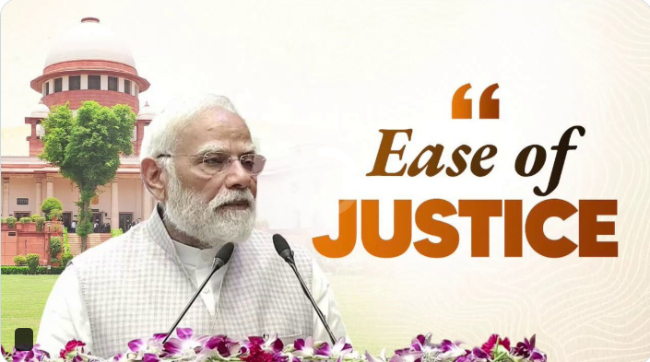
New Delhi – “The language of law should be simple enough for the common man to understand,” said Prime Minister Narendra Modi. He was speaking at the inaugural session of the National Conference organised to strengthen the ‘Legal Aid Delivery Mechanism’ in the Supreme Court premises. Chief Justice B R Gavai, Justice Surya Kant, and several other judges were present on the occasion.
Prime Minister Modi further said, “Every citizen, whether poor or rich, should have easy access to justice. When people understand the law in their own language, they follow it better and disputes are reduced. Timely justice for all is the foundation of social justice. With the help of technology, the judicial system is now becoming more modern. The ‘e-Courts’ project has made the process of justice delivery easier and more transparent. The Government has also launched the ‘Legal Aid Defence System’ to provide free legal assistance to the poor and the deprived.”
The Prime Minister also launched a new training mechanism on community mediation. He said, “India has an ancient tradition of resolving disputes through mutual agreements. The new mediation law modernises this tradition. It will help people settle disputes amicably and maintain social harmony.”
True success lies in earning the trust of the common man – Chief Justice
Justice is not a privilege of a select few, but a right of every citizen, said Chief Justice B R Gavai. “True success is not measured by statistics, but by the trust of the common man,” he added.
Technology is essential – Justice Surya Kant
Justice Surya Kant said that legal aid would be made more accessible. “Technology is essential for providing facilities such as legal aid centres, online conciliation, and digital grievance redressal for people living in remote areas. It is equally important to understand local languages and people’s needs,” he said.
70% of prisoners have not yet been convicted ! – Justice Vikram NathSpeaking at another event organised at NALSAR Law University in Bhagyanagar (Telangana), Justice Vikram Nath said, “Seventy per cent of the inmates in Indian prisons have not yet been convicted. This is a very serious situation, and there is an urgent need to reform the legal aid and judicial processes. Some inmates have served more time in jail than the maximum sentence for their alleged crimes, yet their cases are still pending. Others remain imprisoned simply because they could not secure bail. If their trials had been completed on time, many of them could have been released; however, they continue to languish in jail.” Editorial PerspectiveIf 70% of prisoners have not been convicted, why are remedial measures not being taken ? |
Editorial PerspectiveIf this is the situation, why are corrective measures not being implemented ? |
 Illegal church in Solapur and misconduct by a municipal employee to be investigated
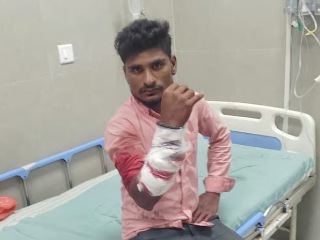 Karnataka: Religious fanatics breaks farmer’s hand over bursting firecrackers in front of a mosque !
 Wife earning more than her husband is not entitled to maintenance : Karnataka High Court
 Gold jewellery seized by the police stolen from a police station in Kerala !
 A four-wheeler suspended by a crane and deliberately blown up in Badnagar (Madhya Pradesh) !
 Religious conversion and sexual exploitation of Hindu women exposed in Kota (Rajasthan)